
Since President Donald Trump returned to office early last year, he’s often followed the mantra of tech titans he admires: “Move fast and break things.”The expression is meant to highlight the benefits of disruption – how vigor and an outside-the-box approach can shake up a stagnant system. But as President Trump wraps up the second year of this term, with midterm elections less than six weeks away, voters are signaling that, from their perspective, many things just seem, well, broken.The U.S.-Israeli war on Iran, which Mr. Trump predicted would last four to six weeks, is entering its eighth month. Fuel costs are up significantly because of the war, with downstream effects on other consumer items, while Mr. Trump’s tariffs have driven up prices as well. Public concern about artificial intelligence is surging, yet the president is prioritizing AI’s rapid development, while prospects for government regulation or cooperation with China appear low. Polls show voters are particularly unhappy about the war and the cost of living, with Mr. Trump’s approval ratings this week hitting all-time lows. Swing demographics, such as Hispanic voters, have moved sharply away from the president over issues including affordability and the administration’s immigration policies.Notably, some Republican candidates have begun distancing themselves from the president, especially in cases where they’re in tight campaigns. ReutersCargo vessels sit largely idle in the Strait of Hormuz, as seen from Musandam, Oman, Aug. 31, 2026. In Michigan, Rep. Mike Rogers, running in a hotly contested race for Senate, this week called for an end to the war in Iran. Kansas Sen. Roger Marshall voiced concerns about Immigration and Customs Enforcement operations in his state, while Florida Rep. Maria Elvira Salazar is running a campaign ad in which she says, “Mr. President, some of your immigration enforcement efforts have gone too far.” Florida Rep. Byron Donalds, who is running for governor, recently removed some references to Mr. Trump from his campaign website, while Utah Sen. John Curtis called for an investigation into the president’s eldest son, whose recent wedding was partially funded by a Russian oligarch.It’s a striking turn of events for a president who has exercised an iron grip over his party for more than a decade. “This is the first time in Trump’s presidency that voters have stopped giving him the benefit of the doubt,” says Logan Phillips, an election forecaster at Race to the WH.The voters the president appears to be losing, he adds, are those for whom Mr. Trump wasn’t always necessarily a natural fit, but who voted for him anyway – i.e., those outside the MAGA base, often old-school Republicans. Now, Mr. Phillips says, “people are starting to lose patience.”For Republicans, that could mean suppressed turnout in November. As of now, forecasters give Democrats strong odds of retaking control of the House, and a slightly better than 50% chance of taking over the Senate.But despite the political red lights flashing before him, Mr. Trump shows no signs of slowing down, instead plowing ahead with disruption, particularly with both Congress and senior White House staff disinclined or unable to stop him. The courts seem to be the strongest remaining check on Mr. Trump, but even there, the Supreme Court’s conservative majority often lets him have his way, in keeping with its reigning view of executive power.The current drama around the White House press corps is just the latest example of a president behaving brazenly on an issue that doesn’t address voters’ concerns. In the wee hours of Thursday, a federal judge temporarily blocked Mr. Trump from banning three news outlets – CNN, MS NOW, and Politico – from the White House. Reporters from those outlets continued to be banned from the premises Thursday morning, but by midday, were allowed in. Still, the boycott by other TV networks that provide footage of presidential events was having an impact, as the visit of Chinese leader Xi Jinping was not getting the kind of TV coverage it normally would have. Kevin Lamarque/ReutersCorrespondent Laura Barron-Lopez reports for MS NOW near the White House on Sept. 24, 2026, hours before her network was able to return to the White House after a judge's order called for their access to be restored. President Donald Trump had sought to ban CNN, Politico, and MS Now from access, alleging they were producing "fake news." In the ongoing legal case, the plaintiffs claim violations of the First Amendment right to a free press and the Fifth Amendment right to due process. The Trump administration argues that entry into the White House is a “privilege,” not a “right.”It’s a classic case of a president whose impulse is to take action now and (maybe) face questions later, pushing the bounds of norms, the law, and the U.S. Constitution.Some things Mr. Trump has “broken” can be restored, such as refunding the money from unauthorized tariffs or rehiring federal employees who had been improperly laid off. But when the moves involve tearing down physical structures – such as the East Wing of the White House and potentially the John F. Kennedy Center for the Performing Arts, as he has threatened – that’s not possible.The U.S.-Israeli war on Iran is another example of presidential action without required authorization – in this case, a congressional “authorization for use of military force.” Mr. Trump told the United Nations this week that the war should end “immediately after” the Nov. 3 midterm elections, but few observers expect that.Even in cases of alleged presidential overreach that are easily reversible, such as the media ban, there’s a lingering sense that after the drama has subsided, it will affect how Washington functions. That holds true in White House-press relations or in the president’s dealings with Congress or in his relationships across federal agencies. “Trump is kind of moving within the slipstream of the imperial presidency and taking it to a whole other level,” says Matthew Dallek, a political historian at George Washington University.Some of Mr. Trump’s actions have been enabled under a conservative framework known as the “unitary executive theory,” which posits that the president has strong authority over agencies and officials of the executive branch.The Supreme Court majority – including Trump appointees – has shown its inclination toward that view in key rulings.“Trump is taking these ideas and pushing them to almost their most extreme points,” Dr. Dallek says.The judicial and legislative branches have restrained Mr. Trump at times. In February, the Supreme Court struck down some sweeping tariffs the president had imposed via executive orders. Last week, a federal judge ruled that Trump officials must provide 30 days’ notice before making any changes to the Kennedy Center, including demolition. At times, though, Mr. Trump ignores judicial orders, such as when he sent more than 100 Venezuelan men to a prison in El Salvador last year without due process.And there’s no doubt that, in Mr. Trump’s second term, he’s moving with a freer hand than in the first. Part of that is a function of his selection of senior staff, people who are less willing to cross him than those in the first term. In the case of the White House ban on three news outlets, Mr. Trump reportedly blindsided his senior aides; Susie Wiles, the White House chief of staff, was out of town. Mr. Trump’s struggles also follow a pattern of second-term U.S. presidencies beset by drama, scandals, and voter fatigue. Ronald Reagan had the Iran-contra scandal. Bill Clinton faced the Monica Lewinsky scandal and impeachment. George W. Bush lost voter confidence over the Iraq War. Deepen your worldviewwith Monitor Highlights.Politics with respectGet political stories with respectful analysis.There‘s a world of new ideas in everyBooks newsletter.There‘s more to life, enrich yours withCulture & Learning weekly.Follow humanity‘s discoveries withScience & Nature stories in your inbox.Gain a spiritual perspectivefrom the stories in your inbox.Want to understand the deeper impact of critical events? Learn the Monitor‘s insight.Already a subscriber? Log in to hide ads. If Democrats retake one or both houses of Congress in the midterms, expect a final two years of the Trump administration awash in conflict.Administration officials will be “deluged with requests from Congress to write reports and explain what they’re doing; they’re going to be on the spot,” says Dan Greenberg, a senior legal fellow at the libertarian Cato Institute. “The norms of cooperation and breathing space that a Republican Congress has given the Trump administration over the last two years will vanish.” ALREADY A SUBSCRIBER? LoginReal news can be honest, hopeful, credible, constructive.The Christian Science Monitor was founded in 1908 to lift the standard of journalism and uplift humanity. We aim to “speak the truth in love.” Our goal is not to tell you what to think, but to give you the essential knowledge and understanding to come to your own intelligent conclusions. Join us in this mission by subscribing.
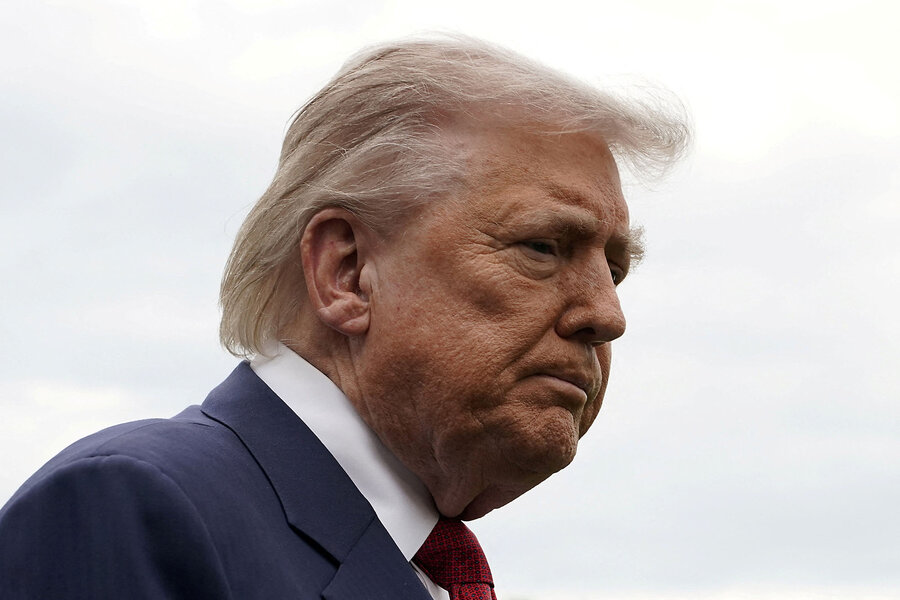
Trump is moving fast and breaking things. He could pay in November.
Full Article
Original Source
Read the full article at Csmonitor →KhanList aggregates and links to publicly available news content. We do not host full articles from third-party sources. Always verify important information with original sources.