
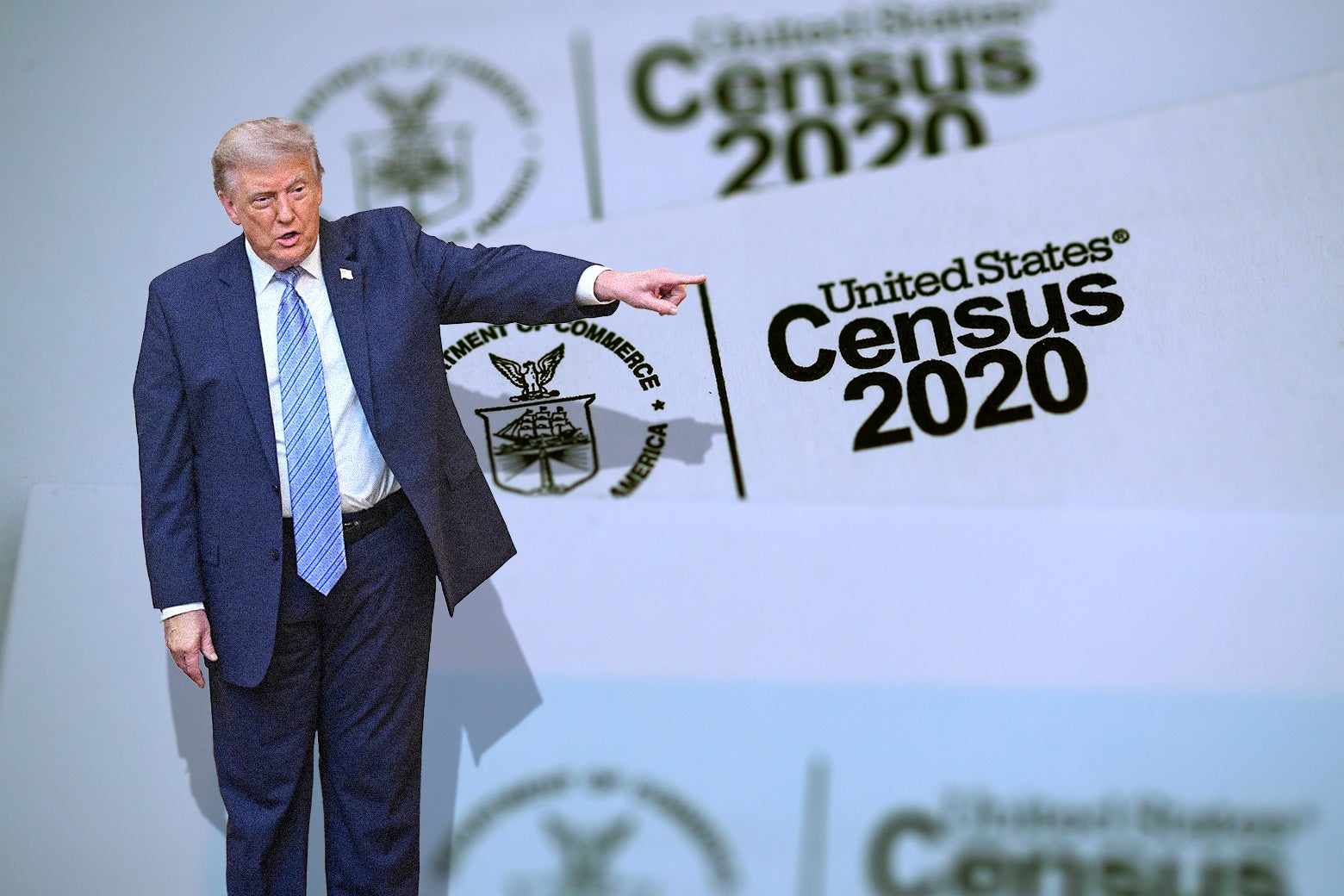
Jurisprudence Photo illustration by Slate. Photos by Justin Sullivan/Getty Images and Saul Loeb/Pool/AFP via Getty Images. Sign up for Executive Dysfunction, a weekly newsletter that highlights one under-the-radar story about how Trump is changing the law—or how the law is pushing back—and keeps you posted on the latest from Slate’s Jurisprudence team. Last week, the Trump administration proposed a regulation that, if not undone by the president taking office in 2029, would end the uninterrupted practice—one almost as old as our nation—of collecting race and ethnicity in the decennial census. This proposal would impair public health and cost numerous Americans their lives. The most widely reported part of the regulation was the decision not to count noncitizens without green cards, a change that could have radical implications for future elections and billions in federal funding. But the race and ethnicity change is also important and could trigger large implications for public health. As we have argued in recent academic research, race and ethnicity data are key in understanding population health outcomes. Our article shows that racial health disparities come from both differences in exposure to environmental stressors and different underlying vulnerability stemming from, for instance, genetics or access to healthcare. The resulting differences can be stark. For instance, Black children are 60 percent more likely than U.S. children overall to have asthma and four and a half times more likely to die from it. Hispanic women have a 40 percent higher incidence of cervical cancer and 20 percent higher death rate from it compared to non-Hispanic white women. And Asian Americans have extremely elevated rates of certain diseases, including tuberculosis and hepatitis B. For many diseases, it is impossible or impracticable to collect detailed, local-level prevalence data. Government agencies have responded by using race and ethnicity as a proxy or input into models determining the prevalence of these health conditions. Most notably, the U.S. Centers for Disease Control and Prevention combine survey data with census race and ethnicity estimates to model the prevalence of a number of chronic diseases—including asthma, chronic obstructive pulmonary disease, and cancer—at a fine-grained geographic level. That granular data allows decisionmakers to allocate resources and target outreach to the areas with the highest need. For instance, Michigan has established a pilot program to place mobile health unit vans in at-risk areas. Private health systems also use this type of data frequently, with one medical system using it to concentrate services in four high-risk neighborhoods of New York City. Without collecting race and ethnicity data in the census, these estimates could not be produced, needlessly wasting resources and endangering lives. And the Trump-proposed rule makes this pernicious move despite centuries of contrary historical practice. The practice of collecting race and ethnicity data is as old as the census itself. The 1790 census differentiated between “Free White” individuals and all others, and race has appeared in every census since. The White House Office of Management and Budget promulgated the first government-wide standards in 1977, which have been used by every administration during the past five decades. The Biden administration made long-needed changes to the standards in 2024, including adding a “Middle Eastern or North African” category. That revision was undertaken with analytical rigor: The process took two years, involved 35 agencies, incorporated extensive new and existing research, and elicited over 20,000 comments. Meanwhile, the census’s proposed rule has no scientific justification or participation by federal agencies with experience in this area. And the little rationale the rule does provide does not withstand scrutiny. The Trump administration first argued that lowering the number of questions would increase response rates. Unlike the meticulous, empirically based Biden-era revision, the Trump rule cites only two studies for this proposition: One is over 30 years old, and the other is not about the census. Not to mention that the Trump proposal would simply swap out the race question for one on citizenship—making clear that the concern over response rates is a subterfuge. Second, the proposed rule suggests the collection of racial data may be unconstitutional under recent Supreme Court decisions in Students for Fair Admissions v. President and Fellows of Harvard College and Louisiana v. Callais. While both decisions cover the topic of race-based preference, neither even remotely addresses the constitutional status of data collections. Callais concerned the role of race in drawing legislative districts under the Voting Rights Act, while SFFA involved racial preferences in college admissions. Courts have made clear that collection of racial data does not raise the same constitutional concerns as racially based preferences. Even a colorblind administration should still be invested in avoiding preventable deaths. Finally, the rule argues that the collection of race and ethnicity data would continue through the Census Bureau’s yearly American Community Survey. But the two are complements, not substitutes. The ACS has an annual sample size of only 3.5 million, whereas the decennial census has universal reach. That smaller sample means certain demographic groups may be over- or under-covered, biasing the total estimates. To mitigate this problem, researchers adjust the data using the demographic data derived from the decennial census, a process that would be impossible without the race and ethnicity question. By heedlessly seeking to end a centurieslong practice, the Trump administration is headed down a dangerous path. It will compromise our ability to provide effective healthcare, lead to underinvestment in the communities that need it the most, and cost American lives. Donald Trump Health Health Care Jurisprudence Census Judiciary
Trump Is Aiming Again at a Familiar First-Term Target. The Consequences Could Be Deadly.
Full Article
Original Source
Read the full article at Slate →KhanList aggregates and links to publicly available news content. We do not host full articles from third-party sources. Always verify important information with original sources.