
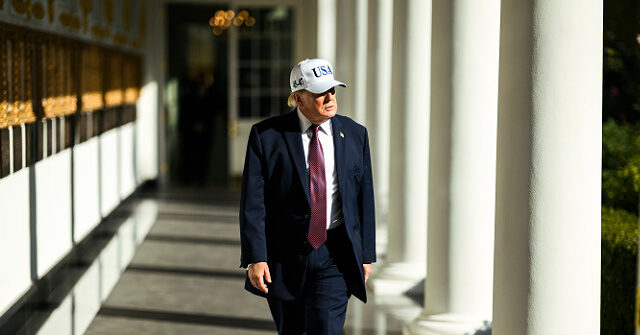
President Donald Trump declared Monday that Iran’s military is effectively defeated and another U.S. offensive appears unlikely, signaling that the months-long conflict could soon end following talks with Qatar’s prime minister. Speaking at the White House after meeting with Qatari Prime Minister Sheikh Mohammed bin Abdulrahman Al Thani, Trump said the United States would maintain its naval blockade and military presence in the region at the request of neighboring Gulf states, while insisting that any settlement must ensure Iran never obtains nuclear weapons and guarantee the long-term security of America’s regional allies. “Iran militarily is effectively over,” Trump told reporters, pointing to the destruction of Tehran’s navy and air force and the crippling of much of its missile and drone manufacturing capacity. Although Tehran retains some ability to produce missiles and drones, Trump said its broader military capabilities have been largely dismantled, leaving the regime severely weakened as diplomatic efforts continue. War Secretary Pete Hegseth echoed that assessment Monday, saying Iran’s weakened military position had left Trump with considerable flexibility in determining how to bring the confrontation to a close. “Iran is devastated. Iran is in the weakest position it’s been in a very, very long time,” Hegseth said, adding that the War Department stands ready to carry out whatever course the president chooses. Trump said Iranian officials were communicating with Washington and expressed optimism that the conflict could be resolved without another round of major strikes. “They’re talking to us, and they’re talking very politely,” Trump said. “And we’ll see what happens. But there’s a good chance that that could get ended.” The president attributed the decision to maintain the current American military posture to requests from Iran’s neighbors, identifying Qatar, Saudi Arabia, the United Arab Emirates, Bahrain, and Kuwait among the governments favoring the status quo. Trump pointed to the continuing U.S. naval blockade, which he described as the largest in history, saying it had effectively halted Iranian maritime shipments for months and inflicted severe economic damage on Tehran. Washington tightened those restrictions further over the weekend with the launch of Operation Iron Gate, a U.S. Central Command initiative designed to intercept weapons, dual-use technology, sanctioned goods, and illicit revenue moving across Iran’s land borders and the Caspian Sea. The new operation extends American interdiction efforts beyond the maritime blockade, effectively surrounding Iran with restrictions by both land and sea — a combination Trump described as a “total lockdown.” With the blockade and expanded interdiction measures remaining in force, Trump indicated that Washington could continue weakening Tehran without immediately resorting to another major military offensive. Trump said additional military action “doesn’t seem to be a very necessary thing,” while emphasizing that American forces remained “locked and loaded, ready to go for any reason.” His latest assessment followed an interview broadcast Sunday on CBS’s 60 Minutes, in which he said he saw no immediate need to resume major strikes while American forces continued monitoring Iran’s damaged nuclear facilities. “I’m not looking to,” Trump said when asked about renewed military operations. “I don’t think there’s any reason to.” He noted that Iranian nuclear material remained buried beneath thousands of tons of rock from earlier American strikes and said the United States continued monitoring the sites. Trump underscored that position in a Truth Social statement following his White House remarks, indicating that renewed military action appeared unlikely unless developments in the region required an American response. “Should there be any change with respect to developments in the Middle East, the United States of America is ‘locked and loaded’ and ready to go,” he wrote. “At this point, however, that seems to be quite unlikely.” Trump also declared that “Israel, and the entire Middle East, are protected from Iranian danger and threats,” while expressing confidence that the conflict was moving toward a conclusion. The president nevertheless made clear that ending the conflict would require a lasting settlement that protects Israel and other American allies and permanently prevents Iran from obtaining nuclear weapons. Asked why he would not simply declare the conflict over, Trump said Iran continued to pose a threat to neighboring countries despite the destruction of much of its military. “Because we have some great allies there, and we have to make sure they’re not hurt,” he said. “They are right now a lot safer than they were six months ago, because Iran’s been very much decapitated.” Trump said Iran had been “very much decapitated” militarily but remained, to some extent, “the bully of the Middle East,” underscoring his determination to secure a lasting agreement that protects neighboring countries. “We want to make sure it’s a long-term solution, not just a short-term,” Trump said. “They’ll never have a nuclear weapon, but we have to make sure that’s a long-term solution.” The president reiterated that preventing Iran from acquiring nuclear weapons remained a nonnegotiable American demand, asserting that Tehran privately understood and accepted the condition despite publicly rejecting it. “They understand that. They accept that. They don’t admit that they accept it,” Trump said. “They will tell you that they don’t accept it, but they accept it 100 percent.” The prospect of a diplomatic settlement was central to Trump’s discussions with Al Thani, whose government has played a leading role in mediating indirect negotiations between Washington and Tehran. In a telephone interview with Reuters following the meeting, Trump said Qatar and Saudi Arabia favored a peaceful resolution, even as Washington maintained its military readiness. “Qatar would rather see a peaceful solution,” Trump told the outlet, adding that Saudi Arabia shared that preference but that American forces were “ready to go anytime we want.” Al Thani also met with Vice President JD Vance, who has been closely involved in the indirect negotiations with Tehran and maintained frequent contact with the Qatari leader in recent weeks, according to Axios. The Qatari prime minister welcomed the Washington discussions, saying they focused on advancing U.S.-Iran negotiations and reaching an agreement that could bring peace to the region. Significant obstacles remain to a settlement, with Tehran seeking relief from the American blockade and sanctions, among other concessions, while Washington insists on restrictions that would permanently prevent Iran from developing nuclear weapons. Regional mediators have discussed a proposed two-day arrangement aimed at bridging those differences, under which Washington would initially ease restrictions on Iran before Tehran took steps to reopen the Strait of Hormuz and resume nuclear negotiations, according to the report. A senior Qatari official, however, disputed circulating accounts of the proposal’s terms, telling Al Jazeera that reports involving frozen Iranian assets, uranium enrichment, and other negotiating details were “categorically false.” Secretary of State Marco Rubio had cautioned Sunday that negotiations remained far from a breakthrough, citing Iranian demands that Washington considered unacceptable. “I wouldn’t say we’re on the verge of a breakthrough,” Rubio told reporters ahead of a Group of Seven meeting in Paris, describing Iran’s demands as “not just unacceptable but, in some cases, outrageous and ridiculous and really not realistic.” Iran’s leadership has meanwhile sent conflicting signals about negotiations, with President Masoud Pezeshkian expressing openness to talks even as senior security officials publicly reject reports of diplomatic progress. Pezeshkian said Supreme Leader Mojtaba Khamenei had instructed the government to end the prolonged state of neither conflict nor peace. “We can hold talks with dignity and bring the matter to an end with dignity,” Pezeshkian said, according to Iranian media. Yet Mohsen Rezaei, secretary of Iran’s powerful Supreme National Security Council, dismissed reports of negotiations and demanded that Washington accept seven Iranian conditions for ending the conflict, including demands the United States has previously rejected. “FOLD YOUR HAND. STOP manufacturing FAKE NEWS about imaginary talks,” Rezaei wrote on X. With negotiations continuing and Tehran’s demands still unresolved, Trump maintained that the conflict was approaching its conclusion, while leaving open the possibility of further American military action. “We’re seeing momentum toward the end of this conflict,” Trump said. “I think it’s going to be ending fairly soon.” The president nevertheless stopped short of guaranteeing a diplomatic settlement, warning that American forces remained prepared to resume operations if necessary. “I don’t guarantee anything,” Trump said. “But if we do have to go back in, we are locked and loaded and ready to go.” Joshua Klein is a reporter for Breitbart News. Email him at jklein@breitbart.com. Follow him on Twitter @JoshuaKlein.
Trump: Iran War ‘Effectively Over’ Militarily — Renewed Offensive ‘Quite Unlikely’
Full Article
Original Source
Read the full article at Breitbart →KhanList aggregates and links to publicly available news content. We do not host full articles from third-party sources. Always verify important information with original sources.