
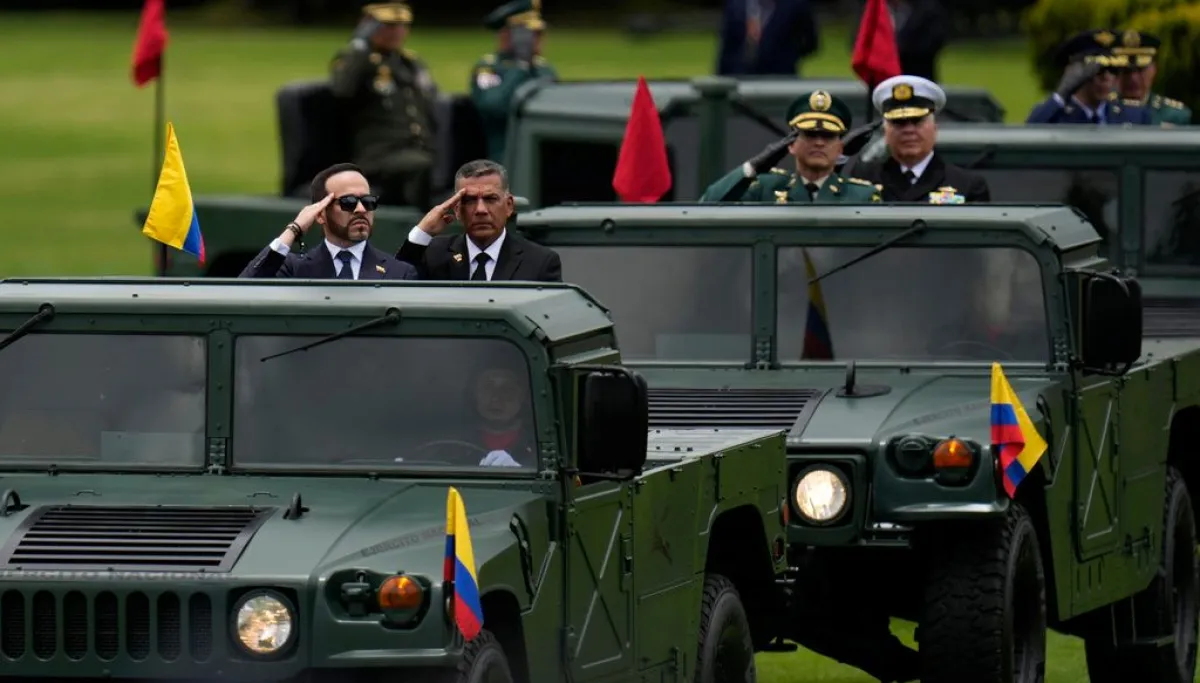
President Donald Trump‘s fight with the Latin American drug cartels is one of this administration’s success stories. The cartels have been forced into expensive evasion efforts. Corrupt politicians in Mexico are under unprecedented pressure. Venezuelan dictator and drugs chieftain Nicolas Maduro now lives in an American prison cell. And the United States has just restored a key counter-drugs alliance with Venezuela’s neighbor, Colombia.Brigitte Garcia’s death testifies to why this fight matters.Garcia was a 27-year-old nurse. She became mayor of a town on Ecuador’s coast by pledging simple improvements to people’s lives: clean water supplies and increased tourism. But in March 2024, Garcia and one of her staffers were shot in the back of their heads. The murders were part of a vicious cartel campaign to terrorize and enforce the corrupt loyalty of politicians across Ecuador. In August 2023, presidential candidate Fernando Villavicencio was similarly assassinated on cartel orders. As with Pablo Escobar’s 1989 murder of Colombian presidential candidate Luis Carlos Galan, and Mexico’s blight of journalist killings, history underlines a hard truth. Namely, that Latin American cartels seek to destroy democracy. The cartels thus pose a clear threat to stability and freedom in the Western Hemisphere. THE STALEMATE INCREASINGLY SUITS TRUMP OVER IRANFortunately, the cartels have their enemies. One is Trump. Another is Colombian President Abelardo de la Espriella.Since entering office earlier this month, Espriella has abandoned his left-wing predecessor’s appeasement of the cartels. Instead, Espriella quickly reached an agreement to escalate cooperation with the U.S. military. This deal may lead to joint U.S.-Colombian ground action against cartels. Still, its most important benefit will be the establishment of a joint operations center in Medellin. As with the 1990s hunt for kingpin Pablo Escobar, this center will allow U.S. personnel to share real-time intelligence with their Colombian counterparts, and vice versa. It will enable more rapid and effective drug enforcement activity.A particular focus will fall on the Gulf Cartel, which dominates cocaine supply to Mexican and other international cartels for onward smuggling and distribution. But Colombia’s far-left FARC and ELN terrorist groups will also now face strikes anytime their leaders or cultivation fields are identified. Colombia’s renewed U.S. cooperation is especially valuable for two reasons.First, it will enable more decisive action against drug production efforts and greater interdiction of smugglers at Colombian ports. This will better address the drugs problem at its source. Colombia will no longer be a relative safe haven from which the only real risk to cartels is the odd U.S. strike on a drug running boat.Second, concerted action in Colombia can pay outsize dividends in the global fight against drugs. That’s because the cocaine industry flows into a far wider array of organized criminal activity around the world.Balanced expectations are certainly necessary here. Winning the war on drugs remains an impossible goal. The vast profit incentives born of selling these products at high prices means that there will always be individuals willing to serve this trade. The trade will also sadly retain a vast supply of customers.But the U.S. and its allies can exert increased friction on the supply and distribution elements of this perverse industry. That friction will drive up price points for those seeking to buy drugs. More importantly, it will help to discourage young people, security and military personnel, and politicians from bending to the cartels’ agenda. Over time, it will lead to more stable, prosperous democratic societies that are less vulnerable to criminal influence.Even better, U.S.-Colombian cooperation reflects a broader regional trend.The U.S. now has counter-drug cooperation agreements with Argentina, Bolivia, Chile, Costa Rica, the Dominican Republic, Ecuador, El Salvador, Guyana, Honduras, Panama, Paraguay, and Trinidad and Tobago. And while Mexico remains the central concern on drug smuggling into the U.S., President Claudia Sheinbaum increasingly recognizes that the old way of doing business won’t work with Trump. The old way being the Mexican government tendency to provide the U.S. with minimal cooperation and the occasional drug lord extradition scalp. All while allowing the cartels and systemic corruption to largely run free. The Jalisco New Generation Cartel’s extreme brutality, and clever U.S. exploitation of the Sinaloa Cartel’s civil war have also pressured Sheinbaum to step up.More needs to be done. Trump should ensure that countries taking risks to join this fight are rewarded with greater engagement and financial aid. Trump should also pick up the phone and tell his daughter Ivanka and son-in-law Jared Kushner to end their business dealings in Albania. Although the couple presumably just want to make some money, their Albanian dealings will enable drug cartel money laundering.TRUMP IS BLINDED BY HIS PERSONAL RELATIONSHIP WITH KIM JONG UNFinally, Trump should better outline to Americans the misery that their cocaine consumption causes inside and outside of U.S. borders. He should note that the criminal gangs that bring such mayhem to our streets derive the majority of their revenue from drug sales.He should point out that Brigitte Garcia’s murder is only a drop in the ocean of Latin America’s drug tragedy. Tens of thousands of innocents have been maimed or murdered by the cartels in only the past 10 years. Trump should state plainly that when Americans buy a gram of coke, they aren’t buying some illegal fun, they’re paying the salaries of vicious murderers.For the first time in a long time, however, the fight against the cartels is going well. Trump and his foreign partners deserve credit for ripping up a rotten status quo.
Trump has the cartels on their heels — now with Colombia’s help
Full Article
Original Source
Read the full article at Washingtonexaminer →KhanList aggregates and links to publicly available news content. We do not host full articles from third-party sources. Always verify important information with original sources.