
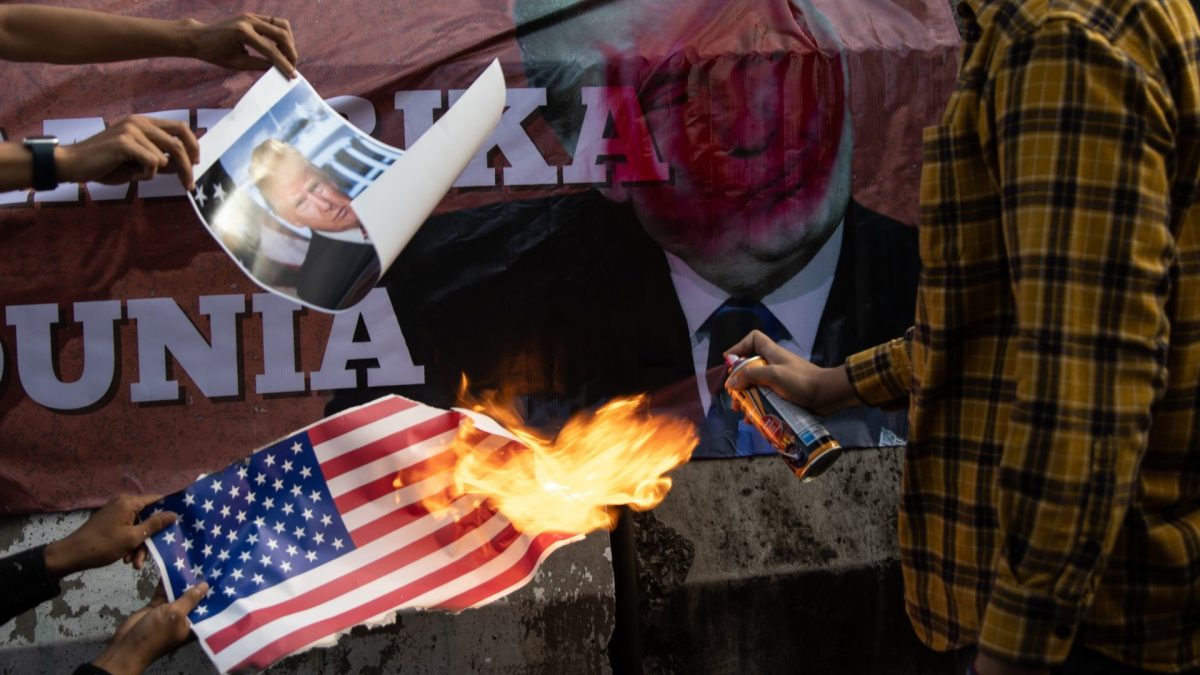
Donald Trump is unpopular at home and abroad and his posturing on the world stage is costing his party, and country, power and influence. The US President’s adversarial style is not only turning off American voters ahead of November’s midterm elections, it is turning global public opinion against the US, polling of 42,000 people across 36 countries reveals. The research by the Pew Research Centre, a non-partisan think-tank based in Washington DC, has found dramatic reductions in the number of people who view the US as a reliable partner to their country, with less than a quarter feeling confident in Trump’s leadership. Shorts Trump sank to the lowest approval rating of his political career this week, according to a Reuters/Ipsos poll, which could cost his party control of Congress in November as Republican candidates scramble to distance themselves from the polarising President. And record low approval at home is matched by global public opinion data that has seen an “overwhelmingly negative” shift in how people see the US, according to Pew. Analysts say negative perceptions of the US will hit the American economy in sectors such as tourism, and that rival powers are positioning to take advantage. Positive views of the US fell dramatically in formerly closely allied countries, with notable drops in Canada, France, Germany, Australia and South Korea compared to polling four years ago. In Britain, only 26 per cent of people say they have confidence in Trump to do the right thing regarding world affairs, while the share of people who think the US is a reliable partner has crashed from over 80 per cent in 2022 to less than 50 per cent in 2026. “I’m not surprised, for two obviously related reasons,” Jason Reifler, professor of politics and international relations at the University of Southampton, told The i Paper. “He’s a divisive figure and in domestic polling, his personal approval ratings are low and seem to be trending lower. “And the second is the United States, with Trump as President, has consistently taken conflictual adversarial positions on trade and security matters with a number of close allies in ways that it would be surprising if those countries didn’t react negatively to it.” Growing anger at the rising cost of living in the US, driven by the President’s disastrous war with Iran, combined with worries about the wider state of both the economy and democracy are shifting views in key battleground states across America. Large majorities across the 36 countries polled disapproved of Trump’s handling of the conflicts in Iran, Gaza and Ukraine, the trade tariffs he has imposed and aggressive US immigration policies. 74 per cent of adults in the nations surveyed disapproved of how Trump is dealing with the crisis in Iran. Only one in four Britons now believes Washington takes the interests of other countries into account when making foreign policy decisions, an all-time low for UK respondents and a figure closely matched in other former strategic partners such as Germany, Italy and Japan. Global public opinion has real impact on the “soft power” a country has, the critical ability to win friends and influence people. “This is an administration that just doesn’t believe in soft power. It’s a hard-power administration that has gone back to the 19th century and gunboat diplomacy. It’s a nation that wants to bully other nations,” said Dafydd Townley, senior teaching fellow at the University of Portsmouth and chair of the American Politics Group of UK academics. Townley points to declining tourist numbers in states like Florida or New York and immigration and visa policies under Trump that make the America less attractive for foreign students, as tangible effects of losing global support that damage the US economy. “If you base relations on hard power, then your soft power is going to decline and you’re just going to be less attractive to work with. The United States is ultimately being viewed as unreliable in terms of international relations,” he told The i Paper. Reifler agrees that global public perception is important economically as well as diplomatically. “I think it does have real-world implications if fewer people have a positive view of the US in terms of the ability to attract capital investments for example, or the US becoming so problematic that companies decide to start listing on the London stock exchange rather than New York,” he said. “I don’t think we’re quite there yet, but those things might start to matter.” The decline in America’s reputation will open doors for other world leaders to develop diplomatic arrangements to get round Trump’s transactional foreign policy, such as Canadian prime minister Mark Carney’s proposed alliance of middle powers, or the European led “Coalition of the Willing” to support Ukraine. Shifts in US engagement and influence provide “the opportunity for leaders to reposition themselves”, according to Reifler. And as both perceptions of soft power and the hard reality of alliances shift, China is waiting in the wings as an alternative to America. China now sits second behind the US in the global soft power rankings and is expected to overtake the US as Trump’s antics and inconsistency on the global stage drain support. “What the United States is doing is essentially pushing nations towards China,” said Townley. “China has huge economic potential for every Western nation and while there are a whole host of breaks in position to stop them doing that, security for example, if Trump is going to push you towards China, then China is just sat there saying, ‘Thank you very much’.” The long-term damage to US power and influence is likely to last well beyond Trump, even if a new president were to try to rebuild America’s reputation. “If there is a skilful Republican in the White House or a run-of-the-mill sort of normal Democrat, I think a lot of the damage would be repaired, but probably not all of it,” said Reifler. Townley is more pessimistic, arguing that rebuilding brand America is “probably an impossible job and it’s not something that’s going to happen with the immediate replacement of Donald Trump as President”. The research from Pew reveals how, under Trump, perceptions of the President and the country have become more closely aligned than under former leaders. That’s a problem for the US, said Townley. “Ultimately, this Trump administration is full of people who are there to do what the President wants, not what is necessarily best for the United States.” Additional reporting by Liam Buckler
Trump has sent America into decline. These figures prove it
Full Article
Original Source
Read the full article at Inews →KhanList aggregates and links to publicly available news content. We do not host full articles from third-party sources. Always verify important information with original sources.