
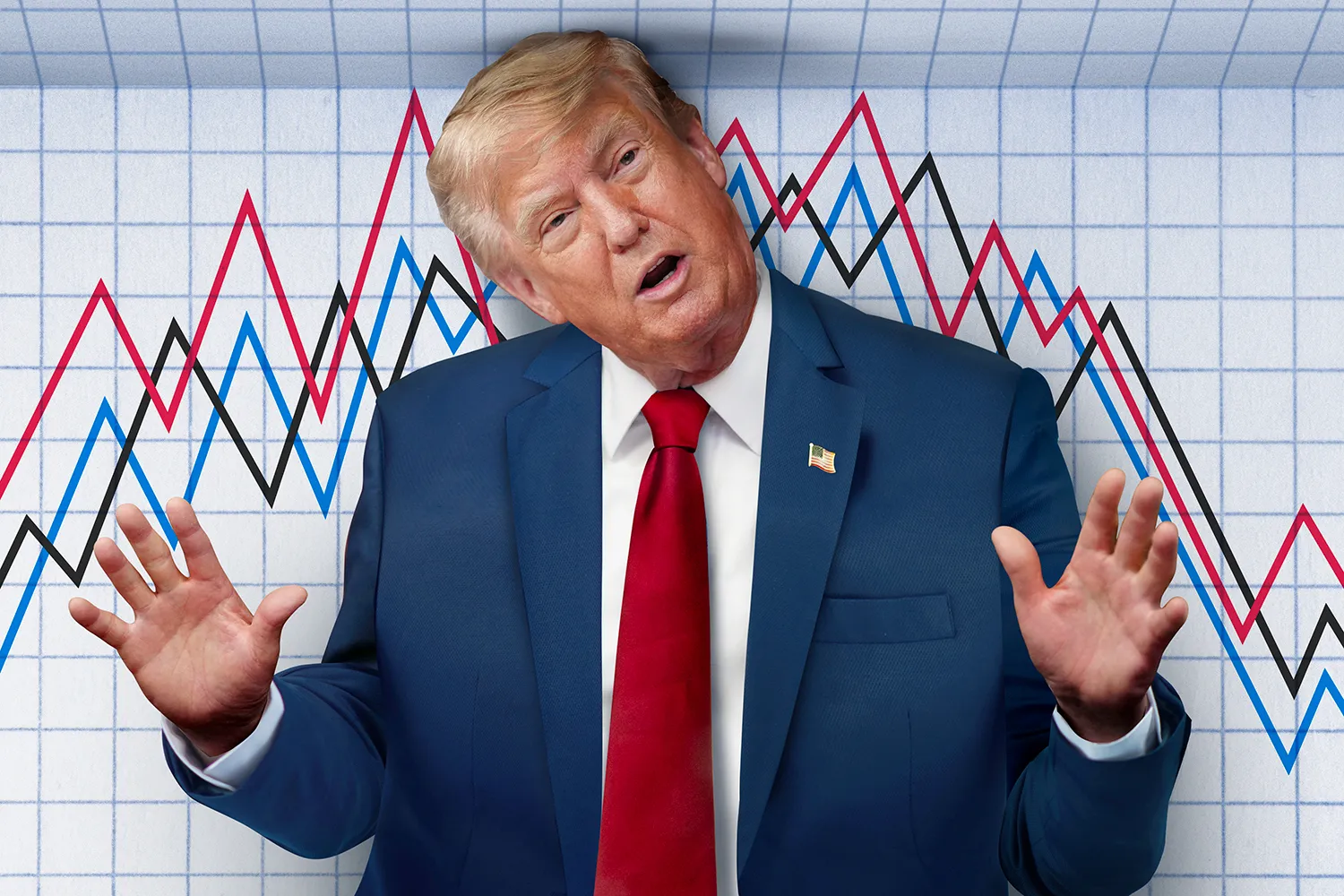
Donald Trump must look back at the start of 2026 with a wistful sigh. The U.S. president rang in the new year with a grand bash at Mar-a-Lago, his private club in Florida, attracting guests such as Israeli Prime Minister Benjamin Netanyahu and Emirati billionaire Hussain Sajwani. At the party, Vanilla Ice pumped out “Ice, Ice, Baby.” A live speed painter conjured up an image of Jesus Christ. Since Christ himself wasn’t around to do the honors, Trump promised to autograph the painting and then personally auctioned it off for $2.75 million. The first year of the president’s second term was largely going to plan. Trump had assembled a cabinet of loyalists, signed more executive orders in his first 100 days than any other U.S. president, and deployed the Justice Department to go after his enemies. He had ordered the bombing of Iran’s nuclear facilities in June 2025 while simultaneously cosplaying as a statesman who could end all wars. He had even orchestrated a vibe shift in Silicon Valley: The world’s richest men were now flying to the White House to kiss the ring. Then, on Jan. 3, Trump launched Operation Absolute Resolve. The world’s mightiest military swooped into Caracas to capture Venezuelan leader Nicolás Maduro. The mission was daring and impressive. It was also illegal, unconstitutional, and lacked long-term payoff. But for Trump, it was an affirming display of strength. He was belatedly realizing the full extent of the awesome power wielded by a commander in chief—and what good was power that couldn’t be exercised? It could not have escaped Trump’s notice that his actions generated limited national or international blowback. Maduro was a corrupt dictator; he had no real allies, and his arrest did little more than provide yet another example of a growing void in international law. An emboldened Trump proposed taking Greenland, a Danish territory, next. It was a threat that could have destroyed NATO, the world’s biggest military alliance. And as CEOs and world leaders gathered in Switzerland for the World Economic Forum later that month, there was little else one could discuss. Will he, or won’t he? On everyone’s lips, it was Trump, Trump, Trump. A burgeoning cottage industry of lobbyists doled out expensive advice on how to navigate an administration that had concentrated so much power in one person. The most common prescription was a mixture of flattery and gifts. Trump may one day come to see those heady days at the start of this year as the period in which he peaked in terms of global influence. And then things started to go downhill. Cresting and then declining should be no surprise; it happens to everyone and everything. But Trump, now focused more on ballrooms and pools than on the Nobel Peace Prize he lobbied for just one year ago, only has himself to blame for prematurely morphing into something resembling a lame duck. The chief cause is surely his decision in February to go to war against Iran. More than six months in, the conflict has drained U.S. resources, raised the cost of living, and turned Trump into one of the most unpopular presidents in recorded history. In a second term of very few leaks, Trump’s once loyal cabinet officials are now telling reporters that their boss ignored their concerns about attempting regime change in Iran. The war has almost irreparably damaged Trump’s foreign-policy toolkit. Short on both offensive and defensive missiles, Trump can no longer dangle the possibility of changing battlefield dynamics in Ukraine, a conflict he promised to end in one day, or provide a suitable deterrent to China’s ambitions in Taiwan. The hard realities of a slow industrial base will severely constrain his ability to project power. Inflation, made worse first by tariffs and then by the war’s impact on gas prices, will stymie his decision-making at home and abroad. Trump is losing the support of the influential media figures who paved the way for his ascent. A looming defeat for his party in the midterms this November will erode his ability to enforce rank-and-file loyalty. The national and international conversation will begin to move on to a post-Trump world. In some ways, it already has, thanks to the president’s constant reminders to allies about burden-sharing. The more Europe spends on defense and the more countries such as Saudi Arabia are forced to hedge their bets on military alliances, the less they will need Trump, Trumpism, or even the United States. The president himself will remain a disruptive—and potentially destructive—presence on the world stage. He still has more than two years left in office and powerful economic tools to wield as cudgels against allies and adversaries alike. Yet countries and companies will learn that he has peaked. His coercive capacity, so potent last year, seems lessened from overuse. This realization will alter the very nature of Trump’s power—and the discussions about a world order to come. A military service member wearing a red safety vest stands among rows of bomb munitions on an aircraft carrier deck, with fighter jets parked in the background under a dim sky. A handout photo from U.S. Central Command shows U.S. sailors as they transfer ordnance on the flight deck of the USS Abraham Lincoln in the Arabian Sea on Feb. 27. U.S. Central Command via Getty Images Consider, first, some missile math. According to the Center for Strategic and International Studies (CSIS), the United States had around 2,300 Patriot missiles, the best-in-class mobile interceptors, at the start of this year. Within weeks of the Iran war’s start, the United States had used more Patriot missiles than it had given Ukraine in four years of conflict. By August, six months into the war, the inventory had dropped to around 800 as the United States rushed to defend its bases and allies from Iranian attacks. (The Pentagon disputes this accounting but has not provided its own numbers.) A single interceptor costs $4 million and, more importantly, takes at least two years to build. The United States produces only 600 Patriots a year, although plans are afoot to increase production. These facts are well known to U.S. adversaries and represent a new weakness that countries such as Iran can exploit. U.S. interests worldwide are now more vulnerable to attacks, and the White House is less willing to sell its few remaining interceptors to potential buyers in Ukraine or the United Arab Emirates, therefore diminishing its clout. It’s not just Patriots, either. Six other key defensive and offensive munitions used by the U.S. military were significantly drawn down in the first two months of the Iran conflict, a CSIS assessment in late April showed. The U.S. military still has enough weaponry to pummel Iran for months and defend its most important assets. And Tehran remains thoroughly outmatched—it has no functional navy and air force anymore. But wars aren’t merely about which military is stronger; their outcomes can often depend on which side can endure more pain for longer. Iran retains the ability to hit back, whether at U.S. bases in the region or at the energy infrastructure of U.S. allies in the Persian Gulf. Iranian Shahed drones, which first came to global attention when Russia deployed them against Ukraine in 2022, have become a menace in the Gulf. U.S. policymakers who had expected Iran to shut down the Strait of Hormuz only ever imagined it would do so with sea mines, not drones, giving it the ability to target its disruption. Tehran has discovered it can trouble far richer and larger military powers almost indefinitely. This has put the United States on the back foot, with no winning strategy to exit a draining war. Trump has validated Tehran’s playbook; as he put it to Axios in August, he was now adopting a strategy of “low-keying” further attacks on Iran. Meanwhile, the United States has yet to fully account for the damage it has incurred. According to the New York Times, Iran has hit at least 18 U.S. bases across seven countries in the Middle East, puncturing Washington’s air of invincibility and serving up a bill for rebuilding that will run into billions of dollars. At home, gas prices remained elevated by a third over the spring and summer, directly impacting U.S. consumers. The cost of diesel and jet fuel have jumped by even more, raising the costs shouldered by businesses and airlines. Perhaps most gallingly for Trump, the energy crisis could have been even worse had it not been for China’s decision to draw on its immense fuel reserves. Put another way, Beijing bailed out Washington as well as the global economy—and the whole world knows it. Trump’s approval ratings have plummeted as the war has continued. An Economist/YouGov poll conducted in early August found that the number of Americans who disapproved of his presidency outnumbered those who approved of it by 29 percentage points. On the topic of inflation, Trump hit a negative 44 rating in May, suggesting widespread anger at rising prices. Even within Trump’s usually loyal MAGA base, discontent has been high, with prominent supporters such as podcasters Tucker Carlson and Joe Rogan publicly criticizing the president for launching a war on Iran. Polls now suggest significant losses for the Republican Party in both the House and Senate in the November midterms. Such an outcome would erode Trump’s authority and return to Democratic leaders the voice they seem to have lost. Blaming Israel for the war is not a viable option for Trump. After all, Netanyahu has made the pitch about Iran’s threat to U.S. presidents, including Trump in his first term, for decades. No other administration calculated that a war would generate the desired outcome. A blame game has already begun. But in reality, this one is squarely on Trump: He is the commander in chief who made the final call, the loyalty-obsessed leader who fired the experts who might have tried to rein him in. In any case, if his bombing of Iran’s nuclear facilities last year was a spectacular success, as his administration repeatedly claimed, what was the need to go back in? The most plausible explanation for why Trump did it is that he was drunk on power, surrounded by yes-men, and convinced that he could succeed where all others had failed. From Icarus to the present day, this is how men have always lost their wings. Three men in dark suits stand in front of a blue backdrop with "NATO OTAN" logos; the central figure wears a yellow tie while the men on either side gesture outward with open hands. From left: NATO Secretary-General Mark Rutte, U.S. President Donald Trump, and Turkish President Recep Tayyip Erdogan arrive ahead of a family photo during the NATO summit in Ankara, Turkey, on July 8. Chris McGrath/Getty Images As war loses its appeal, Trump may look for other means to impose himself internationally. But after their initial shock at Trump’s purposeful start to his second term, countries are rapidly adopting new strategies. A prominent example came in August when Pakistan, Saudi Arabia, and Turkey signed a defense pact in which they would consider an attack on one of them as an attack on all. Each country had its own set of reasons for strengthening deterrence, but it’s difficult to ignore the broader trend line they were reacting to: an increasingly unreliable and unpredictable United States. Riyadh had received a security commitment from Washington just last year but felt, especially after the Iran conflict, that it needed more—so much so that it was willing to override concerns about a rivalry with Ankara and risk upsetting New Delhi by cozying up to Islamabad. Across the Middle East, countries that relied on U.S. security guarantees and allowed U.S. bases on their soil are now contemplating how those choices planted a target on their backs. Iran has retained the threat of attacking any U.S. partner in the region. Every other Gulf state will now look at Saudi Arabia’s moves and ask whether it should make similar arrangements. Europe is also scrambling to decrease its dependence on the United States, embarking on a generational surge in military spending. At Trump’s own urging, NATO member states are planning to up their defense spending to 5 percent of their GDPs. The United States sought to share the burden of collective defense, but it has only sped up European independence, especially since threatening to take Greenland by force. Last year, the European Union began a new program, SAFE, to provide 150 billion euros (about $170 billion) in loans for members’ arms procurement. U.S. defense companies were limited to receiving up to 35 percent of any project sanctioned by the program. Canada, another country destabilized by Trump’s threats, became the first non-European country to join SAFE, similarly capping the amount of Ottawa’s defense dollars that can go to the United States. Meanwhile, Denmark ordered a French-Italian air defense system this year instead of trying to join the line for U.S. Patriot batteries. European bodies are now looking to avoid another area of U.S. dominance: cloud computing. Instead of picking the market-leading services from Amazon, Google, or Microsoft, the Dutch central bank this year opted for a German alternative. Relying less on the United States goes hand in hand with not heeding Trump’s words anymore. At the height of the Iran war, as the United States asked its NATO allies for help in reopening the Strait of Hormuz, German Defense Minister Boris Pistorius was clear: “This is not our war,” he said, channeling the view of almost every European leader. “COWARDS,” Trump replied on social media. Even Netanyahu, usually a staunch Trump ally, has rejected the White House’s 15-point plan for lasting peace in Gaza. The friendships Trump has chosen to trample on—from Canada to Europe to India—were in fact Washington’s secret sauce, the one thing Beijing couldn’t manufacture. In squandering those partnerships, Trump has accelerated the diffusion of U.S. power as well as the process of his own declining influence. The derisk-from-America movement isn’t limited to defense, of course. There’s also trade. This year, the EU fast-tracked talks that had been ongoing for years to sign a free trade agreement with Mercosur, a bloc of South American countries, and with India, which has been stunned by its sudden demotion in status under Trump 2.0. Brussels is also exploring pacts with Australia, Indonesia, and the UAE, right as the United States continues to tariff its way into Asia’s bad books. In hindsight, the first major sign of the limits of Trump’s influence came last year, when the term TACO—Trump always chickens out—became a popular way to describe the president’s repeated backing off from his tariffs in the face of market anger. The trend began when Trump, ever the contrarian, pushed ahead with his April 2 plans despite widespread agreement among economists that indiscriminate tariffs represented a domestic tax on consumption. The manner in which Trump and his team calculated tariff numbers and picked targets was bizarre, as was the fact that the tariffs keep running into domestic legal hurdles—but those reports are well-trodden ground. What is most consequential here is that Trump ran into a bully his own size in the form of China. On April 4, Beijing retaliated with export restrictions on heavy rare earths and permanent magnets, sectors in which it maintained a strong monopoly. Markets slumped worldwide as automakers and semiconductor manufacturers digested the news that their supply chains were broken. Beijing had thrown down a card it never wanted to play—weaponizing its chokehold over critical minerals—but in doing so it forced the White House to pull back on the worst of its China tariffs. It also ended up nudging the pendulum of the U.S.-China relationship back into the realm of uneasy detente. Trump, who had normalized a hawkish posture toward Beijing when he hit the campaign trail in 2015, was now signaling that the United States would bide its time before picking a fight again. Once again, the president had overplayed his hand. He waxed, and then he waned. A colorful wood duck resembling Donald Trump standing against a plain yellow background, wearing a long red necktie tied around its neck. Doug Chayka illustration for Foreign Policy What will a diminished Trump look like? The president is unlikely to enjoy the task of managing his own decline. Trump still has the world’s largest economy behind him and historic tailwinds in the form of the country’s artificial intelligence boom. He also retains a powerful chokepoint in the primacy of the U.S. dollar, which enables the Treasury Department to sanction entities around the world. But even here, overuse has begun to erode this extraordinary power. Years of sanctions have devastated the economies of countries such as Iran and North Korea without changing their behavior. Trump’s disdain for allies will make it harder to secure full international cooperation on new restrictions. Meanwhile, a growing number of countries are banding together to trade outside the dollar system. The area in which Trump has most reduced U.S. credibility is its ability to project military power. Even if he can successfully extricate himself from his Iran quagmire, it’s difficult to imagine him embarking on future missions far from U.S. shores. What’s more likely is a renewed focus on Latin America, a region no other great power currently has designs on. It’s possible Trump may try to repeat a version of his Venezuela mission in Cuba, with its weakened leadership and severe economic troubles. The president may double down on demonizing immigrants and try a fresh push to round up and deport people found to be without the right paperwork. Trump is also likely to continue finding innovative ways to ramp up tariffs, especially in areas related to national security, such as the production of drones or semiconductors. But none of these moves will reach the globally disruptive heights of the first 12 months of his second term if Democrats have a stronger voice in Congress. Already, a militarily diminished Trump is losing interest in playing the role of global peacemaker. He has of late seemed more interested in legacy plays that have little consequence, such as adding his name to the Kennedy Center in Washington. Even those cosmetic moves could be easily undone by a successor. Part of the issue here is that Trump entered office in 2025 with years of vengeful plotting under his belt. He began his term with a flurry of executive orders designed to overwhelm the media and his political opposition. That energy was always going to be difficult to sustain. When the primary strategy is flooding the zone and sowing chaos, there is rarely a plan for what comes next. The question now is how world leaders and CEOs should navigate a U.S. leader who is losing his peak coercive powers. Public obsequiousness and flattery, the norm last year, may now seem like needless debasement. Pay-to-play deals, while still likely, will look less financially attractive with the clock ticking on this administration. Instead, leaders may now focus on keeping Trump at arm’s length, hoping he leaves them alone. Countries will continue to explore new partnerships and alliances without the United States. Companies may merge or bulk up to deter Trump’s meddling. The stock and bond markets will remain a powerful check. Global attention will soon fixate on the race for the White House in 2028, taking away from Trump one of his oldest superpowers: his ability to command attention. The world before 2025 was already drifting toward a post-American landscape. Trump accelerated the process. But in doing so, he has overplayed his hand and made it more likely that the international system will one day return to at least some of the rules it was becoming disenchanted with—just not with the United States as its exemplar. When Trump chairs the G-20 at the end of this year or next attends a global convening such as the World Economic Forum, the question on everyone’s minds will no longer be will he or won’t he. It will be about whether Trump matters anymore.
Trump Has Peaked
Full Article
Original Source
Read the full article at Foreignpolicy →KhanList aggregates and links to publicly available news content. We do not host full articles from third-party sources. Always verify important information with original sources.