
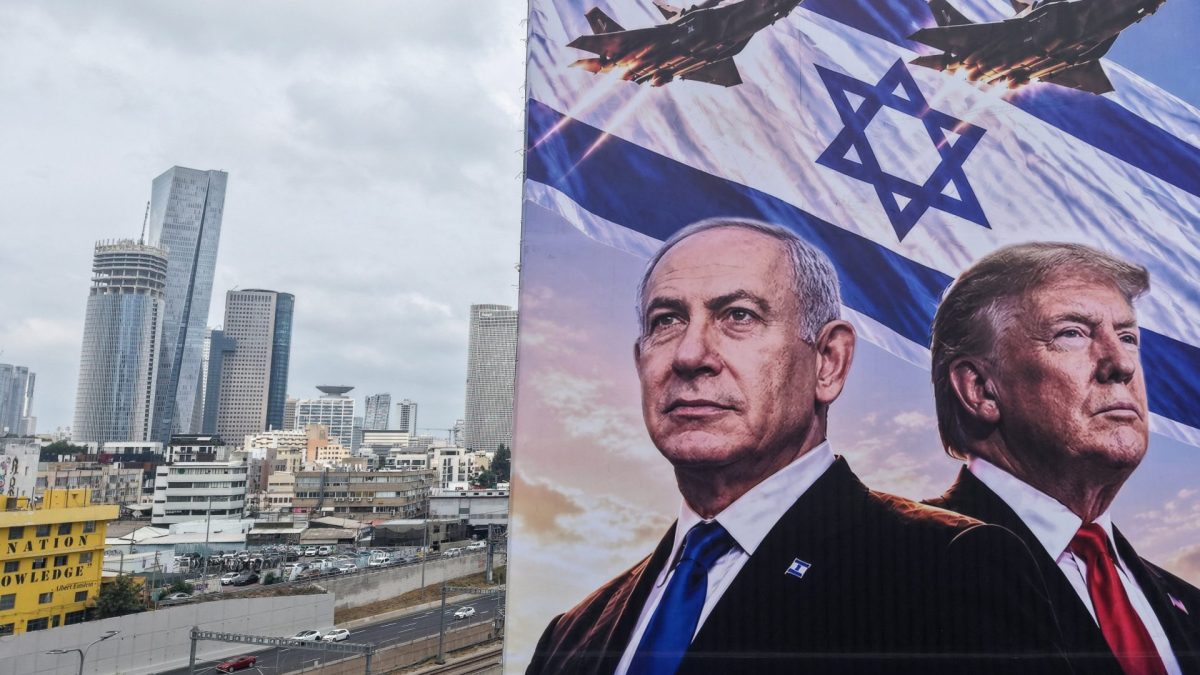
Among the many strange and unexpected things Donald Trump said during the midterm elections, one statement was truly shocking. As Americans voted, Trump announced, almost casually, that US military aid to Israel would cease by the end of 2026. Israel’s President Isaac Herzog said it felt “like a bolt from the blue”. The statement was unexpected because Trump has styled himself as the “most pro-Israel President ever”. It also reverses decades of bipartisan consensus about US military support for Israel. Now, a new US consensus is emerging, one that may redefine Israel’s most important relationship and leave the Jewish state more isolated than ever. Trump made his announcement in a phone call to Fox News. He said Israel no longer needed the nearly $4bn the US gives it every year for weapons. Later, on CBS’s 60 Minutes, he blamed the Republican wipeout in the midterms on “a great dislike, incredibly, for Israel”, along with the linked issues of the Iran war and rising petrol prices. In a typical Trumpian flourish, he added: “Without us, Israel would not exist… Israel would not exist except for Donald Trump.” (Trump also told Fox that if Americans ever tired of him, he would “move to Israel, become prime minister”.) While Trump caught many by surprise, he said that Israel’s Prime Minister, Benjamin Netanyahu, knew what was coming: “We made a deal months ago that we’re stopping and they’re fine with it.” Netanyahu told reporters days before his country’s own elections last month that US military aid would end. “Get used to the fact that we won’t [keep receiving it], because America has changed,” he said. “It’s over. It’s only a matter of time.” Netanyahu’s office posted on X last week that the move “from aid to partnership shows the strength and sophistication of our relationship”.Donald Trump and Benjamin Netanyahu in Tel Aviv in October last year. US public opinion has soured over Israel in the last 12 months (Photo: Chip Somodevilla/Getty Images) In reality, however, the Israeli leader was likely trying to get ahead of increasingly hostile public opinion in the US. The wars in Iran and Gaza have increasingly turned US public opinion against Israel. A Pew Research Center poll in March found that 60 per cent of Americans viewed Israel unfavourably, up from 53 per cent a year earlier. In October, a Chicago Council on Global Affairs survey said 56 per cent wanted US military aid to Israel cut or stopped altogether. This was the first time a majority had said that in a reputable poll. Meanwhile, AIPAC – the American Israel Public Affairs Committee – was once all-powerful in Congress, but its super PAC spent tens of millions trying to stop Abdul El-Sayed, a pro-Palestinian Democrat, from winning a Senate race in Michigan and failed. In Texas, another victorious Democrat, James Talarico, said during the campaign that he had never taken AIPAC money. He added: “Seeing what’s happening in Gaza makes me sick to my stomach as a teacher, as a Christian, as a human being.” Netanyahu is widely blamed in Israel for alienating US public opinion. He rose to prominence in the 1990s as somebody who could speak to American audiences – but is now responsible for a dramatic decline in relations. The beneficiary of this is Gadi Eisenkot, the opposition leader and former head of the army who has been tasked with trying to form a new government. Earlier, Eisenkot said that the fact that Israel’s defence establishment learned of Trump’s intentions on military aid through the media “shows just how dangerous Benjamin Netanyahu’s conduct is”. A demonstrator holds a sign with a picture depicting Benjamin Netanyahu during a pro-Palestinian rally in Washington DC (Photo: Elizabeth Frantz/Reuters) Still, he also wants to wean Israel off the aid. “Maybe it will take five to 10 years,” he told Time magazine, “and it is our interest to do it.” It is far from certain that Eisenkot can form a government. In theory he has the backing of parties holding 67 of the Knesset’s 120 seats, but 19 of those belong to the Arab parties, which could be a non-starter for some of his coalition. After the elections, Netanyahu’s Likud party is still the largest in parliament and he continues as caretaker prime minister and would remain in that position if Eisenkot fails. It’s also possible that Netanyahu himself finds the votes to form a new coalition – he has called for a government of national unity. Or there may be fresh elections. Either way, it’s a challenging political moment for both countries, after Trump also failed to convince voters. His Republican Party suffered a humiliating loss last week, weakening his own hand. Israel can, of course, still buy American weapons with its own money. And the cut in aid might not be quite as simple as Trump’s declaration. The Israeli newspaper Yedioth Ahronoth reported that a replacement agreement now being finalised would keep aid running at $3.3bn a year for five more years, starting from 2028, while Washington puts money into joint missile-defence projects. Matt Duss, who runs the Center for International Policy and once advised Senator Bernie Sanders, put it bluntly on X: “They’re not really cutting aid, just reprogramming it as ‘joint projects’ and hiding it in the defense budget.” But whatever the truth, Israel’s alliance with the US is not what it was, and the Iranians have noticed. Iran’s foreign minister, Abbas Araghchi, responded to Trump’s remarks on 60 Minutes by posting that Americans were “sick and tired of Israel bamboozling US administrations into Forever Wars”. The regime’s hardliners will feel emboldened to hold out in talks – and to fight on if hostilities with the US and Israel resume. The question now is whether Trump and Netanyahu will have one last hurrah. A dramatic escalation is tempting for the US President – a final, massive wave of bombs and missiles to force Iran into an agreement that he can claim as a win. On Sunday, Trump called a new offensive “highly unlikely”, but only so long as talks progressed – and his position changes from one day to the next. Netanyahu has made removing the Iranian regime his life’s work and, according to one report, calls Trump every day to try to push for the bombing to resume. The risk for both men is that their failure breaks not Iran but the historic alliance between the US and Israel.
Trump has abandoned Netanyahu. The US-Israel relationship is in peril
Full Article
Original Source
Read the full article at Inews →KhanList aggregates and links to publicly available news content. We do not host full articles from third-party sources. Always verify important information with original sources.