
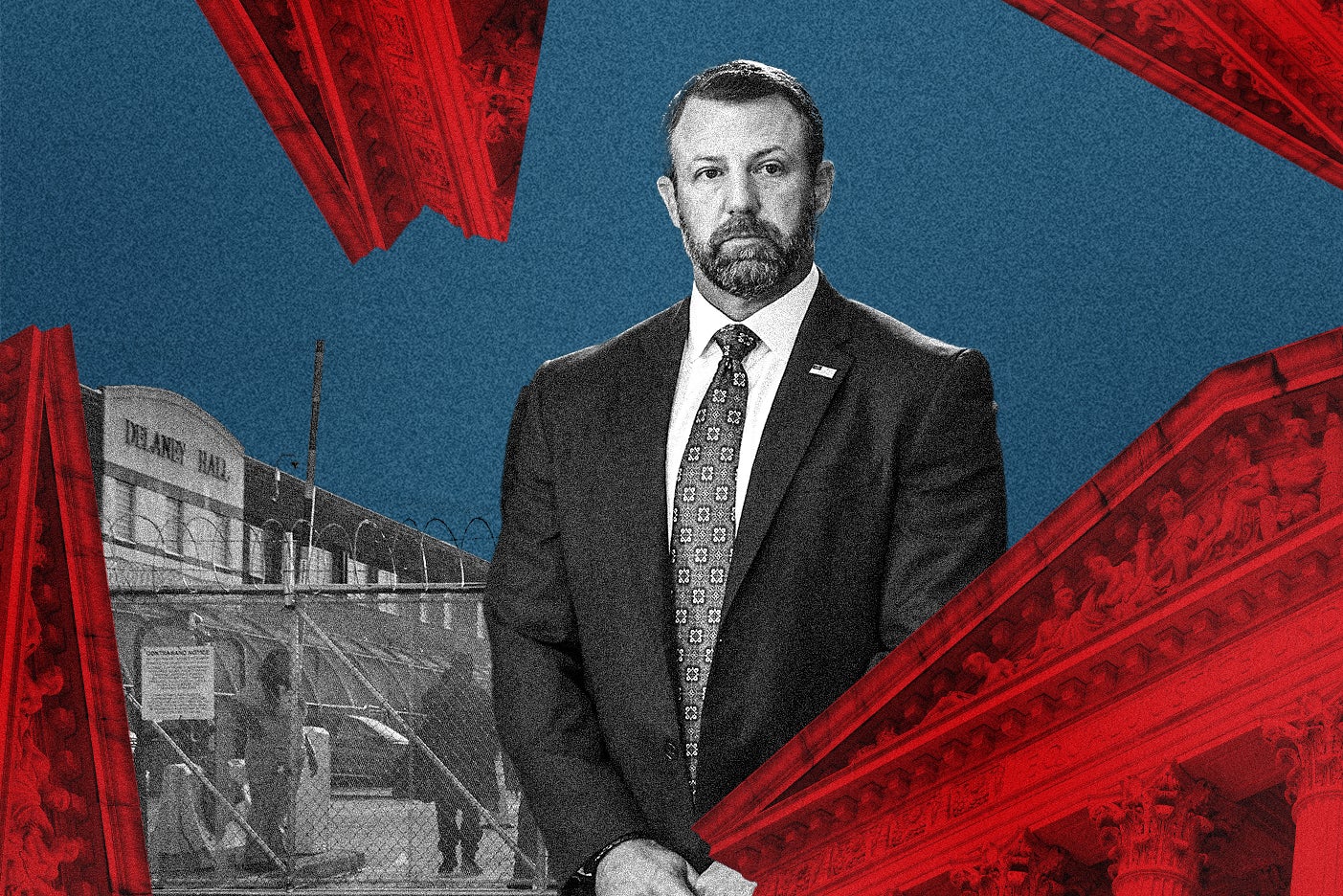
Jurisprudence By Enter your email to receive alerts for this author. Sign in or create an account to better manage your email preferences. Unsubscribe from email alerts Are you sure you want to unsubscribe from email alerts for Shirin Ali? Sept 24, 20265:40 AM Photo illustration by Slate. Photos by Michael M. Santiago/Getty Images and Jim Lo Scalzo/Pool/Getty Images. This is Executive Dysfunction, a newsletter that highlights one under-the-radar story about how Trump is changing the law—or how the law is pushing back—and keeps you posted on the latest from Slate’s Jurisprudence team. Click here to receive it in your inbox each week. President Donald Trump and his deputy chief of staff Stephen Miller have transformed America’s immigration system into an astonishingly cruel deportation machine. This week we learned they have once again taken things up a notch. For the past 10 days, the Department of Homeland Security has stopped offering tracking services for anyone arrested and detained with an outstanding removal order, priming detainees to be quickly removed to third countries without ever having spoken to an attorney or even their families. More than 16,000 people are estimated to have been impacted by this new practice, according to a new report by the Associated Press, and immigration attorneys are sounding the alarm. The Department of Homeland Security has been running an online detainee locator since 2010 where anyone can look up a person being held in immigration detention. This is an especially important tool for immigration attorneys, who use this, often exclusively, to track where their clients are being held in order to call them and meet with them for legal counsel—a constitutional right any person being held by the U.S. government has, regardless of immigration status. On Sept. 15, without any real notice, DHS suddenly began to exclude people who have been arrested and detained by Immigration and Customs Enforcement and who have a removal order against them from their database, making it virtually impossible to find out where they are being held. As of early July, ICE detention facilities held more than 65,000 people, and around 30 percent of them likely had final removal orders, according to the AP. Some people who face removal orders have legal protections against their deportation because they face credible threats of torture or persecution in their countries of origin, but the Trump administration has found a loophole with third-country removals. Now, they’ve found yet another workaround: simply not including these folks on DHS’ detainee locator, which is delaying, if not outright preventing, attorneys being able to contact their clients and initiate legal proceedings to protect them from deportation. Meanwhile, since the start of Trump’s second term, the number of deportation flights has been drastically rising, with Human Rights First estimating departures increased by 59 percent in July 2026 alone, compared to the same time last year. Stephanie Alvarez-Jones is an attorney with the National Immigration Project and has been representing people detained by the Trump administration. I spoke with her to see if any of her clients had gone missing from DHS’ detainee locator, what it might have taken to find them, and what this latest move signals about the Trump administration’s motives when it comes to immigration. This interview has been edited and condensed for clarity. Shirin Ali: What goes through your head when you realize a client you’ve been representing is no longer listed on DHS’ detainee locator? Stephanie Alvarez-Jones: A number of my clients and other folks at the National Immigration Project have had this happen to them. The initial reaction is panic, especially as we’re seeing this trend of rapid transfers and third-country removals. When I could no longer find someone, that was where my mind immediately jumped to. I started to plug in my client’s information and was getting a message that this person is no longer in the system and I immediately jumped to: Oh my gosh, how could all of these people have been transferred or removed so quickly, we were just in touch. Are they about to be deported?How do I go about finding all of these folks? We now know that if someone with a removal order is in the process of either being transferred to a detention facility or if they have already been deported, they no longer appear on the ICE locator. You get a message that says the system has changed. Upon realizing your clients were no longer listed in DHS’ system, what steps did you take to try to find them? And how long did it take? It took different amounts of time for different individuals. For some of them, where there were already pending habeas proceedings, for example, I would reach out to opposing counsel to see if they had any knowledge as to where my client was. In other cases, it was waiting to be able to hear from the client directly; they would eventually call me because we’re in fairly regular contact or I would hear from their family members or friends. For some of them, it was just troubleshooting; did I enter the wrong number? Did I do something to mess up? It’s like running things through a couple of times, trying to look them up on different websites and trying to schedule legal appointments with them. It’s sometimes a combination of trying all of these different roundabout mechanisms to try to confirm that these folks were, in fact, still in detention and where I left them, more or less. The longest amount of time it took me to find my clients was about a day or two. However, the caveat there is those individuals were already detained, so I had a starting point. I knew where they were the last time I spoke to them, they were at X detention center. Or we had already filed a habeas case. It’s a very different story if it’s someone that just got detained, because historically, people would be detained and it might take a couple of hours before they started showing up in the ICE detainee locator. From that point on, you would know they’re in custody and someone would be able to track where they’re going, like if ICE transfers them. Now, if one of my clients ends up getting picked up today, for example, and they have a final removal order against them, I’m totally clueless and in the dark because I had no starting point, because ICE is no longer listing these folks at all in their detainee locator. It is very different from here on out for anyone else that gets detained with an active removal order against them because you’re starting from zero. I think unquestionably this is making it much more challenging for both the lawyers representing individuals in detention and for their families, who also look to the ICE locator to figure out where their family member or loved one is so they can either visit them or send money to them. These are essential, life-sustaining resources for an individual in detention, and not being able to find someone just makes that all that much harder. In some cases, I think there might be alternate ways to find someone; you might be able to ask a government attorney or schedule a legal call with someone and be able to know that they’re there. But they’re certainly not a foolproof play, and what this ultimately ends up doing is it puts the burden on the detained person to be able to call out and say, “Hey, I’m in such-and-such place, I think?” Folks get transferred across the country and repeatedly throughout their time in detention, and they should not have to bear the burden of being able to communicate to the outside world that they’re being detained by the government. Is DHS legally obligated to disclose where they are detaining someone? They are required to not impede access to counsel. The way that the immigration detention system works is that you need to know where your client is detained in order to be able to schedule a legal call with them, at a bare minimum. There are other aspects that flow from where someone is, but at its core, you need to know where a client is detained in order to speak to them, and that is what previously the ICE detainee locator allowed you to do. This is very case-specific because in some cases there might be grounds to be able to say, “Hey, I’m trying to communicate with my client and you’re impeding that, tell me where my client is so I can schedule a legal call with them.” In other cases, there might be a court order that prevents a person from being transferred from a particular detention center or district, and that would be a different ground to say, “Hey, my client isn’t showing up anymore, but you know they’re not supposed to be moved without prior court approval. What’s going on?” That’s another mechanism, but again, it’s very case-specific. I think there’re so many things about the way that DHS is operating right now that are meant to isolate and restrict access to counsel, and this is certainly an access-to-counsel issue, but I can’t comment on legal strategy or what might happen there. What are the risks that people face when they cannot speak to their lawyer? There are so many things that communication between an attorney and a client are necessary for. Just because an individual might have a final order of removal against them, that does not mean there’s no further legal process that they can engage in. For example, just in their immigration proceedings, a client might need to speak with their attorney about filing an appeal or a motion to reopen an immigration proceeding, and that is very much based on where the client is. Talking to the client is necessary to get all the information needed for that paperwork; you can’t do something without talking to your client. There’s also the habeas side of things, and there’s been a lot of reporting about how habeas litigation has totally exploded, especially in this past year, and that’s based on where an individual is detained. If ICE is disappearing folks, then attorneys are left to guess and figure out where their client might be detained in order to file a habeas petition that, in many cases for individuals with final removal orders, are really urgent, time-sensitive, emergency petitions. Trying to prevent someone from being unlawfully deported either to their home country or, what we’ve been seeing a lot recently, to a third country that they have absolutely no connection to and where they haven’t been given the opportunity to express any level of fear toward. Reporting this week has made it a lot clearer what these third-country removals actually look like, especially the ones to Africa. It’s a disturbing, horrifying image. The U.S. government has been disappearing people to third countries since almost the start of this administration. Once they’re sent off, they’re often cut off from their communities and from their lawyers. But now the disappearance starts much earlier, from the moment someone is detained here in the United States, and that significantly compounds the harm. Why do you think DHS and ICE are suddenly deciding that they’re going to remove detainees from their locator? I can’t speculate as to their motivations, but everything that ICE has done throughout this administration is meant to make detention harder and to isolate individuals in detention. This is another tool to make it harder for individuals to be in touch with their family and their legal team. It makes it harder for their attorneys to then file any type of relief and protection for that individual. It is absolutely meant to stymie the defense of these individuals in immigration attention. This latest change to ICE’s detainee locator is another prong of this administration’s immigration agenda to close in on our immigrant communities. They all work together, the stripping away of status, the expansion of detention center networks across the country, the removal of funding from immigration organizations—all of these are happening very much not in a vacuum. They are all going toward making it harder to get or maintain status in the United States, and if you are detained, making it harder to survive in detention. The administration has made detention conditions so awful that the cruelty is the point. And then making it harder to even fight when you are fighting to stay in the United States, or to at least avoid deportation to a country where you might face further incarceration. These are all interrelated steps that play into this agenda of cruelty and to push out, regardless of the harm, process, and legality, as many people as possible. We hope you learned a thing or two from this edition of Executive Dysfunction, and if you enjoyed reading it, please consider supporting our legal journalism by becoming a Slate Plus member! Elsewhere in Jurisprudence In this week’s episode of Amicus, Dahlia Lithwick digs into the contentious legal drama happening over President Trump’s mail-voting executive order. She’s joined in conversation by Richard Hasen of UCLA School of Law, and they discuss the latest legal challenge and how it seems to be impacting American voters’ sense of election security with a consequential midterm election just weeks away. The Amicus bonus episode dives into the uncertain future of the shuttered Kennedy Center, with Dahlia Lithwick joined by Madiba K. Dennie of Balls and Strikes to talk about how the president was photographed with a poster reading “Kennedy Center DEMOLISHED.” The storied institution not only represents Trump’s latest obsession with destroying buildings, but America’s troubled history of white supremacy.The Trump administration is attempting to take a swing at the U.S. census, which is slated to take place in 2030. Friends of Slate Richard L. Revesz and Sarah Wheaton explain in Slate how a proposed regulation attempts to stop collecting race and ethnicity data, which could have wide-ranging implications for public health. A Texas surrogacy case that has garnered national attention raises a critical question: What does it mean to be a parent? Friend of Slate Evelyn Tenenbaum, a law professor at Albany Law School, explains how this case grapples with two opposing principles: a woman’s right to control her own body during pregnancy and the rights of people who are legally and biologically the child’s parents once they are born.The Trump administration has been trying to drastically change the U.S. visa system by going after students, scholars, and journalists, but a federal judge has postponed its efforts. Friend of Slate Jay Willis, editor in chief of Balls and Strikes, explains how the changes the administration wants would create a “needless, self-inflicted economic catastrophe” that is barely disguised racism. Thank you for reading Executive Dysfunction! We’re thrilled to be in your feeds and will be back with more dysfunction analysis next week. Donald Trump Immigration Jurisprudence ICE Stephen Miller Executive Dysfunction
Trump Found a New Horrifying Way to Disappear ICE Detainees
Full Article
Original Source
Read the full article at Slate →KhanList aggregates and links to publicly available news content. We do not host full articles from third-party sources. Always verify important information with original sources.