
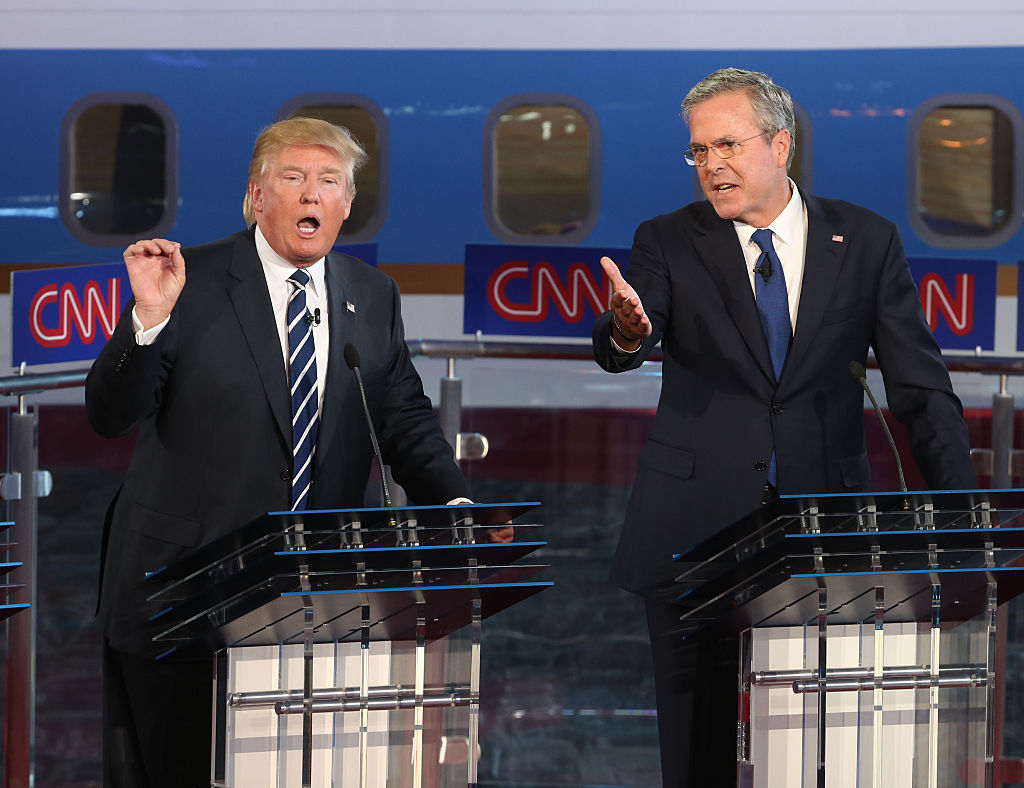
Politics The current Republican president got elected repudiating the last one. Now, he’s melding Bush-Cheney with his own legacy. There are a number of things one could observe about the Trump-endorsed Sen. Darline Graham (R-SC) winning her primary last week as she seeks to keep her late brother Lindsey Graham’s seat: her status as a novice, President Donald Trump’s staying power, hereditary succession. Here’s another. I was born in Charleston, South Carolina in 1974. For half my life, my state has been considered “Bush Country.” “South Carolina is Bush Country,” declared Texas Governor George W. Bush himself in 2000 during a hotly contested Republican presidential primary contest against Senator John McCain. (His father, the late former President George H.W. Bush, said the same during his 1988 presidential campaign). In 2004, Dubya’s challenger, the Democratic presidential nominee Sen. John Kerry, would have no luck in Bush Country. In 2008, eventual Republican presidential nominee McCain knew his old rival’s stronghold state was key to any victory and courted South Carolina Bush loyalists. The McCain supporter Lindsey Graham said, “Nobody’s going to get to the right of John on the war or spending.” “The war” Graham spoke of was of course the 2003 U.S. invasion of Iraq, partisan support for which would almost wholly consume Republican identity in the years that followed. Though in 2000 Bush ran on “compassionate conservatism” and a more “humble” foreign policy, the 9/11 attacks and wars in Afghanistan and Iraq had changed all that. To Graham’s comment, what being on “the right” meant for most conservatives was defending the Iraq war and the Global War on Terror narrative (WMDs, the Patriot Act , waterboarding, Gitmo, and then some). The cofounder of this magazine, Pat Buchanan, in 2004 wrote a book about where the right went wrong and how neoconservatives hijacked the Bush presidency. Conservatives were expected to reflexively defend Bush-Cheney, no matter how bad the administration failed or unpopular it became. In Bush Country, it was no different. Even as late as 2016. Or so many thought. “Obviously the war in Iraq was a big, fat mistake, all right?” Trump thundered on a Republican debate stage in Greenville, South Carolina in February 2016. “George Bush made a mistake, we can make mistakes. But that one was a beauty.” It was jarring. No Republican presidential candidate since Buchanan or Ron Paul had so vehemently denounced his party’s foreign policy. And Trump was saying these words to Jeb Bush, former governor of Florida and Dubya’s brother. “They lied,” Trump added, with force. “They said there were weapons of mass destruction—there were none. And they knew there were none.” The boos (there are typically more donors and operatives at debates than regular voters) were loud. Many prognosticators in the GOP and media thought Trump had really stepped in it, potentially diminishing his strong lead in the polls. “I am sick and tired of him going after my family,” Jeb Bush lamented. Two days after that debate, Jeb Bush brought in family reinforcements. The Guardian reported, “George W. Bush remains one of the most popular Republicans in the staunch conservative state of South Carolina…. The two Bush brothers appeared accompanied by Laura Bush and South Carolina senator Lindsey Graham.” “They took their seats as Graham hailed George W. Bush as a ‘decent and honorable man’ and proclaimed: ‘This is Bush country, Mr. President,’” the report noted. But was it? Graham’s grand declaration aside, Jeb himself didn’t seem so sure. “South Carolina isn’t Bush Country anymore. He’s hijacked my party,” Jeb said of Trump in a CBS interview. “Someone has to take a stand,” Bush insisted, implying he was the man for the job. Three days later, Trump won the South Carolina primary, one of the most important on the calendar, with 33 percent of the vote. By confronting and demolishing the Bush-Cheney legacy in a state where Republicans had defended it for over a decade. Second place went to Florida’s Sen. Marco Rubio, the neoconservative favorite in that race (the neocons didn’t necessarily need the tainted Bush name to get the same Bush foreign policy), at 22 percent. The political chameleon Sen. Ted Cruz of Texas also received 22 percent. Jeb got 8 percent. He dropped out the next day. It turned out, South Carolina really wasn’t Bush Country anymore and Trump really had hijacked the GOP. He became president in 2017 and would again use antiwar rhetoric throughout his 2020 and 2024 campaigns. Eventually something changed. Today, President Trump has plunged America into a war in Iran that has no end in sight, has repudiated much of the original “America First” extended team of Marjorie Taylor Greene, Tucker Carlson, and others who were once his most vocal champions, and has traded their influence for that of neoconservative fossils like Mark Levin and the now-deceased Lindsey Graham, who seemed to know what he was doing all along. Lindsey’s play bore fruit. When it was reported last week that his former Director of National Intelligence Tulsi Gabbard had warned Trump about many of the negative consequences of a war with Iran, the unrepentant neoconservative Marc Thiessen had this praise for the president and his decision to go to war: “This was the most courageous decision an American president made in my lifetime, and it is all the more courageous for the fact he made it while so many around him were discouraging him.” “He did it anyway,” Thiessen added. “That’s true greatness in action.” That’s something. What Thiessen, a former George W. Bush speechwriter, was really doing was thanking Trump for ditching the Bush-bashing and instead coming around to his former boss’s way of thinking. Not surprisingly, Jeb Bush has praised Trump for attacking Iran too. “A noble cause,” ol’ Jeb said. But it was Graham who arguably helped flip Trump the most. As the Dispatch’s Michael Warren wrote of the senator’s “tenacious pursuit of influence:” [BLOCK]As a hawk in a party that, under Trump’s influence, was already skewing dovish by 2017, Graham was a counterweight to another erstwhile intraparty Trump opponent, Sen. Rand Paul, on matters of national security and foreign policy. If Paul and other noninterventionists saw in Trump a compatriot against dumb foreign wars, Graham saw a willing convert to his interventionist cause—Trump didn’t want to look weak like Obama or Joe Biden, did he? Graham learned how to sell Trump on tough talk and even action in the Middle East, and then publicly praised him for it. All of this culminated in Graham’s cheerleading of Trump with respect to Iran… Graham was not the only one to encourage Trump to invade Iran weeks later…but the war is, in many ways, a reflection of his muddled legacy.[/BLOCK] The Iran war will be part of Graham’s legacy, and Trump’s, and also effectively a continuation of George W. Bush’s. Darline Graham will also now be part of this same legacy—or at least that’s what her supporters appear to hope. Appointed senator not even two months ago, Graham is still relatively a blank slate. She is not her brother, and time will tell how differently or not she’ll vote. Republican senators almost always beat Democrats in my state, so after November we will probably have six more years to find out. But the War Party that carried Lindsey across the finish line clearly wanted a stand-in for her brother, or as much of one as they could get. In a recent debate, Darline admitted not being “informed” on national security—yet she will still be expected to vote on it. Subscribe Today Get daily emails in your inbox She will likely be “informed” by then. Lindsey Graham never left Bush Country. Donald Trump blew it up. It was the only country I was ever glad to see him blow up. Then he went and put it back together again.
Trump Does Nation-Building in ‘Bush Country’
Full Article
Original Source
Read the full article at Theamericanconservative →KhanList aggregates and links to publicly available news content. We do not host full articles from third-party sources. Always verify important information with original sources.