
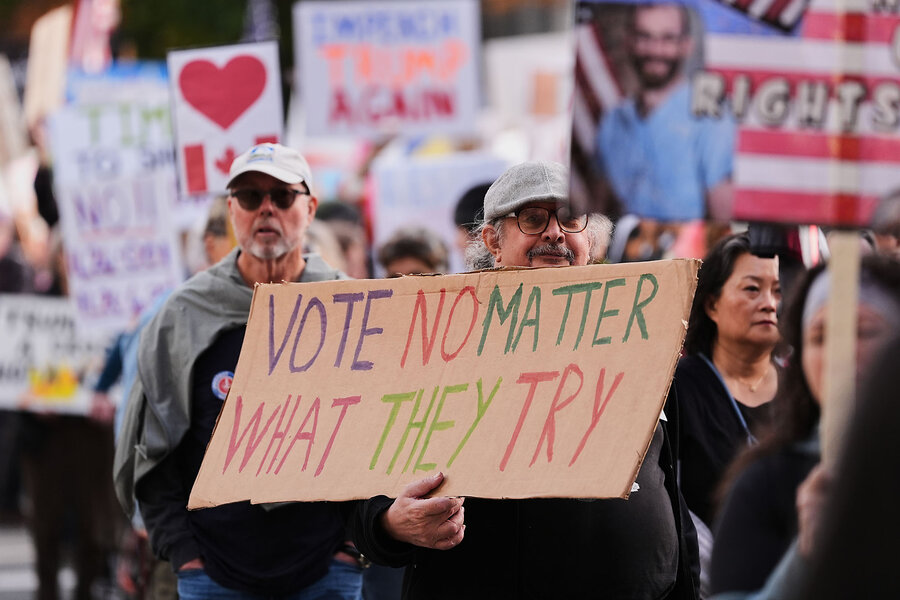
Washington | Oct. 22, 2026, 12:11 p.m. ET | 5 min read The November 2020 U.S. presidential election was “highly competitive and well managed” despite a pandemic, aggressive rhetoric by candidates, and unsubstantiated claims of voter fraud, according to international observers.America’s democratic institutions again showed “resilience” in the 2024 election, even amid disinformation and repeated claims of fraud, according to observers from that same institution, the Organization for Security and Co-operation in Europe.There will be no OSCE report for the November 2026 midterm elections, however, because the Trump administration told observers they are not welcome. It’s the first time since 2002 that the group won’t monitor a U.S. election. While this rescindment won’t necessarily affect how the election is run, experts say it does send troubling signals to peer governments abroad and to voters at home about how democracies could and should function. The message is, “‘Maybe now we don’t need to invite observers. We can do what we want.’ And I think that that’s a step backwards,” says Jonathan Stonestreet, associate director of the Carter Center’s Democracy Program in Atlanta and a former senior election adviser with the OSCE.Impartial, international election observers provide a voice of calm and clarity in elections on the verge of turning contentious, Mr. Stonestreet says.“When you go into a country, and the opposition is saying that the election is going to be fraudulent, and the government is pushing back and saying that the opposition is cheating, that’s not a good sign,” he says. “It helps very much to have credible observers saying, ‘Here’s what we saw. This is what we believe happened, and this is how we would assess the election.’” November’s midterms are consequential, as Democrats are forecast to take control of the House and possibly the Senate for the two remaining years of President Donald Trump’s term. They are also contentious. Jae C. Hong/APHomeland Security Investigations officers escort a person accused of illegally registering to vote to a processing location in Los Angeles, Oct. 19, 2026. Republicans followed Mr. Trump’s order to redraw congressional districts in several states to favor their party, and Democrats responded by redistricting in other states. Though states run elections and maintain voter rolls, the Justice Department demanded sensitive personal data from all 50 states to try to find noncitizen voters, and sued states that refused. Some Republican-led states have cut polling stations, leading Democrats to accuse them of trying to limit voting in areas more likely to vote for Democrats.This week, the Democratic Party sued President Trump and the DOJ for the administration’s “demands and threats” toward states to force them to segregate tens of thousands of mail-in ballots until voters’ citizenship status can be verified. This follows a Justice Department lawsuit last week against California for “refusing” to purge suspected noncitizens from voter rolls.U.S. elections deemed of “high quality”The U.S. helped create the OSCE to promote stability, peace, and democracy following the end of the Cold War. It includes Canada, the European Union, Turkey, and all nations of the former Soviet Union. Until now, Russia and Belarus had been the only states to reject OSCE election observers.OSCE election observers are highly trained in monitoring the polling process. In select polling stations, in urban and rural areas across several states, they watch officials check voter IDs and also look for signs of intimidation or ballot stuffing; they witness vote counting and verify the custody chain for ballot boxes. Observer missions begin their work well before Election Day to get an understanding of the political climate and local laws.The OSCE said the U.S. decision was “regrettable,” but the Trump administration was unapologetic. The media fact-checker Snopes reported that a White House official told them: “American elections will be administered, participated in, and observed by American citizens.”Election experts agree that America’s election system, run by local and state officials, is solid. Mr. Stonestreet, who has studied elections for three decades – in newly formed democracies and well-established ones – says that elections in the U.S. are of “very high quality.” “This is really about people who are our neighbors and friends and parents of the kids that our kids go to school with,” he says. “They’re the ones who are running these elections. It’s not some secret force or something. It’s just Americans.” Rebecca Noble/APThe Rev. Medina Moore, right, a voting rights organizer for the Arizona Faith Network, hands a T-shirt to Cindy Weiser during a training session for poll chaplains and peacekeepers, in Scottsdale, Arizona, Oct. 6, 2026. Mr. Trump blamed his 2020 loss to Joe Biden on fraud and voting irregularities. But an Associated Press investigation of the 25 million votes cast across six battleground states found fewer than 475 potential cases of voter fraud, and the head of the federal agency that monitored elections said it was the “most secure” election in U.S. history.Trump spurns international orderCharles Stewart, an MIT political science professor and founder of the school’s Election Data and Science Lab, says that Mr. Trump’s rejection of OSCE election observers has to be seen in a larger context of the president’s aversion to institutions of the postwar international order, such as NATO and the International Criminal Court.“The world knows that the Trump administration is withdrawing from the international order,” Dr. Stewart says.The professor doesn’t expect the current administration’s behavior to influence other nations, particularly those with authoritarian leadership. His greater concern is that the Trump administration’s rhetoric might influence local polling officials. He says some have talked in public chat channels about concerns of foreign interference from international observers.“There is kind of this undertone of distrust among election officials about why are these people really here?” Dr. Stewart says. “I think that undertone becomes even greater when the good goals of election observation are not being supported by the government.”What the 2000 and 2020 elections showed is that no election system is perfect, says Judith Kelley, a Duke University political science professor. In 2000, the U.S. Supreme Court stopped a recount in Florida, essentially awarding the state’s electoral votes and with them the presidency to George W. Bush. Even major Western democracies can benefit from the scrutiny of trained and experienced impartial outsiders, Dr. Kelley says, adding that is what makes the Trump administration’s rebuff of the OSCE so odd. “If Trump wins, he can say, ‘Look, we are perfectly capable of running our elections.’ If he doesn’t win, he’ll say ‘This is fraud,’ and it will look strange not having international election observers to validate how the elections were run.” Deepen your worldviewwith Monitor Highlights.Politics with respectGet political stories with respectful analysis.There‘s a world of new ideas in everyBooks newsletter.There‘s more to life, enrich yours withCulture & Learning weekly.Follow humanity‘s discoveries withScience & Nature stories in your inbox.Gain a spiritual perspectivefrom the stories in your inbox.Want to understand the deeper impact of critical events? Learn the Monitor‘s insight.Already a subscriber? Log in to hide ads. For Dr. Kelley, the greater damage of potentially flawed elections here is “not what the other countries think about the U.S. The problem is that the norms are being undermined.”Once that happens, she says, a new approach to elections will be normalized, in the U.S. and in other countries. “That will be taken advantage of by the leaders [of other countries] who are also trying to undermine their elections.” ALREADY A SUBSCRIBER? LoginReal news can be honest, hopeful, credible, constructive.The Christian Science Monitor was founded in 1908 to lift the standard of journalism and uplift humanity. We aim to “speak the truth in love.” Our goal is not to tell you what to think, but to give you the essential knowledge and understanding to come to your own intelligent conclusions. Join us in this mission by subscribing.
Trump disinvited international election observers. Here’s what that could mean.
Full Article
Original Source
Read the full article at Csmonitor →KhanList aggregates and links to publicly available news content. We do not host full articles from third-party sources. Always verify important information with original sources.