
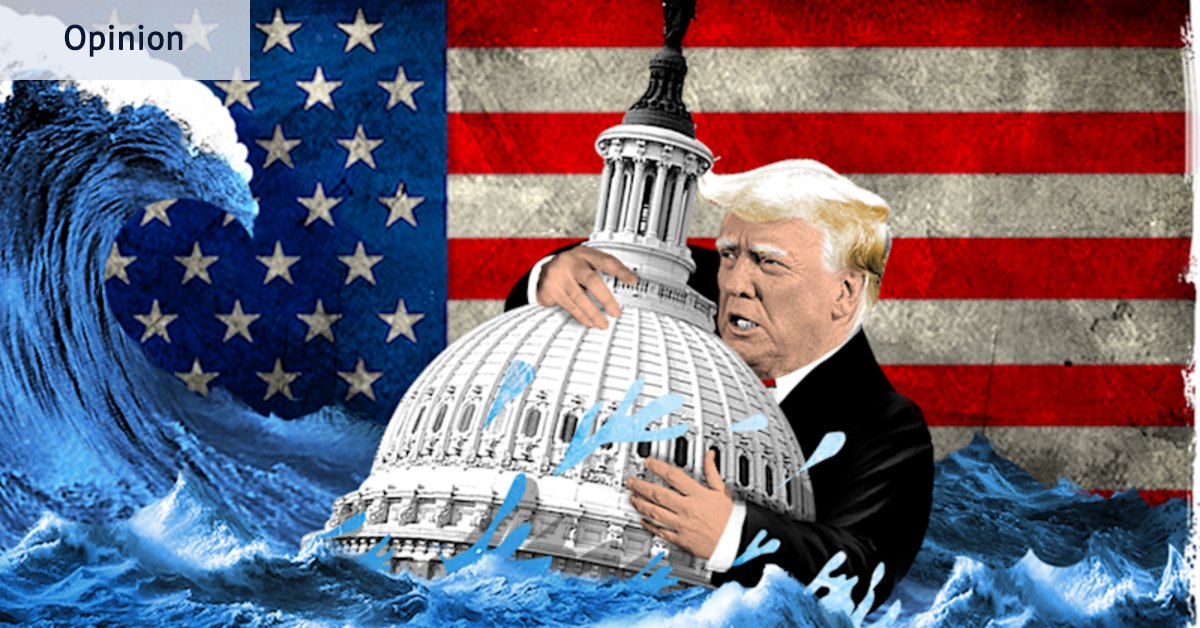
OpinionColumnist, author and academicNovember 6, 2026 — 5:00amNovember 6, 2026 — 5:00amWave. Deluge. Tsunami. At some point, we might have to abandon the nautical metaphors because they can’t quite capture the scale of what’s happening. It’s true the Trump administration got swamped this week, Donald Trump himself just about drowning in the Democratic swell.There are, frankly, too many examples from which to choose. James Talarico’s outrageous senate win in Texas, snapping a 32-year losing streak by around 12 points. Gina Hinojosa’s even more seismic victory in the same state to become its first Hispanic governor. Swings just either side of 20 per cent in multiple House races in Kentucky. Georgia electing its first black female governor. Democrats winning a Senate seat in Kansas for the first time in 94 years. Droughts extinguished by the flood. Photo: Illustration: Dionne GainBut the trouble with the metaphors is they assume something steady lies beneath. They are measured against some idea of normality. A wave, for example, is measured in relation to an otherwise consistent water level. But there is nothing stable underneath all this. There hasn’t been for at least a decade since Trump upended American politics. Biden’s 2020 win was more convincing than Trump’s. Then in 2024, Trump’s was more convincing again, delivering a greater share of the electoral college and both chambers of Congress. His position mirrored Barack Obama’s dominance in 2008. And it has unravelled in two years.I think there are two implications here. One is that Trump’s victories, while sensational, have always been volatile, crystalising a broad mood of disillusionment and betrayal, but never quite establishing a broad, coherent movement beyond the MAGA devotees that are only one cohort of his vote. The second is that there is little final or decisive about election results in this era. They do not settle questions. They just keep raising them.Both these were easy to overlook in the dizzy aftermath of Trump’s second victory. His 2024 coalition incorporated racial minorities (especially Asians and Latinos), young voters and women in numbers that were meant to be impossible. But it was not a new, permanent political alignment around Trump. Shorn of Trump’s idiosyncrasies, it was a very conventional election result: a deeply unpopular administration, presiding over a cost of living crisis, lost decisively. Trump’s win proved that 2016 was no aberration. And that 2020 was no final repudiation of him. But it didn’t prove that he had built something invulnerable.Indeed, this week’s devastating results are a direct result of vulnerabilities that were always in this administration. This is not an administration that lost its way. It’s an administration whose own contradictions simply played out.Take big tech. It was never clear how Trump would reconcile his populist, anti-elite message with his conspicuous fealty to the tech billionaires those same masses overwhelmingly distrust. And that arrangement became completely untenable as the spectre of AI came to haunt the consciousnesses of so many. No issue unites the anger of a divided America as much as the growth of data centres across the country. No issue has Trump more at odds with his own voters than the regulation of AI. And perhaps nowhere has Trump been so intransigent as on these issues: variously ignoring, berating and insulting people with AI concerns.The story is deceptively similar on the Iran war. At first blush, it seems a radical departure for Trump: an incomprehensible own-goal from a president who made so much of his refusal to start wars, and his singular ability to end them. But on closer inspection, Iran was always the exception to this rule.As far back as 1980, during the hostage crisis, Trump advocated sending American troops there. In 1988, he said if Iran fired a single bullet at “one of our men or ships” it would be enough for him to invade and take Kharg Island. His reasoning four decades ago was strikingly familiar: “They’ve been beating us psychologically, making us look a bunch of fools”.The problem isn’t that Trump broke promises. Much like on tech, it’s that Trump built his worldview on an untenable fault-line: an anti-war position in general combined with a long-term pro-war position on Iran.President Donald Trump talks to reporters during a tour of White House Ballroom construction at the White House on Wednesday following the Republicans’ midterm defeat.APIf Trump has broken promises, they are more about results than policy. Inflation is a little higher, but significantly elevated for essentials such as groceries and fuel. Some of this is the creature of his own policy, the result of his trade and military wars. Some of it reflects a global problem bedevilling most advanced economies, including our own. None of it suits Trump, presiding over an angry electorate, trained to direct their anger without delay at those in power.Not so much broken promises, then, as false ones. Trump spoke some truth when he gave voice to the idea that globalisation’s riches had come at the expense of the immiseration of the American working class, especially those without tertiary education.He diagnosed correctly how a broadly liberal culture found nothing much to celebrate in those very same people, leaving them both economically and socially alienated. But Trump then offered the mirage that such things could simply be restored by force. That American power, if wielded by a real man, could bend the world, the economy, and a fracturing culture to his – and by extension, the people’s – will. He revealed instead that shows of strength often conceal a reality of weakness.Waves pass. Tsunamis are a singular event, in whose wake comes rebuilding. I don’t think we’re seeing such things. I suspect we’re looking at something more chronically treacherous than that – a stretch so rough, and a sea so angry it makes little sense to point to this wave or that.Now the Democrats celebrate. But they claim a victory not unlike Trump’s: built mostly on disgust with the powers that be, rather than assent to the powers to come. The successful Democrats this week span everything from avowed socialists to pro-life Christian ministers. There is no straight line that connects them, other than that they are not Republicans. Certainly nothing that tells us what kind of person the next president might be. All this heralds a new era in one sense: Trump’s spell over American politics has probably now been broken. But in another sense, the era of upheaval continues because the air is still thick with the spirits he summoned.Waleed Aly is a broadcaster, author, academic and regular columnist.The Opinion newsletter is a weekly wrap of views that will challenge, champion and inform your own. Sign up here.From our partners
Trump crashed on his own shores of discontent, but the blue wave doesn’t deliver certainty
Full Article
Original Source
Read the full article at Smh →KhanList aggregates and links to publicly available news content. We do not host full articles from third-party sources. Always verify important information with original sources.