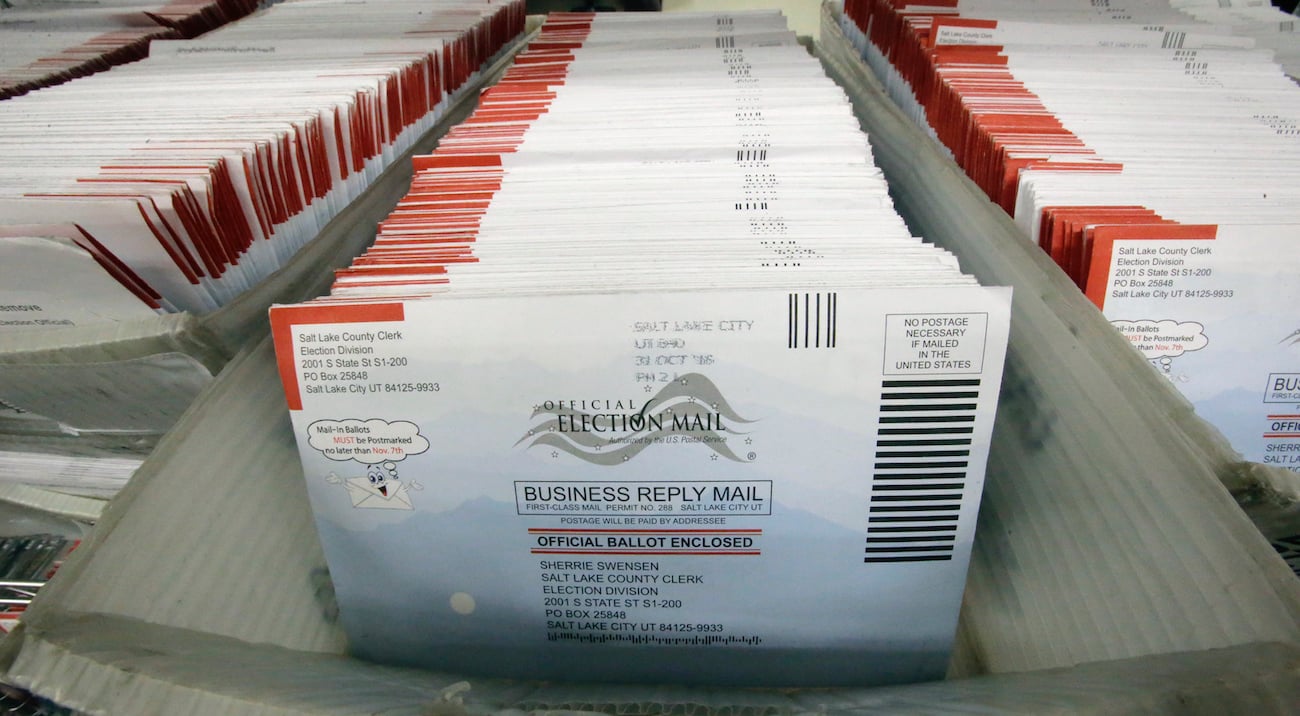
A Trump executive order directed USPS to enforce strict rules for mail-in ballots, but challengers say elections are a process controlled by individual states.(CN) — President Donald Trump hit a setback this week in his attempt to leverage the U.S. Postal Service to limit mail-in voting in the November midterm election.A federal judge in Boston blocked an executive order directing USPS to supply mail-in ballots only to states that turned over their voter registries to the federal government.On March 31, Trump ordered the postmaster general to propose measures to “protect the integrity of the mail” in federal elections, including requirements that state and local officials use only envelopes designed with specific barcodes and markings.In the order — dubbed “Ensuring Citizenship Verification and Integrity in Federal Elections” — Trump ordered USPS not to transmit a voters’ mail-in or absentee ballots from unless their name is on a “state citizenship list.”Voting rights groups, led by League of Women Voters of Massachusetts, merged efforts with a challenge by 23 individual states and the District of Columbia — which in June won a block on key aspects of the executive order. U.S. District Judge Indira Talwani wrote then, “The Constitution does not grant the president any specific powers over elections.”Talwani’s order is now before the Supreme Court. In the meantime, the Barack Obama appointee built on her finding in a Tuesday ruling in favor of the voting rights groups, declaring once again that Trump’s executive order is unconstitutional.“The court need only determine whether the EO is facially unconstitutional based on the substance of the text’s directives. The court has already answered and will again resolve the question clearly and affirmatively. The executive branch has no authority to regulate elections.” Talwani wrote in the 27-page order.Trump has long attacked mail-in voting and blamed the process for his loss in the 2020 presidential election — though Trump himself voted by mail in a Florida special election in March.Power to set election rules rests with individual states and with Congress, as the states suing Trump argue in the consolidated case. Their attorneys say Trump’s proposed changes are ripe for abuse and chaos.States have allowed voting by mail since the Civil War. Talwani walked back through the nation’s history of legislation to expand and secure voting access.“Congress has enacted several laws to support voting by mail and increase citizen participation in voting,” the judge wrote, including the 1986 Uniformed and Overseas Citizens Absentee Voting Act, signed by President Ronald Reagan; the 1993 National Voter Registration Act under President Bill Clinton; and the 2002 Help America Vote Act signed by President George W. Bush.Not only does Trump’s executive order restricting mail-in voting run counter to the Constitution, but his administration has “made little effort to defend the EO on its merit,” the judge said.She also noted that the Nov. 3 midterm election is less than 90 days away, which “underscores the critical need for an injunction to prevent defendants from changing election rules on the eve of the election.”Talwani blocked USPS from enforcing the relevant section of Trump’s March 31 order with respect to the upcoming or any earlier federal election, “including refusing to transmit mail-in or absentee ballots; or otherwise initiating or completing rulemaking to promulgate the specific regulations outlined” in the order.“This injunction does not bar the federal government from providing nonbinding USPS guidance on ballot mail envelopes,” the judge added.Attorneys for the League of Women Voters of Massachusetts hail from the American Civil Liberties Union, ACLU of Massachusetts, Brennan Center for Justice and Legal Defense Fund. The legal team applauded the ruling in a joint statement Tuesday.“This ruling reinforces the clear language of our Constitution: The president plays no role in our elections and he cannot turn the U.S. Postal Service into a tool for disenfranchising voters. Millions of citizens rely on mail voting, and USPS has no authority to determine which of them should receive ballots," the attorneys said.The White House did not immediately return a request for comment on the ruling.Subscribe to our free newslettersOur weekly newsletter Closing Arguments offers the latest about ongoing trials, major litigation and rulings in courthouses around the U.S. and the world, while the monthly Under the Lights dishes the legal dirt from Hollywood, sports, Big Tech and the arts.Additional Reads
Trump can’t require state ‘citizenship lists’ for mail-in voting
Full Article
Original Source
Read the full article at Courthousenews →KhanList aggregates and links to publicly available news content. We do not host full articles from third-party sources. Always verify important information with original sources.