
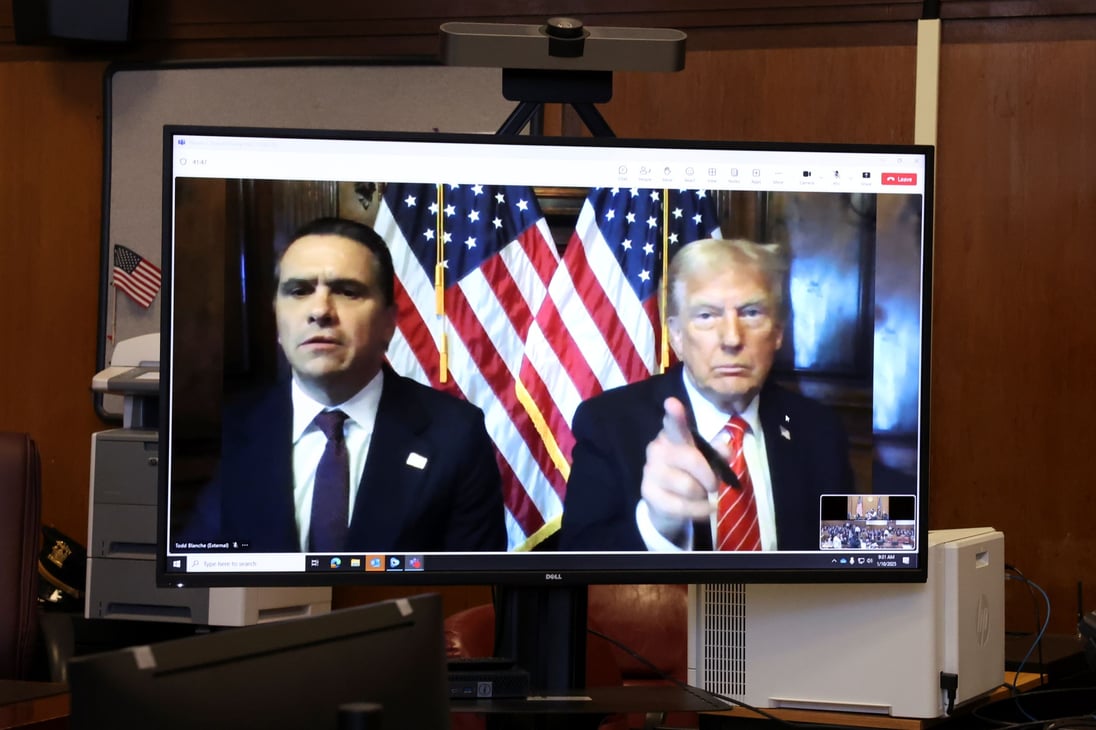
MANHATTAN (CN) — President Donald Trump asked the Second Circuit on Monday to reconsider his motion to transfer his New York state criminal convictions to a lower court, where he seeks to have the jury verdict overturned based on presidential immunity affirmed by the Supreme Court.Manhattan District Attorney Alvin Bragg brought the state prosecution — which led to Trump’s conviction in May 2024 on 34 counts of falsifying business records — and said the cover-up of hush money payments to multiple women was part of Trump’s broader scheme to influence the 2016 election.Trump’s defense teams have attempted to move the case from state court to federal court — even after his sentencing — on the basis that he should have been shielded from prosecution for official acts.U.S. District Judge Alvin Hellerstein, a Bill Clinton appointee in the Southern District of New York who died last month, rebuffed those efforts.On Monday, Trump’s defense attorney Robert Giuffra from Sullivan & Cromwell argued he was entitled to removal to federal court because it was timely filed within 60 days of the Supreme Court’s July 2024 ruling in Trump v. United States, which gave former presidents absolute immunity for duties within their core powers and some immunity for other official actions.“The appeal of this unprecedented criminal case brought by the state of New York against the president of the United States belongs in federal court,” Giuffra said. “This case involves important questions of presidential evidentiary immunity that arose out of the Supreme Court’s landmark decision in Trump v. United States.”Giuffra argued the case involves federal preemption because the Manhattan District Attorney’s office enhanced a time-barred misdemeanor and turned it into a felony by essentially charging Trump in the hush money case with violations of the Federal Election Campaign Act.“Congress directed that these sorts of federal questions against federal officers should be heard in federal court,” Giuffra said.U.S. Circuit Judge John Walker pressed Trump’s defense to cite any case in which a federal appellate court on removal had reviewed a state court decision.Giuffra pointed to the 2024 D.C. Circuit case Harris v. United States DOT, in which Abram Harris sued the Federal Motor Carrier Safety Administration in D.C. Superior Court, claiming fraud and abuse of process; it was dismissed sua sponte, and Harris appealed to the D.C. Court of Appeals. The Department of Transportation filed a notice of removal in federal district court and the Superior Court but did not notify the appeals court until more than a month later. In federal court, Harris amended his complaint, and DOT moved to dismiss, which the court granted.Walker acknowledged Harris dealt with the issue but asked how that applies to a federal circuit appeals panel taking on such a case.“I’m asking now about an appeal here and whether we would then just be asked to review the cases, as we would as if the trial court, state trial court, was a district court, and rule on the issues there,” the George H.W. Bush appointee said.Giuffra affirmed the procedure Walker described in Granny Goose Foods Inc. v. Brotherhood of Teamsters.“What happens is the case would come to the district court here. It would be then they would take this. They would adopt the state court judgment. They would prepare the appellate record. It would come to you in order to speed this process up,” he said.New York, meanwhile, argued Trump failed to establish good cause to file a second notice of removal because he did not diligently pursue removal when he first raised his evidentiary claim based on presidential immunity in state court.“Nothing prevented this defendant from seeking leave to remove at least two earlier points than when he actually did,” Manhattan District Attorney’s Office chief appellate attorney Steven Wu said.Walker opined to Wu that the Supreme Court’s immunity ruling and Trump’s removal motions are intertwined “because the Supreme Court said use of evidence about conduct, even on charges that purport to be based only on unofficial conduct, would heighten the prospect that the president’s official decision-making would be distorted if it implicated official act.”“I mean, this was obviously a local hush money case, but on the other hand, once you get into questions about evidence relating to what went on in the Oval Office or what the president may have done, then you have to look at the immunity point, notwithstanding the fact that it’s a local,” the judge said.Trump’s defense recently argued a separate appeal of the conviction before a state appeals court — New York’s Appellate Division, First Department — where a panel of five judges mulled over Trump’s defense team’s claims that presidential immunity and federal preemption should justify dismissal more than two years after the trial.In a letter to the Second Circuit, Trump’s lawyers said it would be “unfair” for the federal appeals panel to consider that the First Department has heard oral argument as a reason to deny removal.“The protection Congress afforded to federal officers (very much including the sitting president) who diligently insist on a federal forum cannot be defeated by strategic delays that the district attorney of New York encouraged, and that the president repeatedly tried to prevent,” Giuffra wrote to the Second Circuit.U.S. Circuit Judges Raymond Lohier, a Barack Obama appointee, and Jose Cabranes, a Clinton appointee, joined Walker on the panel, which did not immediately rule.A separate Second Circuit panel previously sent the case back to Hellerstein, finding in its November 2025 ruling that Hellerstein should address whether Trump’s conviction ran afoul of the Supreme Court’s 2024 ruling on broad presidential immunity.Hellerstein denied Trump’s motion in 2023 to transfer the case to federal court before it went to trial, contending the state indictment charges Trump with acts done within his official capacity as president, as he was in office when he was accused of falsifying business records about the payments to Daniels and Playboy Playmate model Karen McDougal, who also reportedly claimed to have an affair with the president.A jury found in 2024 that Trump orchestrated for his former personal attorney and “fixer” Michael Cohen to pay $130,000 to Daniels, who Trump was concerned would share details from their 2006 sexual encounter at an inopportune time during the election.When repaying Cohen, Trump disguised the payments as legal fees, sometimes signing those illicit checks from the Oval Office during his first presidential term, witnesses testified.Ten days before Trump’s second inauguration in January 2025, New York Supreme Court Justice Juan Merchan sentenced Trump to unconditional discharge, cementing his status as a convicted felon in New York City but sparing the then-president-elect from punishment, such as community service or a fine.Subscribe to our free newslettersOur weekly newsletter Closing Arguments offers the latest about ongoing trials, major litigation and rulings in courthouses around the U.S. and the world, while the monthly Under the Lights dishes the legal dirt from Hollywood, sports, Big Tech and the arts.Additional Reads
Trump back at Second Circuit to dump hush money verdict
Full Article
Original Source
Read the full article at Courthousenews →KhanList aggregates and links to publicly available news content. We do not host full articles from third-party sources. Always verify important information with original sources.