
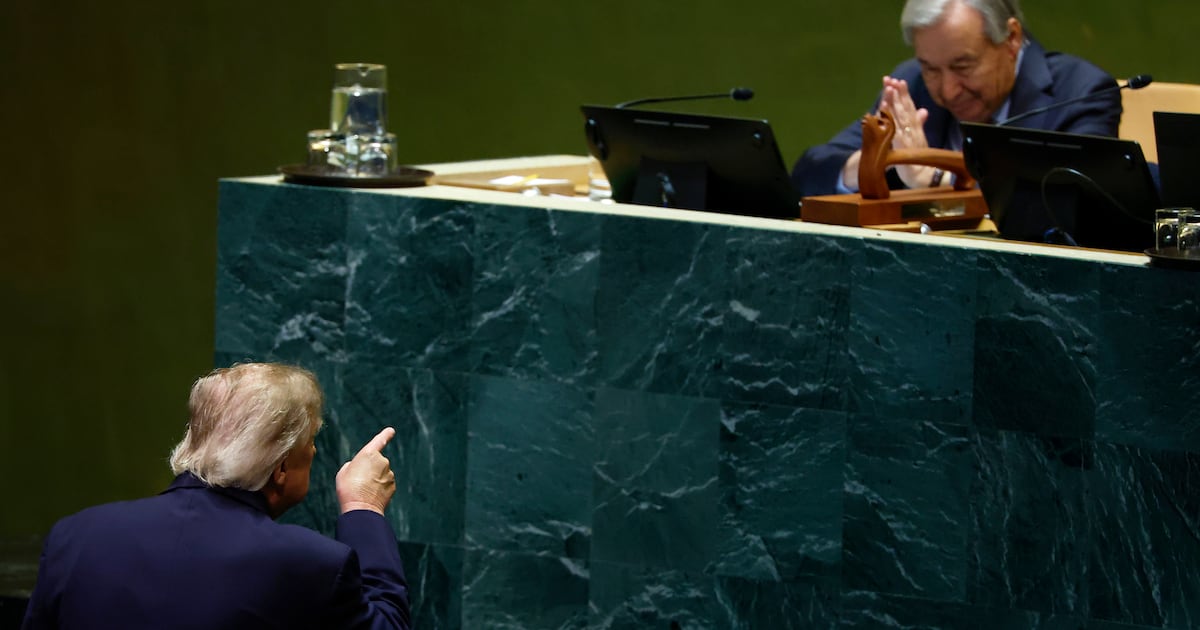
This year, the teleprompter was working. This year, the United Nations escalator did not break down at the worst possible moment. A year on from his withering rebuke of the international postwar peace alliance, Donald Trump returned to the big, maudlin building on First Avenue with plenty to say. He championed the effectiveness of his war against Iran and asserted himself as the central figure as the United States seeks “to reshape the world stage and solve problems that have plagued us for far too long”.With Iranian president Masoud Pezeshkian and Abbas Araghchi, its minister of foreign affairs, both in New York and an Iranian delegation in the assembly hall, Trump told world leaders he had arrived at a point where he faced a critical choice on Iran.“Will a deal be made with Iran that lets them rebuild and create a far greater country than it ever was before – maybe one of the greatest in the Middle East or even the world? Or do I annihilate the Islamic republic and do it quickly, never giving them a chance to destroy people and countries again?”The various delegations pondered this stark choice in heavy silence.READ MORE“Do I drive them into hell with no chance of survival and no hope?” On he continued, before arriving at an answer that has come to sound wearingly familiar.“But I believe we will make a deal right after the election. Because it doesn’t make sense for them not to. They are waiting to see how I will do in the midterm election. What they don’t realise is that I’m not running. I did that already – and won in a landslide. And I’ll be here for 2½ years.”US president Donald Trump addresses the United Nations General Assembly in New York. Photograph: Angela Weiss/AFP via Getty Images It was not difficult to detect a slight note of pleading in that prediction. But his series of rhetorical questions defined the contrasting tenor of Trump’s address. If it was more conciliatory to the idea of the United Nations, and slightly more flattering towards gathered leaders, overall it illuminated his radical and unexpected detour into foreign-war adventurism since returning to power – with hints of more to come. He warned that Cuba is an “absolutely failed state”, adding: “It is failing like never before, and it will fall. We will not allow a haven for foreign adversaries to threaten America.” He permitted himself a congratulatory rehash of the military operation that led to the downfall of Venezuela’s Nicolás Maduro, and avoided elaborating on his on-off obsession with Greenland. He held up the US’s role in implementing a ceasefire – of sorts – in Gaza. It was further evidence, in Trump’s eyes, of his place as the decisive figure in international relations. He continued: “While others have talked, I have acted. While others have spoken of peace, I have made peace. While others have ignored threats, I have confronted them. While others have talked of courage, I have shown it. While others have promised strength, I have used it to make America the most powerful country in the world.”Trump made this case during a week when opinion among US citizens of the war in Iran reached a new low. A CNN poll – released on Tuesday morning, even as the news network was banned, along with two other outlets, from covering Trump as part of the White House press pool – found that 71 per cent of respondents disapprove of how Trump is handling foreign affairs. Twenty-six per cent approve of how he is handling the war in Iran, while he is down 13 per cent in Republican party approval for his approach to the conflict. In states locked in key midterm senatorial races, Democratic candidates are lining up to direct the gaze of disgruntled voters to the eye-watering gasoline and diesel prices lit up in neon. Sixty-four per cent of respondents replied that they do not believe the US is winning the war against Iran.So, seven months after what was presented as a brief, decisive military operation that would overwhelm and subdue Iran, Trump is caught between issuing apocalyptic threats and sending disguised overtures to the leaders of the current regime. Prior to Tuesday’s address, US secretary of state Marco Rubio hinted that the US would be open to meeting Iranian delegates over the course of the week in New York.In their ascendancy period, Trump’s cabinet and Maga supporters liked to accuse his detractors of suffering from “Trump derangement syndrome”.Donald Trump's address to the UN General Assembly in New York received a laboured, dispersed applause. Photograph: Angela Weiss/AFP via Getty Images But the wan applause in the assembly hall suggested other leaders have become desensitised to, or even a little bored by, the US president’s propensity for shock-and-awe speeches. The words keep flowing at a relentless velocity, but the situation does not change much. Beyond the heavy security blanket, there was a significant absence of street protesters, reflective of the ongoing struggle for the United Nations to project its relevance and dynamism beyond this annual September gathering in Manhattan. There was, contained within Trump’s message, a bleak truth to his critique that the international body has effected little change since last year’s series of speeches were made here. Trump did not hang around his former city for long. He returned to Washington for a summit with Chinese president Xi Jinping, where he is expected to expound upon the new frontier of artificial intelligence.
Trump at the UN: Global leaders become desensitised to same old shock-and-awe tactics
Full Article
Original Source
Read the full article at Irishtimes →KhanList aggregates and links to publicly available news content. We do not host full articles from third-party sources. Always verify important information with original sources.