
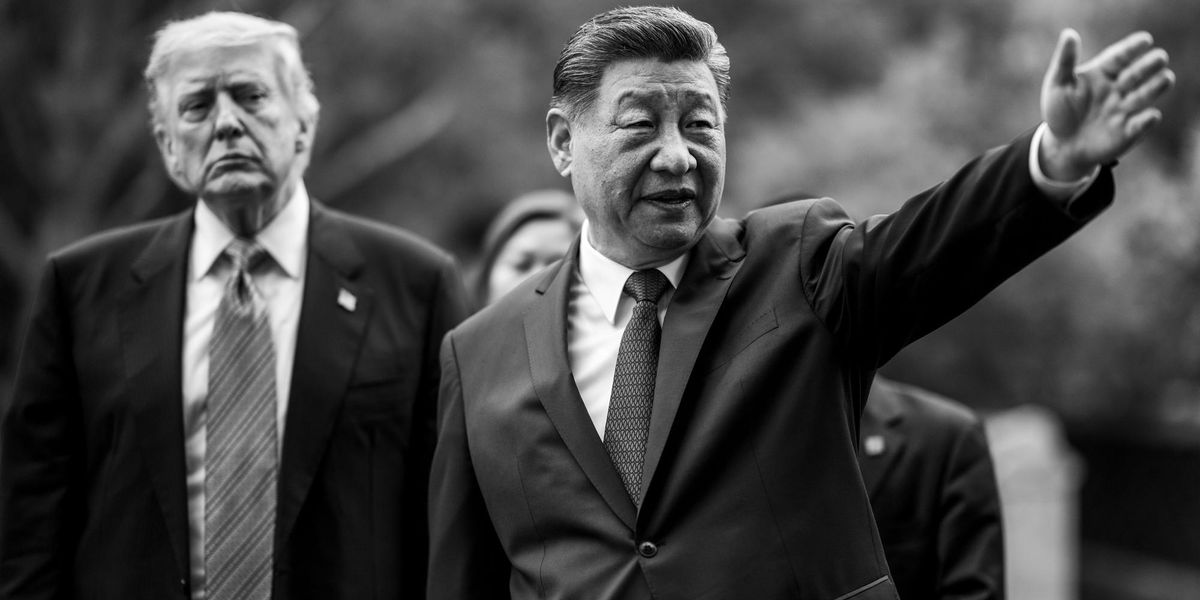
As Chinese President Xi Jinping arrives in Washington for his third meeting in less than a year with U.S. President Donald Trump, calm seems to prevail in the relationship. This is a dangerous illusion.The sense of stability is breeding complacency on both sides even as pressure builds up under the surface. We may be throwing away our last opening to put the world’s most important bilateral relationship on a solid foundation.In keeping with the slogan on which the two sides agreed at their May meeting in Beijing, the U.S. and China are supposedly building a relationship of “constructive strategic stability.” Indeed, compared to the confrontational posture of both sides during the first Trump and Biden administrations, we seem to have stepped back from the brink of conflict. Even the seemingly explosive issue of the ongoing U.S. assault against Iran and its damaging consequences for the global economy, or China’s continued dealings with Iran that are frustrating the U.S. strategy of economic strangulation, do not seem to be major grievances for either side.At first glance, there are strong reasons for rethinking a confrontational approach. In sharp contrast to Biden, Trump does not frame his dealings with Xi Jinping as an ideological crusade. He does not seek to organize the world’s richest and most powerful countries against China or to block its technological development. Trump’s erratic and uninhibited conduct must be deeply disturbing to Xi Jinping, whose dominant psychological trait is an obsession with control. But because Trump wants to strike deals with China rather than geopolitically subordinate it, he has opened a wider range of possibilities in the relationship.Even more significantly, the U.S. and China find themselves in a balance of economic terror. Last year the relationship nearly spiraled into uncontrollable economic warfare when Trump raised tariffs to 145% in a furious response to China’s retaliation against his “liberation day” tariffs. China then brought to bear its most formidable economic weapon, cutting off U.S. access to the rare earth elements crucial to high tech civilian and military production.Trump returned to the table in short order, and the two sides deescalated to where they had started. The trade ceasefire was tested five months later when the U.S. Commerce Department imposed a sweeping expansion of its existing blacklist of Chinese companies and China responded by hastily rolling out a much wider version of extraterritorial controls on rare earths. Again furious, Trump threatened to call off the upcoming face-to-face meeting between the two leaders. But when he found out what his administration had done to provoke the Chinese response, he reversed himself.The economic truce was formalized at the Trump–Xi meeting in Busan, South Korea. Modest progress then followed from Trump’s trip to Beijing in May, with China agreeing to US purchases and both sides promising to talk through ongoing tensions in implementing the truce.On the surface, then, the relationship seems sound. But underneath, the entire foundation is rotting.Since 2018, when the US foreign policy establishment abruptly redefined China as alien and hostile to the US-dominated “rules-based international order”, bipartisan hostility toward China has become the single unifying theme in the otherwise floridly dysfunctional US political system. That this unanimity within the political establishment has survived Trump’s second-term reorientation of China policy was on display last week, when multiple congressional hearings were held to denounce China ahead of Xi’s visit. The members of both parties took turns raising antagonistic measures before witnesses chosen to offer only antagonistic approaches to the full range of challenges posed by China.At a hearing of the House Select Committee on China, for example, Rep. Tom Suozzi (D-NY) asked: “Should we be viewing this as a hawkish relationship between us and China? … Or should we be doing more of a cooperative relationship with them—because we tried that for like 50 years ever since Nixon went to China, and that didn't turn out very well for us.”The Republican and Democratic witnesses alike agreed that the key task is to slow down China’s economic and technological development and speed up that of the United States. In the words of witness Oren Cass, “it should be extremely obvious to us that there is no path to partnership, collaboration, mutually beneficial arrangements with China.”To the limited extent that Trump’s administration is making China policy, it is guided by the same sort of hostility. Although Trump’s desire for friendly meetings with Xi Jinping has starkly limited public anti-China rhetoric and has hamstrung the Commerce Department after its actions nearly derailed the Busan summit, other U.S. agencies are continuing the Biden practice of steadily expanding restrictions on China:— The Federal Communications Commission has banned the import of humanoid robots and power inverters from China and expanded the ban on imports from Huawei and ZTE.— Transportation Secretary Sean Duffy recently sent a letter to Ford denouncing the automaker’s agreements with Chinese companies for creating “reliance on technologies of foreign adversaries”.— Under a proposed rule set to take effect in December, the Office of Management and Budget would prohibit federally funded US research collaboration with Chinese researchers.— The Pentagon keeps expanding its own blacklist of Chinese entities, and has now included most of China’s leading private technology companies.— Treasury Secretary Scott Bessent, commenting recently on the artificial intelligence “race” that US leaders imagine themselves to be running against China, said: “There is no day after tomorrow if China wins at this.” Trump himself holds the same view. (After talks on Sunday with his Chinese counterpart He Lifeng, Bessent said the two sides had agreed to establish an AI dialogue mechanism. This is an encouraging sign, but the atmosphere of deep distrust over technology will make real progress on the issue difficult.)Washington may be split, then, on how to talk about China. But on the substance of the relationship, overwhelming agreement prevails: U.S. and Chinese interests are inalterably opposed, the U.S. must dominate China or lose itself, excluding China’s presence in American society is an urgent priority.Because China is expanding its own capacity to counter U.S. attacks, and because neither side seems to understand what the other has promised in their truce, the two countries are headed for turmoil if not outright conflict.U.S. policymakers could still step back from such a mutually destructive future. The American people are communicating quite clearly that they do not want the single-mindedly adversarial approach that Washington has embraced. A clear majority now favor cooperation with China rather than seeking to limit its power.Recognizing the many shared interests that do unite the U.S. and China could open possibilities for cooperation on urgently needed global reforms. Appreciating the deep economic changes on both sides over the last decade would allow the two countries to explore different possibilities for mutual gain in trade and investment and research collaboration. New thinking on AI would make both countries safer and more prosperous. Taking seriously the idea of “constructive strategic stability” could inspire a new approach to regional security.Policy ideas for repairing the relationship are available. What is in short supply are U.S. leaders with the political courage to stand against the latest ill-fated bipartisan demand for international conflict.
Trump and Xi meet on a 'rotting' diplomatic foundation
Full Article
Original Source
Read the full article at Responsiblestatecraft →KhanList aggregates and links to publicly available news content. We do not host full articles from third-party sources. Always verify important information with original sources.