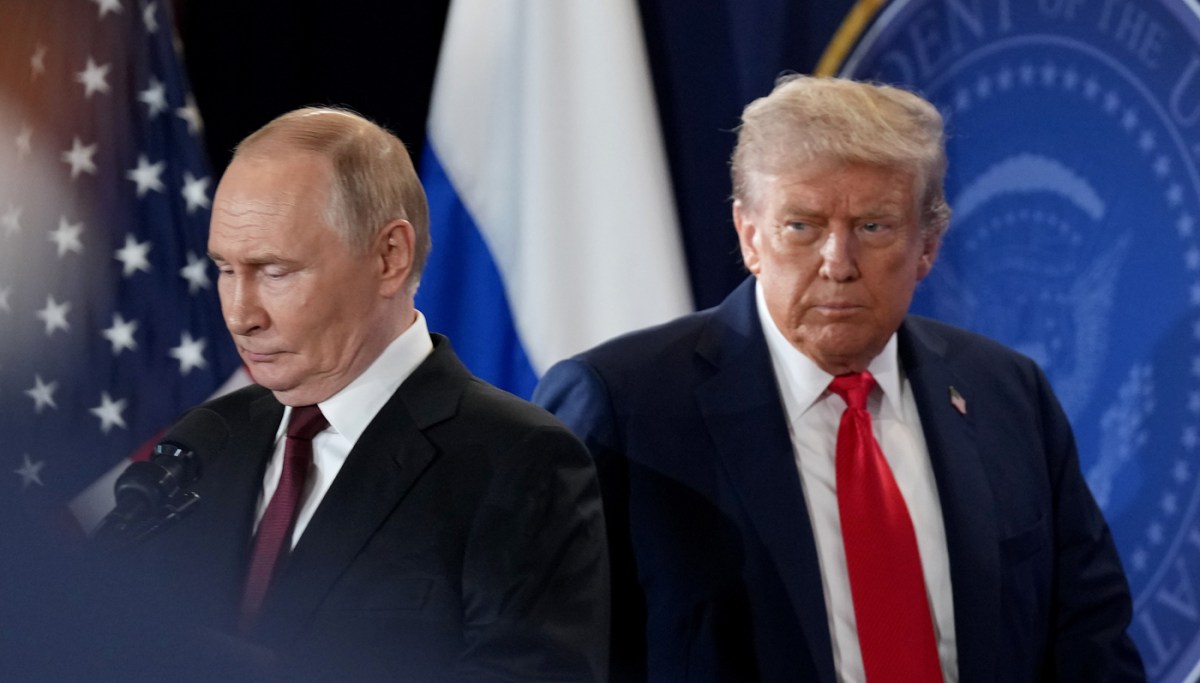
President Donald Trump and his Russian counterpart, Vladimir Putin, are facing similar predicaments after starting wars of choice only to discover that, despite commanding an overwhelmingly superior military force, the quick, decisive, total victory they anticipated has proven frustratingly elusive.In the case of Putin — who, like Trump, is a big fan of being told what he wants to hear — the Russian leader was by all accounts poorly served by his generals and spies in Ukraine who advised him that in the face of a Russian invasion the Ukrainians would fold, President Volodymyr Zelesnsky would flee or be captured, and in a matter of days, all of Ukraine would be under Russian control.That was four-and-a-half years ago. In contrast, Trump wasn’t misled by his adviser as much as by his own gut instincts, which he trusts more than so-called experts. As Trump often boasts, “I know more about (you name it) than anyone.”CIA Director John Ratcliffe, Secretary of State Marco Rubio, and Vice President JD Vance all counseled Trump not to fall for Israeli Prime Minister Benjamin Netanyahu’s rosy scenario that Iran’s radical Islamic regime would fall under the weight of a combined bombing campaign by the U.S. and Israel.Ratcliffe called it “farcical.” Rubio said it was BS. Joint Chiefs Chairman Gen. Dan Caine cautioned that unlike the quick in-and-out commando raid on Venezuela, war with Iran would be a different order of magnitude and, without allied support, would further stress depleted U.S stocks of munitions while risking closure of the vital Strait of Hormuz — “a scenario Trump dismissed on the assumption that the regime would capitulate before it came to that,” according to Regime Change, the best-selling book by New York Times reporters Maggie Haberman and Jonathan Swan.Russia’s President Vladimir Putin and President Donald Trump. (Alex Brandon/AP) When word of Caine’s reservations leaked out just five days before the war’s start, Trump took to Truth Social to shoot down the reports as “Fake News,” insisting, “It is his [Caine’s] opinion that it [a war] will be something easily won.”“Caine had said nothing of the sort,” Haberman and Swan reported.Ties that bind Washington and Moscow While the wars in Ukraine and Iran are distinctly dissimilar and are being fought for dramatically different reasons, when it comes to missteps and miscalculations, they have much in common.First off, both Trump and Putin vastly underestimated the capacity of their enemies to absorb punishing airstrikes — and to persevere despite suffering death, destruction, and privation.For four winters in a row, Russia mercilessly attacked Ukraine’s energy infrastructure in an attempt to freeze Ukrainians into surrender. He didn’t count on the will of a free people to bear unbearable grief and misery to ensure their homeland remains free.Trump also underrated what he was up against: a fanatical theocracy whose religion teaches that death and martyrdom are to be welcomed, that cares little for the welfare of its people, and hates America with a religious passion.Trump keeps saying the U.S. has already won by sinking Iran’s navy, downing its air force, and destroying much of its missile and drone capacity. But then, he wonders why the hell the “crazy” Iranians won’t give up.“They’re a bunch of scum, if you want to know the truth. They’re scum,” Trump vented at the NATO summit this month. “We don’t like them. I don’t like them. They’re evil people.”If there is one lesson Trump should have taken from Ukraine, it’s that drones are the linchpin of modern warfare — cheap, deadly drones that can, by their sheer numbers, overwhelm even the most sophisticated and expensive missile defenses.Ukraine offered the U.S. its state-of-the-art interceptor drones along with the battle-hardened Ukrainians to operate them, but Trump refused, saying the mighty American military did not “need their help.” “We know more about drones than anybody,” Trump told Fox News in March. Even aircraft carriers, once the most tangible symbol of American military might, have to keep their distance from the Persian Gulf, where they once could operate with impunity.Trump loves to tell the story of how, at the beginning of the war, the USS Abraham Lincoln was able to successfully fend off more than 100 drones that Iran launched all at once in an effort to sink the massive carrier. He totally misses the point that the Lincoln had to beat a hasty retreat to the safety of waters in the Gulf of Oman, where pilots would have to fly twice as far to reach their targets.US and Russian progress grounded The ways the Ukraine war evolved over the years provided another lesson — and one that Trump does seem to have taken to heart: In modern warfare, there are few good ground options. Maneuver warfare with big tank battles and thousands of infantry troops is a relic of a bygone era.In Ukraine, for example, Russia’s ground war has ground to a halt, largely because Ukraine’s drone technology has advanced to the point where stepping into its “Fortress Belt” along the front lines means instant death for any Russian soldier.“The average life expectancy of a Russian recruit right now, arriving on the battlefield in Ukraine, is estimated to be between 20 and 30 minutes,” CIA Director John Ratcliffe said at a defense innovation summit in Pennsylvania. “That’s because AI-powered drones have gotten to be such specialized, low-cost killing machines.”On average, Ukraine kills or maims 1,000 soldiers a day.While Trump boasts that his war in Iran has the fewest casualties of any previous U.S. war, he is acutely aware that additional deaths could erode public support.“My preference has always been to take Kharg Island,” Trump told Fox News, referring to the key transshipment point for Iranian oil at the northern end of the Persian Gulf.“My preference would be that,” Trump said, while quickly adding, “I don’t know that America has the stomach for it, to be honest with you.”Ruling out boots on the ground puts Trump in the same bind as Putin.With no good ground options, both leaders must rely solely on air power to achieve goals that seem increasingly out of reach, and bombing people into submission does not have a good track record.“As you look across the totality of history, air power’s got limits, and we always have to be mindful of those,” Caine told a Senate committee this month. When Caine was asked by Sen. Jack Reed (D-RI) if he had “advised the president that a ground combat would be very expensive in the lives of our soldiers, sailors, marines, airmen? And also, could probably lead to an extended unconventional war?” Caine replied, “I have to keep my military advice to the president private, sir.”Yet another lesson from the wars in Ukraine and Iran is that nuclear weapons may be useful for making threats and for overall deterrence, but practically speaking, they have no utility in war.Putin has made veiled threats and even put his nuclear forces on higher alert to spook the Ukrainians. They paid no attention.Similarly, Trump also made threats that seemed to evoke nuclear weapons, telling reporters in May, “If there’s no ceasefire. You’re not going to have to know. You’re just going to have to look at one big glow coming out of Iran.”It’s a scary thought, but no one takes it seriously, because using nuclear weapons might not only end the war, but also end the world.To review, Trump and Putin both: – Anticipated a quick victory – Underestimated the adversary’s ability to adapt – Are relying on bombing to compel capitulation or surrender – Face foes who need only to survive to win – Are feeling the economic effects of an extended war – Need a face-saving way to end the war that can be sold as worth the sacrifice Putin — whose political future, and perhaps very life, depends on not losing has yet to come to grips with the limits of his power.The same might be said for Trump, who was asked point-blank in an interview with Axios’ Marc Caputo in June, “What have you learned about not just the exercise of power, but the limits on your power as a result of the conflict?”“None. I haven’t learned that lesson yet,” Trump replied, “I know there are, but there are no limits. We defeated them totally militarily.”Both Trump and Putin might have benefited by pulling off the shelf a dusty copy of On War, the classic primer on military strategy by 19th-century Prussian military officer Carl von Clausewitz, and reading the chapter on “Advantages of the Defensive.”TRUMP VOWS IRAN WILL ‘PAY’ FOR KILLING US TROOPS. WHAT COMES NEXT?“Defense is a stronger form of fighting than attack,” Clausewitz wrote in 1832. He also observed, “In War more than anywhere else in the world things happen differently to what we had expected, and look differently when near, to what they did at a distance.”Jamie McIntyre (@jamiejmcintyre) is the Washington Examiner’s senior writer on national security.
Trump and Putin are learning parallel lessons about the realities of modern warfare
Full Article
Original Source
Read the full article at Washingtonexaminer →KhanList aggregates and links to publicly available news content. We do not host full articles from third-party sources. Always verify important information with original sources.