
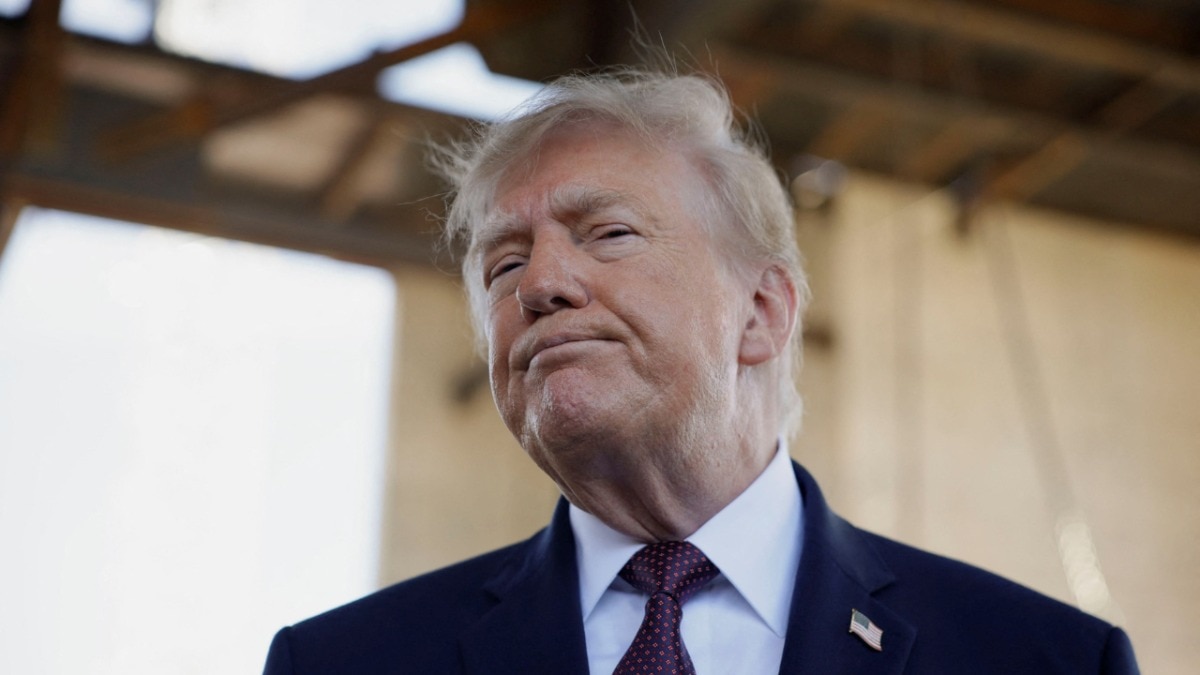
Donald Trump has admitted that the Iran war contributed to Republican losses in the midterms but insisted he would launch the military campaign again to prevent Tehran from acquiring nuclear weapons.The conflict with Iran has become an increasingly difficult issue for the Trump administration as its economic consequences have reached American households. (Photo: Reuters)US President Donald Trump has acknowledged that the war with Iran contributed to the Republican Party's crushing defeat in the midterm elections, particularly by driving up petrol prices and adding to the financial pressure on American households. However, he has refused to reconsider the military campaign, insisting that preventing Tehran from acquiring nuclear weapons was worth the cost."I think it's largely true because it drove the gasoline up... At the same time, if I had to do it again, I'd have to do it again because long-term, it's the only answer. You can't let Iran have a nuclear weapon," Trump said. He made the remarks while speaking to reporters at the White House ballroom construction site, where he was discussing renovation work at the White House and other projects in Washington.His remarks nevertheless offered a significant acknowledgement of the domestic consequences of the Iran war, which has emerged as a major issue within Trump's own party following the November 3 midterm elections. Democrats swept control of both the House of Representatives and the Senate, dealing Republicans a major setback and handing the opposition party considerable power to challenge Trump's administration during the remaining two years of his presidency.IRAN WAR, PETROL PRICES BECOME GOP' LIABILITYThe conflict with Iran has become an increasingly difficult issue for the Trump administration as its economic consequences have reached American households. Military confrontation in the Middle East has disrupted energy supplies and heightened concerns over shipping through the Strait of Hormuz, one of the world's most important oil transit routes. A significant portion of internationally traded crude oil passes through the narrow waterway, making any disruption a concern for energy-importing countries. The resulting pressure on oil markets has translated into higher fuel costs, putting additional pressure on motorists and businesses in the United States.For American voters already concerned about inflation and the cost of living, higher petrol prices have become another source of frustration. The issue is particularly sensitive because Trump had repeatedly promised to prioritise domestic economic concerns under his 'America First' agenda.JD VANCE BLAMES IRAN WAR FOR POLL LOSS Trump's acknowledgement came shortly after Vice-President JD Vance identified the Iran war and Washington's relationship with Israel as major reasons behind the Republican Party's electoral losses. In a lengthy statement on X, Vance argued that the party's defeat was not simply a result of poor voter turnout. Instead, he said, many Americans who had supported the Trump-Vance ticket in the 2024 presidential election had switched sides and voted for Democrats in the midterms.Pointing to internal polling, Vance identified four major reasons behind the voter backlash: the war, rising living costs, concerns over the administration's commitment to its 'America First' agenda and dissatisfaction with Washington's relationship with Israel."The reason we lost is the war," Vance wrote.He said Republican analysts had initially been encouraged by voter turnout figures, believing that the party's supporters were showing up in sufficient numbers. However, one of the data analysts he consulted warned that turnout figures did not necessarily mean those voters would support Republican candidates.Vance recalled the analyst telling him: "We might do better than the polls suggest. But the data is telling us that a lot of Trump/Vance 2024 voters are pissed and planning to vote for the other guys. Our voters are turning out, but they may not vote for us."According to Vance, the warning proved accurate. He also cited a pollster's findings that voters who had abandoned Republicans wanted the administration to end the war, address inflation, return to its 'America First' priorities and reconsider its relationship with Israel.WHY TRUMP SAYS IRAN CANNOT BE ALLOWED TO HAVE NUCLEAR WEAPONSAt the centre of Trump's justification for the military campaign is Iran's nuclear programme and Washington's longstanding concern that Tehran could eventually develop nuclear weapons.Iran has maintained that its nuclear activities are peaceful and intended for civilian purposes. However, its uranium enrichment programme has been a major source of international concern for years.Uranium enrichment involves increasing the concentration of uranium-235, an isotope that can sustain a nuclear chain reaction. Low-enriched uranium can be used as fuel for civilian nuclear power plants, while highly enriched uranium can be used in nuclear weapons.The distinction between the two is crucial. Uranium enriched to around 90 per cent purity is generally considered weapons-grade material. Iran had previously accumulated uranium enriched to 60 cent, a level far beyond what is normally required for civilian nuclear power generation.According to the International Atomic Energy Agency (IAEA), Iran had accumulated an estimated 440.9 kilograms of uranium enriched to 60 per cent purity. However, possessing highly enriched uranium does not automatically mean a country has a functioning nuclear weapon. Developing a nuclear warhead also requires additional technical work, including weaponisation and the ability to deliver it.The question of what remains of Iran's nuclear programme has become particularly complicated following repeated US and Israeli attacks on its nuclear infrastructure in 2025 and 2026.IAEA WARNS IT CANNOT VERIFY IRAN'S NUCLEAR STOCKPILEThe latest developments have complicated Trump's argument that military action has eliminated the threat posed by Iran's nuclear programme.In an update to the United Nations Security Council on October 27, IAEA Director General Rafael Grossi said the agency had found no evidence that Iran had attempted to repair or reconstruct nuclear facilities damaged in the US-Israeli military strikes of 2025 and 2026."Since June 2025, we have not identified any activity to repair or reconstruct any of the facilities damaged in the military attacks of 2025 and 2026," Grossi said.However, there is another significant concern. The nuclear watchdog has been unable to independently verify the whereabouts and condition of Iran's stockpile of highly enriched uranium since the June 2025 strikes.- Ends
Trump admits Iran war hurt Republicans in midterms, but insists he would do it again
Full Article
Original Source
Read the full article at Indiatoday →KhanList aggregates and links to publicly available news content. We do not host full articles from third-party sources. Always verify important information with original sources.