
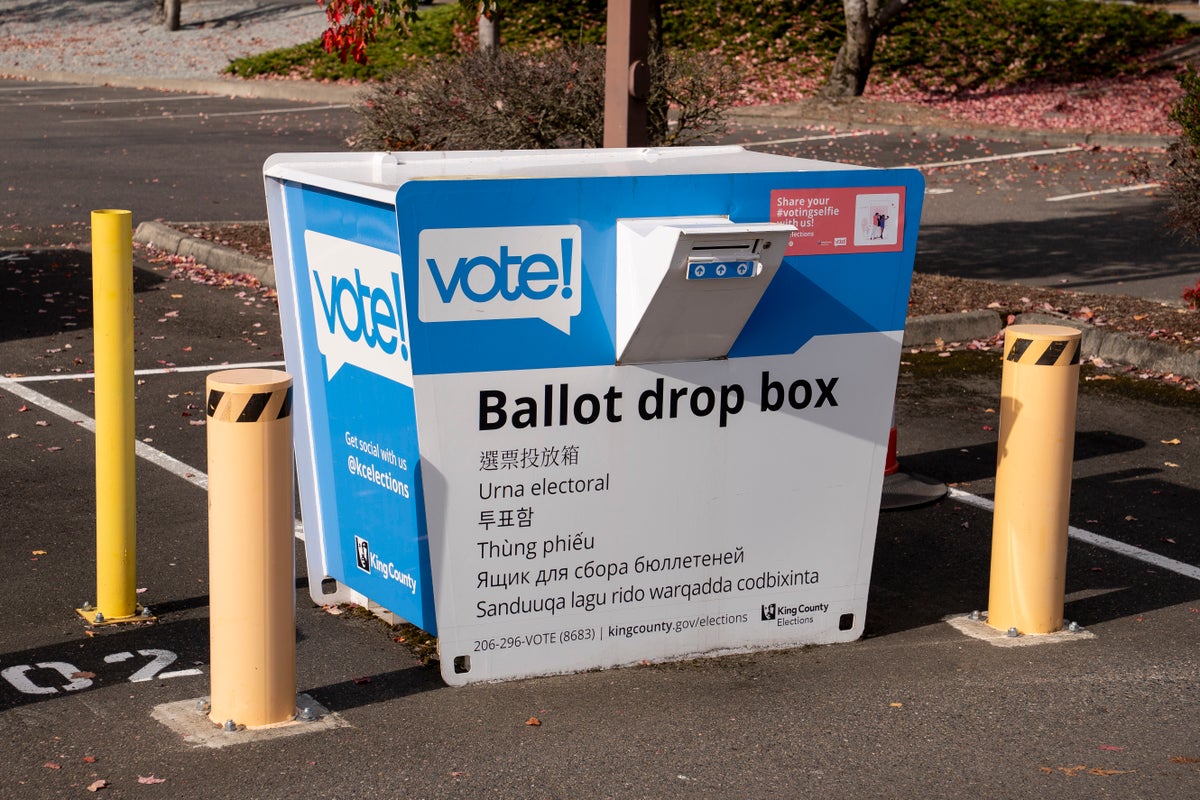
The Trump administration has formally asked Washington state to set aside ballots cast by more than 400 individuals it alleges are registered to vote without U.S. citizenship, following a similar demand in California less than two weeks earlier.The request is the administration's latest effort to raise doubts about election integrity and voting outcomes in key states that will help determine control of both the U.S. Senate and the House of Representatives.In correspondence sent to Washington Secretary of State Steve Hobbs, the Justice Department stated it had identified 1,500 votes previously cast by the 405 flagged individuals across prior elections. Federal officials asked the state to segregate any ballots those individuals might submit in next month’s midterm until state officials can confirm their voting eligibility. The Trump administration on Monday asked Washington state to set aside any ballots received from more than 400 people it alleges are registered to vote without U.S. citizenship (Getty)Washington, which conducts elections entirely by mail for its more than 5 million registered voters, issues mail ballots to every registered voter on its rolls.Records shared by federal authorities reveal that one of the individuals flagged on the list last cast a ballot in 1994.Speaking at a news conference, Neil Floyd, the acting U.S. attorney in Seattle, stated he believed the 405 individuals identified so far represented "the tip of the iceberg.""Because of limitations the state has placed on our investigation, we’ve only been able to uncover a fraction of the total number," he said.Neil Floyd, the acting U.S. attorney in Seattle, stated he believed the 405 individuals identified so far represented "the tip of the iceberg" (Reuters)Hobbs confirmed his office is reviewing the DOJ’s request, while noting that the data provided by the department included the voter history of the 405 individuals, including the record from 1994."The timing of this request — one week before the General Election — is no doubt intended to cast unfounded suspicion on the results," Hobbs said.Floyd explained that much of the suspect registry was compiled through "recent contacts" with suspected noncitizens, as federal officers now systematically query individuals they interact with regarding their voter registration status.Federal prosecutors maintain that proving instances of illegal voting is difficult without direct access to state files. As a result, the Justice Department has demanded state records containing home addresses, dates of birth, driver’s license numbers, and partial Social Security numbers.The intervention is part of a broader push by the administration to identify noncitizen voters, despite evidence showing that voting by noncitizens is extremely rare. President Donald Trump has repeatedly sought to challenge public confidence in the electoral system. Meanwhile, Washington election officials have pointed out that operational changes within the U.S. Postal Service have disenfranchised thousands of lawful voters.President Donald Trump has repeatedly sought to challenge public confidence in the electoral system (Getty)The demand in Washington marks the third direct state challenge brought by the Justice Department while voting is underway. All three states—Washington, California, and Alaska—feature competitive House or Senate races that will determine the balance of power in Congress.Among the country's most contested races is the battle for Washington’s 3rd Congressional District. Democrats consider reelecting Rep. Maria Gluesenkamp Perez vital to their efforts to secure a majority in the U.S. House. She has won two consecutive elections in a district that also supported Trump in each of his presidential campaigns.In California, the Justice Department filed suit to compel state officials to isolate mail ballots from up to 20,000 individuals federal authorities suspect may not be citizens. A separate lawsuit filed last week in Alaska seeks to delay the certification of election results if the Republican incumbent fails to win.A panel of federal appellate judges in California held rare Sunday arguments to question the timing, legal basis, and constitutional authority of the Justice Department’s challenge. On Monday, the judges declined to issue a ruling under the expedited timeframe requested by the DOJ and remanded the matter to a lower court. The Elections Clause of the U.S. Constitution grants state legislatures the power to establish the time, place, and manner of holding congressional elections.In court filings, Los Angeles County Assistant Registrar-Recorder Monica Flores noted that local election workers audited a sample of 200 records from the list the Trump administration supplied. They found the sample contained canceled or inactive registrations, individuals with no voting history, and voters who appeared to have been born in the United States.In California, the Justice Department filed suit to compel state officials to isolate mail ballots from up to 20,000 individuals federal authorities suspect may not be citizens (Reuters)The Justice Department informed Washington state that it expects to send an additional list of suspected noncitizens before Election Day, while acknowledging that some individuals on the list may have acquired citizenship through naturalization since registering.Subsequent investigations into prior claims of noncitizen voting have consistently uncovered far fewer instances than the Trump administration alleged. In Nevada, where the administration claimed 1,500 potential noncitizens were registered, a follow-up investigation identified zero. In Maricopa County, Arizona, the county recorder, a Trump supporter, initially announced 207 potential noncitizens on the rolls, but a review by the Republican County Attorney confirmed only eight.
Trump administration targets hundreds of Washington voters as state questions timing of election intervention
Full Article
Original Source
Read the full article at Independent →KhanList aggregates and links to publicly available news content. We do not host full articles from third-party sources. Always verify important information with original sources.