
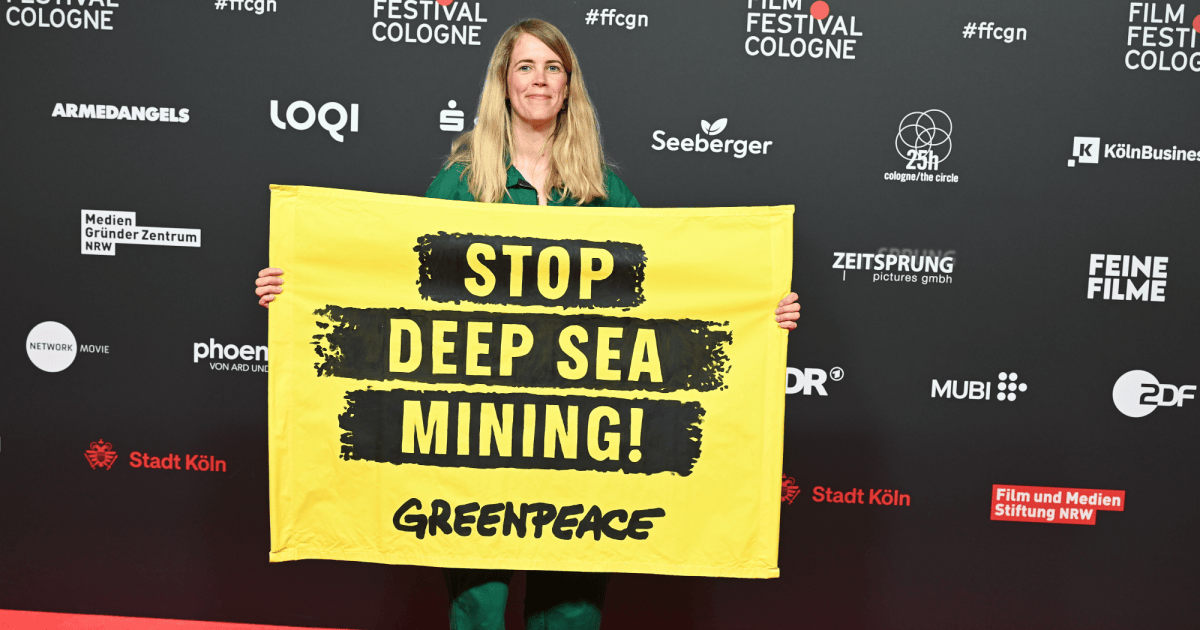
A Greenpeace employee at an awards ceremony during Film Festival Cologne in North Rhine-Westphalia, Germany.Horst Galuschka/Zuma Get your news from a source that’s not owned and controlled by oligarchs. Sign up for the free Mother Jones Daily. This story was originally published by Inside Climate News and is reproduced here as part of the Climate Desk collaboration. In an historic first, the Department of Interior has leased more than 31 million acres of Pacific waters to a deep-sea mining company seeking to exploit mineral-rich deposits from the ocean floor off American Samoa. “This is the first time that a lease has been issued for deep-sea mining in US waters,” said Arlo Hemphill, US project lead against deep-sea mining for Greenpeace USA. Deep-sea mining is a highly contested, emerging industry that aims to extract rock-like deposits on the seabed called polymetallic nodules, formed over millions of years. They contain cobalt, copper, manganese and nickel—so-called “critical minerals” used in batteries, electronics and other devices that have historically been mined on land. To date, no commercial deep-sea mining operations have begun anywhere in the world. Scientists, environmentalists and Indigenous peoples with strong cultural connections to the ocean aim to stop the industry from moving forward at all. “Once mining strips away habitat that took millions of years to form, no amount of money can bring it back,” said Hemphill in a statement. “Congress should press the administration to suspend these leases before work begins.” The lease sale took place Thursday, during a live auction held at the Ventura County Fire Department in Thousand Oaks, California, as Hemphill and dozens of other activists from American Samoa and across the Pacific rallied, prayed and sang outside in protest. The leased areas are home to blue, fin, sei, and sperm whales; leatherback sea turtles, oceanic whitetip sharks, and giant manta rays.” “This is not just seabed on a map. This is our home, our livelihoods, our identity, and our responsibility to protect,” said Sabrina Suluai-Mahuka, founder of Finafinau, American Samoa’s youth and environment nonprofit, who traveled from American Samoa to protest the auction. “Ocean rights are human rights, and our home is not for sale,” she said in a statement. Representatives from just two companies attended the auction, including Adepth Minerals Inc., from Norway, and Wetstone US Ventures, a New York-based offshore critical minerals exploration and deep-sea mining company. Ultimately, Wetstone bid $6 million on two areas marked for mineral exploration that lie adjacent to the Rose Atoll Marine National Monument, a marine protected area established by President George W. Bush in 2009 to protect more than 10,000 square miles of ocean from commercial fishing and other forms of extraction. The bid made Wetstone the provisional winner of the auction, according to a spokesperson from the Marine Minerals Administration. The new office was established earlier this year within the Department of Interior to help promote the Trump administration’s agenda to secure critical minerals. “A dependable critical minerals supply chain is essential to American manufacturing and the technologies that power our economy and national defense,” said Secretary of the Interior Doug Burgum, in a statement about Thursday’s auction. “Today’s sale opens a path to learn more about the resources off the coast of American Samoa and assess whether they could contribute to a more reliable domestic supply.” The areas offered for leasing will be open for exploration activities, which include mapping and surveying the seabed to locate mineral rich deposits. Actual mining would require further federal approvals. But Hemphill and others warn that exploration in itself is a dangerous step towards paving the way for an industry that could threaten ocean ecosystems and the people that depend on them. “The industry will push to move from surveys to exploration to extraction, putting profits ahead of marine life and trampling the culture, livelihood and objections of communities that have said no again and again,” Hemphill said. Ever since the proposed lease sale was announced earlier this year, many American Samoan leaders and communities have voiced their concerns. Several lawsuits were filed against the Trump Administration to stop it from happening. Just a few days before the lease sale, a federal judge in Hawaiʻi ruled the Marine Minerals Administration had violated the Endangered Species Act by approving the lease sale without taking into account the potential impacts of exploration and mining on endangered species. The areas leased are home to several dozen endangered species including the blue whale, fin whale, sei whale and sperm whale, as well as the leatherback sea turtle, oceanic whitetip shark, and giant manta ray. Many of these species are already threatened by climate change, which is altering their sources of prey and migration patterns. More than 1,000 marine science and policy experts from 75 countries say deep-sea mining could further add to the stress these marine animals are facing. “In deciding to move forward with today’s scheduled sale, the Trump administration has performed a renegade, unlawful act,” said Chris Eaton, attorney at Earthjustice, an environmental nonprofit that represented American Samoan and Hawaiian plaintiffs in the lawsuit. “We will use the full extent of the law to vigorously push for the leases to be voided,” he said in a statement Thursday.
Trump Administration Sells First Deep Sea Mining Leases for 19 Cents an Acre
Full Article
Original Source
Read the full article at Motherjones →KhanList aggregates and links to publicly available news content. We do not host full articles from third-party sources. Always verify important information with original sources.