
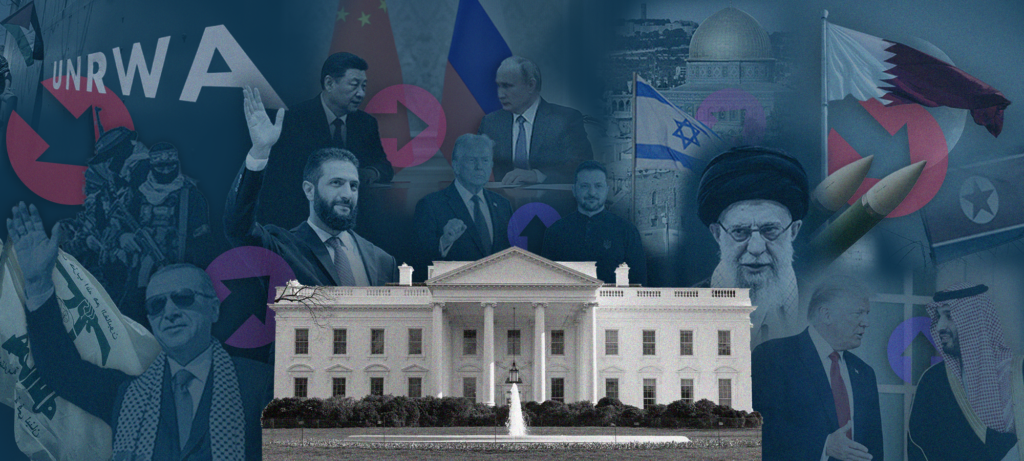
Trend Overview Welcome back to the Trump Administration Foreign Policy Tracker. Once a month, we ask FDD’s experts and scholars to assess the administration’s foreign policy. They provide trendlines of very positive, positive, neutral, negative, or very negative for the areas they watch. President Donald Trump said he is considering military action against Iran after the midterm elections, though he did not rule out a possible deal with the Islamic Republic. At the same time, American forces continued their effective naval blockade against Iran, depriving the regime of billions of dollars in revenue. Concurrently, Washington intensified sanctions against Iran as part of Operation Economic Outcast. Also in the region, Israel held its first election since the atrocities of October 7, 2023, but the results produced no clear path to a new government. President Trump’s endorsement of Benjamin Netanyahu drew controversy for interfering in domestic Israeli politics. Netanyahu’s bloc outperformed the opposition, but neither side has a majority. Meanwhile, Trump announced an agreement for Russian diesel exports to U.S. and global markets, aiming to lower prices ahead of the midterms. The move blindsided Kyiv. Washington simultaneously demanded that Ukraine stop striking Russian refineries, reportedly threatening to withhold intelligence and arms. In effect, the Trump administration gave up on persuading Russian President Vladimir Putin to accept a truce covering both Ukrainian and Russian energy infrastructure. Check back next month to see how the administration deals with these and other challenges. Trending Positive Previous Trend:Neutral In October 2025, President Donald Trump and Chinese leader Xi Jinping met in Busan, South Korea, and agreed to de-escalate their trade war. One year later, the bilateral relationship has settled into a managed stalemate. Both sides have preserved the tariff truce while intensifying competition over advanced technology, research security, and strategic supply chains. That separation gives Washington room to pursue national security measures while limiting the risk of another trade spiral. October 2026 offered concrete evidence of this arrangement in practice. The Treasury Department proposed rules under the COINS Act to expand outbound investment restrictions to biotechnology alongside advanced semiconductors, artificial intelligence, and other sensitive technologies. The Pentagon reported more than 80 termination-related actions following research-security audits at 30 universities and designated Chinese-funded Confucius Institutes a national security concern. The Federal Communications Commission closed a loophole allowing devices containing chips from blacklisted Chinese telecommunications and surveillance suppliers to receive U.S. authorization, strengthening safeguards for American communications networks. Meanwhile, Beijing announced export controls on drone components and industrial machinery and proposed restrictions on advanced AI and solar technologies. These measures aim to protect China’s technological advantages and strengthen Beijing’s leverage over strategic supply chains. Taiwan remains a flashpoint, with Trump holding up a pending $14 billion arms package and treating Taiwan’s defense needs as leverage in trade negotiations with Beijing. That delay carries real risks for deterrence. For now, Trump’s approach offers a practical, if fragile, model for preserving stability at the top while sustaining competition over technologies shaping future military and economic power. Trending Positive Previous Trend:Neutral October saw federal agencies working to harden U.S. networks against adversary access while seeking to resolve gaps in their own defenses. The Cybersecurity and Infrastructure Security Agency (CISA) released CISA 2030: Defend, Harden, Prevail, a strategic commitment to improve international cyber cooperation and deepen information sharing with industry. The strategy is silent, however, on election security and CISA’s staffing losses, pledging only to “build capacity” in its 10 regional offices. Separately, CISA warned that the previously sanctioned Integrity Technology Group, a China-based company linked to the Chinese government, was providing tooling and online infrastructure to China’s Flax Typhoon threat actor. The FBI and the Department of Justice (DOJ) also seized hacking tools associated with Flax Typhoon. Likewise, Washington moved to limit adversary access to U.S. government networks and certification processes. The Department of Homeland Security ordered federal civilian agencies to purge DeepSeek products from their networks and barred future procurement, citing malware risk and Chinese data access. The Federal Communications Commission voted unanimously to remove all China-based labs from its testing ecosystem. Starting in December 2028, all electronics bound for the United States must be tested in U.S. or allied labs to ensure the integrity of the testing process. Finally, DOJ indicted 14 people — including two Americans and 10 China-based actors — as part of the North Korean IT workers scheme, with 187 devices seized and more than 40 laptop farms raided across Texas. The scheme entailed a fraudulent North Korean effort to generate revenue by procuring remote IT work in U.S. companies. Trending Negative Previous Trend:Neutral The Trump administration reduced pressure on Russia and increased pressure on Ukraine in October, undermining American interests and Kyiv’s ability to defend itself against Russian aggression. This included an apparent pause in U.S. intelligence sharing and delays in deliveries of purchased air defense interceptors. Ukraine’s ability to effectively employ the life-saving Starshield system was also limited, though it is unclear whether the order came from SpaceX CEO Elon Musk, the Pentagon, or the White House. Pentagon officials also reportedly pressured allies in Europe to tone down their rhetoric toward Moscow. U.S. forces continued to impose an effective naval blockade against Iran, depriving the regime of billions of dollars in revenue while simultaneously facilitating the export of non-Iranian oil through the Strait of Hormuz. U.S. Central Command (CENTCOM) announced on October 25 that, with the help of U.S. forces, more than 3,000 commercial vessels had transited the strait over the past six months and that Gulf partners had exported more than 1.5 billion barrels of oil since the summer. Demonstrating that it was too soon to declare “mission accomplished,” attacks on vessels continued. On September 30, CENTCOM announced the end of Operation Inherent Resolve in Iraq, marking the end of the 12-year American-led counter-ISIS campaign there. Secretary Hegseth announced a series of initiatives that same day. These included the establishment of an Autonomous Warfare Command by 2027, the “FORTRESS America” initiative to increase the energy and supply independence of U.S. bases, and Project Meridian tasked with identifying capabilities and technologies required in modern warfare. Trending Negative Previous Trend:Neutral Following an October 9 phone call with Vladimir Putin, President Trump announced an agreement for Russian diesel exports to U.S. and global markets, aimed at lowering prices ahead of the midterms. The administration simultaneously demanded that Ukraine cease striking Russian refineries, reportedly threatening to withhold intelligence and arms. In effect, Washington gave up on persuading Putin to accept a truce covering both Ukrainian and Russian energy infrastructure. So far, U.S. diesel prices have not come down. Trump’s announcement blindsided Kyiv, sparking a war of words between the American and Ukrainian leaders. Days later, Ukrainian forces discovered that their access to Starshield, the military-grade version of Elon Musk’s satellite internet system Starlink, had been throttled. This disrupted Ukrainian operations, including some counter-drone defenses. The administration denied responsibility, but U.S. officials and Musk gave conflicting explanations. Some reporting suggests the White House had foreknowledge of or ordered the restrictions. Although Ukrainian access has since been restored at Trump’s request, a Pentagon watchdog has rebuffed bipartisan calls for an official investigation. Meanwhile, U.S. peace envoys held another round of meetings with the Ukrainian and Russian presidents. Putin gave no ground but agreed to resume trilateral talks in November, expected to focus on postwar security arrangements. He then signaled that Russian negotiators will push for revising the “broader European security architecture” — even though European officials were not invited to the talks. Washington must make sure to secure European and Ukrainian buy-in before making any commitments to Moscow. Trending Neutral Previous Trend:Neutral The October 22 phone call between Secretary of State Marco Rubio and Qatari Prime Minister Mohammed bin Abdulrahman Al Thani exposed a critical strategic divergence between the United States and its Major Non-NATO Ally, showing how Doha’s foreign policy actively undermines American objectives through appeasement of Iran and diplomatic wordplay. While the State Department readout emphasized immediate security assurances and the enforcement of freedom of navigation in the Strait of Hormuz, Doha’s statement revealed an insistence on a path of concession toward Tehran. By prioritizing joint coordination to “de-escalate regional tensions,” Qatar signaled a policy of appeasing the Islamist regime in Iran. Despite the Iranian strikes on Qatari territory, oil facilities, and energy tankers, Qatar has refused to sever diplomatic or strategic ties with Iran, choosing instead to spare the Islamic Republic diplomatic accountability. The Qatari readout also revealed a deliberate attempt to hijack maritime security negotiations by insisting on a “comprehensive, lasting peace agreement.” Such language artificially injects the irrelevant Israeli-Palestinian conflict into combating Iranian state-sponsored terrorism. It also shifts the global and American focus away from Iran’s destabilizing behavior in the region and onto the intractable conflict between Israel and the Palestinians. Such an approach fragments the unified front necessary to deter Iranian aggression, neutralizing U.S. leverage and providing a diplomatic off-ramp for an aggressive adversary that continues to bully the region. Trending Positive Previous Trend:Neutral October marked tangible progress in U.S. defense cooperation across the Indo-Pacific. The Keen Sword 27 exercise assembled roughly 45,000 Japanese personnel, 11,000 American troops, and forces from seven additional countries for operations centered on Japan’s southwestern islands. Training emphasized air and missile defense, maritime operations, and logistics near Taiwan. The exercise reinforced an increasingly important requirement for regional deterrence: forces capable of operating together across the First Island Chain. Washington and Tokyo agreed to establish a Japanese facility for final assembly and inspection of advanced air-to-air missiles while advancing cooperation on interceptor production. At defense meetings in the Philippines, the United States, Japan, Australia, and the Philippines agreed to expand military exercises and policy coordination. Secretary Hegseth also proposed a new U.S.-ASEAN defense framework focused on maritime awareness and naval interoperability. Separately, Washington and Tokyo explored greater coordination on regional infrastructure and maritime-security assistance. These steps strengthen the foundations of regional deterrence amid persistent Chinese military and coast guard pressure around Taiwan and in the South China Sea. Sustaining that progress will require Japan and other regional partners to shoulder more responsibility for their defense, expand munitions stockpiles, and improve logistics for combined operations. Washington must also sustain the funding and industrial commitments needed to expand missile production and joint training. Together, those investments would give allied forces greater capacity to respond to Chinese coercion and sustain operations during a regional crisis. Trending Positive Previous Trend:Positive The United States imposed sanctions on the International Criminal Court (ICC) on October 9, building on earlier actions that targeted individual prosecutors and judges. The ICC now sits on the Treasury Department’s sanctions blacklist as a Specially Designated National (SDN). The designation freezes ICC assets under U.S. jurisdiction and generally excludes the court from transactions involving the U.S. financial system. The decision stems from the ICC’s insistence on pursuing American and Israeli officials on war crimes allegations despite neither the United States nor Israel ratifying the Rome Statute underpinning the court. The Trump administration reportedly delayed funding for the Organization for the Prohibition of Chemical Weapons (OPCW) and the International Atomic Energy Agency (IAEA), which play key roles in combating the spread of weapons of mass destruction and are generally regarded as effective and apolitical. The delays appear linked to President Donald Trump’s February 2025 Executive Order 14199, which directed a review of U.S.-funded international organizations and participation in conventions and treaties. Meanwhile, the Board of Peace, launched by Trump to reconstruct and stabilize the Gaza Strip, marked the third anniversary of the October 7, 2023, Hamas atrocities in Israel by stating, “Genuine and durable security for Israel is the foundation on which any peace must be built.” However, little progress has been registered on Hamas’s disarmament, which is a core demand of Trump’s 20-point peace plan for the Palestinian enclave. Trending Positive Previous Trend:Positive “I have a decision to make: Do I finish it off, which would be very easy to do, or do I make a deal?” said President Trump in an October 25 interview. A military operation against the regime would likely center on nuclear sites that the regime is rebuilding, including the previously untargeted Pickaxe Mountain. The Wall Street Journal reported on October 27 that U.S. officials warned Persian Gulf countries to prepare for a “short, intense military campaign” following the November 3 American midterm elections. The following day, the Journal reported that Vice President JD Vance reached out to Mohsen Rezaei, the secretary of Iran’s Supreme National Security Council, to resume negotiations. However, Trump said the outreach was limited to humanitarian assistance. President Trump has continued the blockade of Iranian ports, permitting no oil out. In mid-October, the regime ran out of oil stored offshore. Concurrently, U.S. Central Command has continued to facilitate the movement of Gulf oil through the Strait of Hormuz despite Iranian attacks, with exports reaching prewar levels. Meanwhile, the U.S. Department of the Treasury targeted Iran’s shadow fleet by sanctioning vessels, shipping companies and agents, and a law firm that has established front companies for shadow fleet activity. Treasury also sanctioned illicit finance networks, including one in Iraq, and acted against another network with Russian ties. Treasury’s Financial Crimes Enforcement Network issued an alert on potential Iranian abuse of funds from religious charities. Finally, Treasury issued sectoral sanctions against Iran’s automotive and rail industries. Trending Neutral Previous Trend:Negative Israel held its first election since the October 7, 2023, attacks, but the results have not yielded a clear path to a new government. Nine days before the October 27 vote, President Donald Trump called Israeli Prime Minister Benjamin Netanyahu “a great warrior,” offered his “complete and total endorsement,” and warned that failing to reelect Netanyahu would redound poorly for Israel. This inappropriate intervention in the political affairs of an ally risked deepening partisanship in Washington surrounding the U.S.-Israel relationship. The Iran war has been on hold ahead of Israeli and American elections. But an unannounced October 19 visit to Israel by Secretary of Defense Pete Hegseth raised expectations that the war could soon resume. Days earlier, Trump administration officials condemned an Israeli settler attack on an American photojournalist in the West Bank. Israel is investigating the matter, but these attacks have been a major liability for the Jewish state. At the United Nations, Ambassador Jeff Bartos called for the removal of Francesca Albanese, the special rapporteur dedicated to scrutinizing Israel. Bartos called Albanese “a liar and a lunatic who spews hatred for America, the West, Jews, and Israel, all while atomizing the very meaning of ‘human rights.’” The U.S. delegation also called the UN commission of inquiry investigating Israel “a glaring example of the institutionalized antisemitism rotting the United Nations.” Trending Neutral Previous Trend:Neutral The Trump administration maintained economic pressure on North Korea, but friction with Seoul over intelligence sharing and wartime command overshadowed that progress. On October 28, the U.S. Department of the Treasury sanctioned eight North Koreans, two Russians, and a Russia-based entity over North Korean IT worker schemes that defraud U.S. businesses and fund Pyongyang’s weapons programs. The designations show Washington remains steadfast in maintaining pressure on Pyongyang even as South Korean President Lee Jae Myung presses America to ease sanctions as a path to talks. Intelligence ties, however, remain strained with Seoul. On October 11, South Korea’s National Intelligence Service acknowledged that Washington has withheld some intelligence on Pyongyang’s nuclear facilities for more than seven months, a curb that followed Unification Minister Chung Dong Young’s public disclosure of a suspected uranium enrichment site in March. Washington also barred the agency from a June trilateral meeting with Japan on North Korean cyber threats. Wartime command has become another friction point. President Lee said on October 19 that Seoul can take back wartime operational control early, while a U.S. administration official insisted the transfer will occur only “when the agreed conditions have been met.” Meanwhile, the allies held two of the seven combined field drills postponed after Trump cut Ulchi Freedom Shield exercises short in August. Washington should build on the sanctions by completing the postponed combined exercises and repairing intelligence channels with Seoul. Economic pressure without alliance cohesion will not give Trump the leverage he needs for summit diplomacy. Trending Neutral Previous Trend:Neutral October produced one tangible result from Washington’s financial pressure on Beirut but little progress toward Hezbollah’s disarmament. After Treasury Secretary Scott Bessent urged Lebanese officials on September 28 to disrupt Iranian and Hezbollah financing, Lebanon’s central bank revoked Bank Saderat Iran’s operating license. Its five Lebanese branches have not been confirmed closed, however, leaving the decision’s implementation uncertain. On October 5, Lebanese security forces intercepted a truck transporting hundreds of kilograms of explosives toward Beirut. Hezbollah lawmaker Hassan Fadlallah acknowledged that the shipment belonged to the group and demanded its return and the release of two detainees. Secretary of State Marco Rubio pressed President Joseph Aoun on October 15 to hold the shipment’s organizers and financiers accountable and reject Hezbollah’s demand. Rubio also criticized Lebanon’s use of its boycott law to punish contacts with Israel and urged direct military communications between the two armies. Yet the Lebanese cabinet deferred a proposed referral to the Judicial Council on October 22. Ministers from the Lebanese Forces party boycotted the October 29 cabinet session over the delay. U.S.-hosted military talks between Israel and Lebanon at CENTCOM headquarters in Tampa on October 20-22 ended without agreement on Hezbollah disarmament verification mechanisms, further pilot zones, or Israeli withdrawals. The Lebanese army disputed Israeli accusations concerning a Hezbollah military facility in Kafra, saying it had completed clearing the installation on October 16. The State Department reiterated that Israel’s withdrawal remains contingent on Hezbollah’s disarmament and Lebanese army deployments. Hezbollah, meanwhile, reportedly received fresh Iranian funding to replenish explosives, drones, and command structures. Trending Negative Previous Trend:Very Negative Two Democratic senators introduced a joint resolution of disapproval against a proposed U.S.-Saudi nuclear cooperation agreement under 90-day congressional review. Four Democratic representatives introduced a similar House resolution last month. Both chambers are expected to vote on the resolutions the week of November 30. The accord would open a door to U.S. transfers of uranium enrichment technology to the Saudis without the strictest nonproliferation safeguards, potentially sparking a nuclear fuel-making race in an unstable Middle East. The State Department has reportedly withheld its full $17 million assessed contribution for 2026 to the Organization for the Prohibition of Chemical Weapons (OPCW) — one-fifth of the organization’s annual budget — while reviewing U.S. support for international organizations. The OPCW remains largely effective and apolitical in dismantling chemical weapons worldwide yet faces a severe liquidity crisis driven in part by unpaid U.S. dues. Its director-general warned in October that the organization may soon curtail operations, including its Syria mission to dismantle the Assad regime’s chemical weapons program. Positively, the United States and Israel are preparing post-election strikes on Iran to eliminate reconstituted or previously untargeted nuclear activities and facilities. International Atomic Energy Agency (IAEA) Director General Rafael Grossi told the UN Security Council on October 27 that Tehran has not resumed activity at sites declared to the agency and struck by the United States and Israel in 2025 and 2026. However, commercial satellite imagery shows that Iran is rebuilding several undeclared sites linked to nuclear weapons design. Trending Neutral Previous Trend:Positive In October, Washington further integrated space capabilities across the joint force and advanced research priorities and regulatory reform. Disruptions to satellite support for Ukrainian forces, however, undermined confidence in U.S. support and raised concerns regarding administration coordination and SpaceX dominance. The Space Force continued to mature as a service and expand U.S. space power. It activated a team under Special Operations Command (SOCOM) to institutionalize the integration of space capabilities into SOCOM planning and missions. The Pentagon secured an agreement with Orbital Operations for an orbital-tug prototype designed to transport payloads between orbits, advancing a Space Command priority to enhance in-orbit maneuverability. Multiple agencies took steps to ensure U.S. space superiority. Transportation Secretary Sean Duffy announced new proposed licensing rules on October 6 to streamline commercial launch and reentry approvals, advancing the National Space Transportation Policy and Executive Order 14335. NASA and the Department of Energy agreed to develop nuclear-powered propulsion by 2028 and launch a lunar nuclear reactor by 2030, advancing explicit directives in Executive Order 14369. Alarmingly, restrictions on SpaceX satellite-connectivity speeds for drones disrupted Ukrainian military operations and strained U.S.-Ukraine relations. Kyiv employs civilian (Starlink) and military (Starshield) services. Secretary of State Marco Rubio and Secretary of Defense Pete Hegseth denied the administration’s responsibility for the slowdown, but Elon Musk stated Washington controls Starshield. On October 24, Ukraine confirmed restoration of both services, and Musk acknowledged restricting Starlink. Senators requested an inspector general investigation and briefing amid concerns over U.S. military dependence on SpaceX and its handling of Starshield. Trending Neutral Previous Trend:Negative Tensions between Pakistan and the Taliban escalated into cross-border fighting and Pakistani airstrikes against jihadist sanctuaries in Afghanistan. Pakistan accused the Afghan Taliban of harboring the al-Qaeda-linked Movement of the Taliban in Pakistan and allied jihadist organizations, which are launching attacks inside Pakistan. The Afghan Taliban has historically harbored the Movement of the Taliban in Pakistan, and the group’s emir has sworn allegiance to the head of the Afghan Taliban. The United States supports Pakistan in its fight against the Movement of the Taliban in Pakistan. Additionally, the Pakistani military is exploring support for the Afghan resistance, which is attempting to establish a viable insurgency against the Afghan Taliban. The Pakistanis previously supported the Taliban and its successful insurgency that led to the overthrow of the U.S.- and internationally backed Afghan government. Meanwhile, the Islamic State, al-Qaeda, and allied groups continued to pose significant terrorist threats in October, despite sustained counterterrorism operations. The U.S. government continues to pursue Islamic State-linked supporters plotting attacks inside America. The FBI arrested two alleged Islamic State supporters accused of plotting separate attacks, including the assassination of a Texas congressman and an assault on Minnesota’s Mall of America. Authorities in six countries also detained or charged dozens of Islamic State-linked suspects. A New York jury convicted a woman who married an Islamic State fighter in Syria and conducted weapons training. In Florida, authorities arrested a 15-year-old student for communicating with Islamic State fighters and attempting to make bombs. Trending Neutral Previous Trend:Neutral The relationship between Damascus and Washington continued to deepen in both economic and security terms. On October 1, the State Department removed Syria from the list of countries subject to a denial of defense export licenses. This measure followed President Donald Trump’s decision to delist Syria as a State Sponsor of Terrorism in August. U.S. Treasury officials also met with the Syrian finance minister and central bank governor to discuss banking reforms and Syria’s reintegration into the international financial system. While Damascus has made some reforms to fix the Syrian banking system and align it with global values related to anti-money laundering, there are still risks when it comes to allowing sanctioned individuals who were Assad-era businessmen to enter the Syrian market in exchange for financial settlements. Despite this, the Syrian Central Bank announced that it had received its first letter of credit through an American financial institution, facilitating an oil import agreement with Saudi Aramco. Additionally, a business delegation, including several U.S. companies and institutions, visited Syria to explore investment opportunities. Security cooperation between Syria and the United States also advanced. In early October, Washington co-led a meeting in Rome that secured commitments exceeding $75 million for counterterrorism needs in Syria and Iraq. This is especially relevant at a time when Syrian authorities have cracked down on Islamic State cells across the country. But more needs to be done, particularly to dismantle extremist networks in southern Syria and prevent extremist groups from infiltrating the Syrian security apparatus. Trending Negative Previous Trend:Negative President Donald Trump signaled that Turkey could be drawn into the widening conflict between Saudi Arabia and the Yemeni Houthis. Throughout October, the Houthis, an Iranian proxy group, conducted military attacks against Riyadh. On October 13, Trump indicated he might ask Turkish President Recep Tayyip Erdogan to help Saudi Arabia against the Houthis and predicted Erdogan would comply. Turkey has remained noncommittal. The remarks followed Houthi strikes on Riyadh’s King Khalid International Airport on October 10 that killed at least 13 people and injured more than 300. Erdogan condemned the attacks and reaffirmed his country’s support for the kingdom. He added that Turkey would keep working for peace but failed to explain how. Turkey, Saudi Arabia, and Pakistan had signed the Mecca Joint Defense Agreement on August 7, treating an attack on one as an attack on all. At an October 5 emergency meeting in Riyadh, they agreed to implement it and arrange deployments to Saudi Arabia but gave no troop numbers, dates, or national contributions. Turkish Foreign Minister Hakan Fidan has since ruled out sending Turkish troops abroad, suggesting Ankara will provide mainly defensive and technical aid. Washington has not yet asked Ankara for anything concrete. Even as Houthi attacks on Riyadh and Saudi energy infrastructure destabilize the region and push up global oil prices, Turkey has not announced air defense or intelligence contributions to help its allies. The analyses above do not necessarily represent the institutional views of FDD.
Trump Administration Foreign Policy Tracker: November
Full Article
Original Source
Read the full article at Fdd →KhanList aggregates and links to publicly available news content. We do not host full articles from third-party sources. Always verify important information with original sources.