
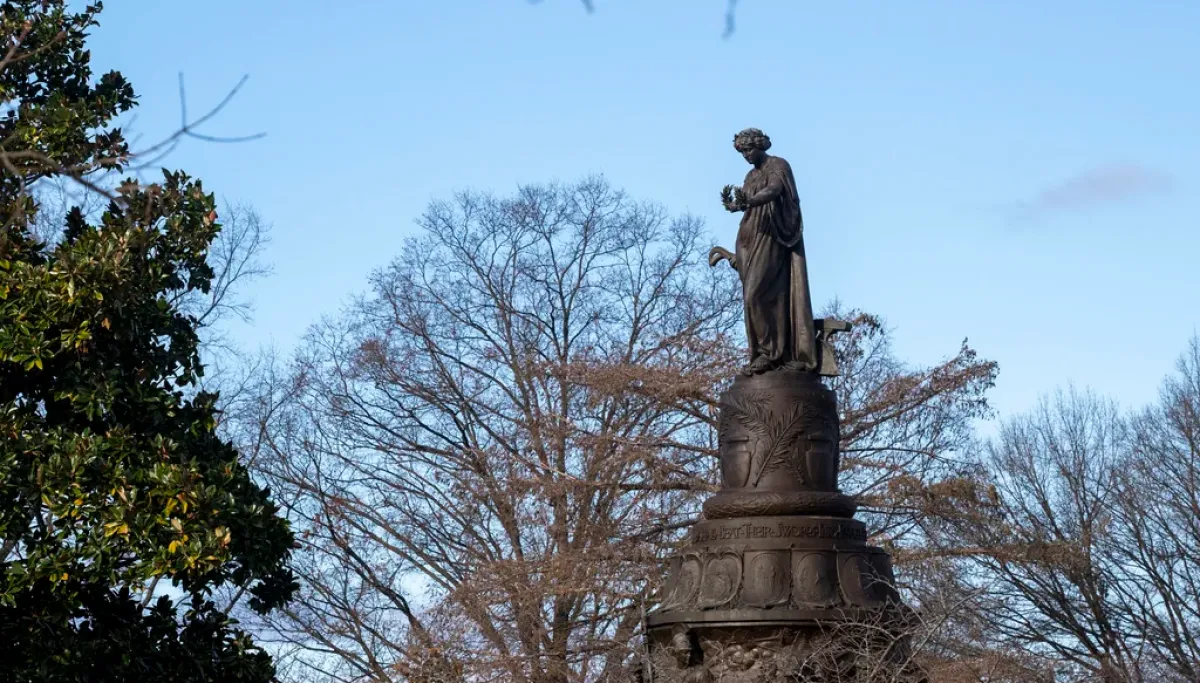
In 1914, President Woodrow Wilson presided over the opening of the 32-foot Confederate Memorial in memory of 482 Confederate graves located in Section 16 of the military cemetery. The statue commemorating the Civil War was removed in 2023, after a commission created by Congress said it painted a “nostalgic, mythologized vision of the Confederacy, including highly sanitized depictions of slavery.” The move provoked backlash from the Trump administration, with War Secretary Pete Hegseth vowing to restore it after arguing it was taken down by “woke lemmings” who believe in “erasing American history.” The Trump administration has now updated a marker at Arlington National Cemetery detailing the memorial’s history to remove the commission’s language slamming it. The military cemetery’s website regarding the memorial has been similarly updated. The Confederate Memorial is seen in Arlington National Cemetery in Arlington, Va., Dec. 18, 2023. (AP Photo/Kevin Wolf, File) The historical explainer at the cemetery formerly read: “The project was eventually led by the United Daughters of the Confederacy, an organization of white Southern women. … Designed by sculptor and Confederate veteran Moses Ezekiel, it presents a nostalgic, mythologized vision of the Confederacy, including highly sanitized depictions of slavery. … Arlington National Cemetery recognizes the importance of telling this complex and sensitive story. This panel represents just the first step in a long-term process to carefully and accurately interpret the history of the Confederate Memorial.”The explainer marker now reads: “The project was eventually led by the United Daughters of the Confederacy. The Confederate Memorial was designed by sculptor and Confederate veteran Moses Ezekiel, and erected in the center of Section 16 in 1914. The Army will develop interpretive content to ensure visitors receive clear and accurate contextual information, and will keep the public informed of development in this ongoing project.”The website now reads: “Unveiled in 1914, the Confederate Memorial was designed by noted American sculptor Moses Jacob Ezekiel, a Confederate veteran and the first Jewish graduate of Virginia Military Institute. Sculptor Moses Ezekiel was buried at the base of his creation in 1921, after being honored at the first funeral ceremony in the newly built Memorial Amphitheater.”The website formerly read: “Unveiled in 1914, the Confederate Memorial was designed by noted American sculptor Moses Jacob Ezekiel, a Confederate veteran and the first Jewish graduate of Virginia Military Institute. The elaborately designed monument offers a nostalgic, mythologized vision of the Confederacy, including highly sanitized depictions of slavery. Standing on a 32-foot-tall pedestal, a bronze, classical female figure, crowned with olive leaves, represents the American South. She holds a laurel wreath, a plow stock, and a pruning hook, with a Biblical inscription at her feet: ‘They have beat their swords into plough-shares and their spears into pruning hooks.’ The statue stands on a pedestal with four cinerary urns, one for each year of the war, and is supported by a frieze with 14 shields, one for each of the 11 Confederate states and the border states of Maryland, Kentucky, and Missouri. Thirty-two life-sized figures depict mythical gods alongside Southern soldiers and civilians.”The website formerly continued: “Two of these figures are portrayed as African American: an enslaved woman depicted as a ‘Mammy,’ holding the infant child of a white officer, and an enslaved man following his owner to war. An inscription of the Latin phrase ‘Victrix causa diis placuit sed victa Caton’ (‘The victorious cause was pleasing to the gods, but the lost cause to Cato’) construes the South’s secession as a noble ‘Lost Cause.’ This narrative of the Lost Cause, which romanticized the pre-Civil War South and denied the horrors of slavery, fueled white backlash against Reconstruction and the rights that the 13th, 14th, and 15th Amendments (1865-1870) had granted to African Americans. The image of the faithful slave, embodied in the two figures on the memorial, appeared widely in American popular culture during the 1910s through 1930s, perhaps most famously in the 1939 film ‘Gone with the Wind.’ Sculptor Moses Ezekiel was buried at the base of his creation in 1921, after being honored at the first funeral ceremony in the newly built Memorial Amphitheater.”DUFFY ANNOUNCES ROLLBACK OF NOISE EMISSIONS STANDARDS TO CLEAR WAY FOR HIGH-SPEED RAILThe changes came after the Biden administration undertook a sweeping effort to remove all names and items associated with the Confederacy, including renaming two Navy ships and nine Army installations in the South, as recommended in 2022 by the congressional commission. The commission was created after the death of George Floyd, which escalated racial tensions, boosted the Black Lives Matter Movement, and fueled nationwide riots and protests, leading military leaders to strip bases and other Pentagon infrastructure of Confederate-linked names.
Trump administration changes wording for Confederate-era statue removed in 2023
Full Article
Original Source
Read the full article at Washingtonexaminer →KhanList aggregates and links to publicly available news content. We do not host full articles from third-party sources. Always verify important information with original sources.