
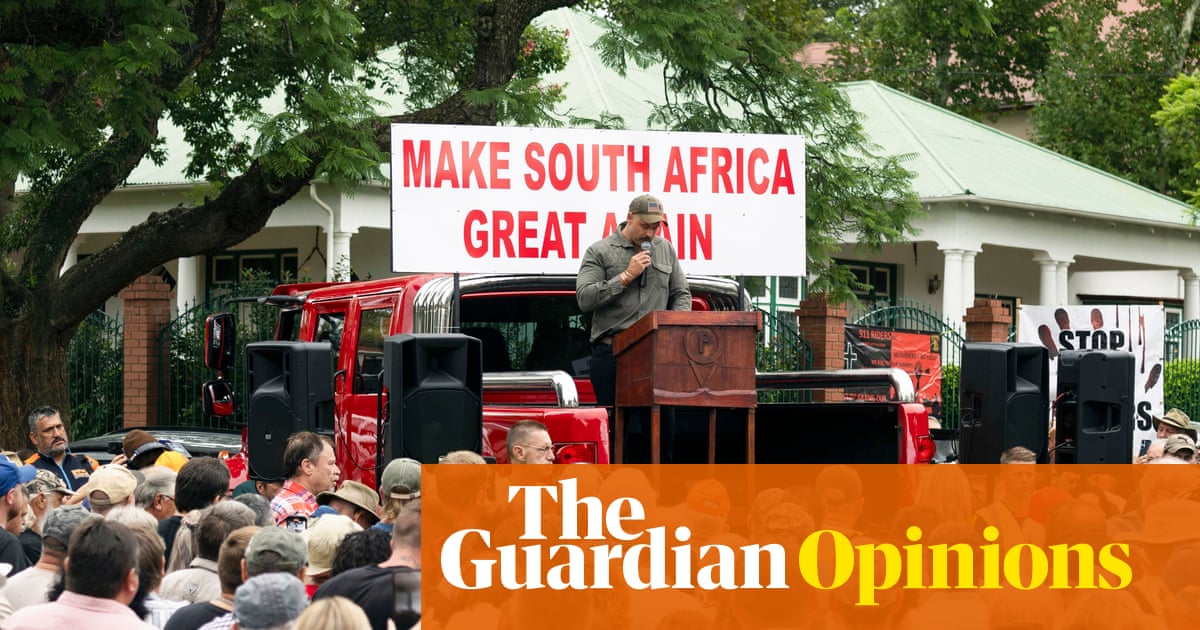
The United States once led most other nations on resettling refugees from all over the world. But in the fiscal year 2025- 2026, except for three people from Afghanistan, all of the 10,258 people admitted through resettlement were white South Africans.But admitting en masse the beneficiaries of South African apartheid, while simultaneously cancelling temporary protected status (TPS) for 350,000 Haitians, and making a spectacle of detaining and shackling them, is just the tip of the racist iceberg: the Trump administration is reportedly using this moment to double the initial resettlement support that refugees receive to $4,500 per person.As an expert on resettlement, I have been advocating for years for an increase in resettlement support. In 2022, I wrote a book showing the inadequacy of existing systems of support, and even consulted for the office of refugee resettlement on the issue. Yet, when the refugees weren’t white, the advocacy was not heard.Resettled refugees are an anomaly in the United States landscape for immigrant support, in that they are one of the very few legal categories of immigrants to receive any form of cash assistance. That is because they are selected, in theory, on the basis of humanitarian need. The people in my book were Syrians who had escaped war, many of whom had children with chronic health issues.This is yet another reason why this administration’s politicization of the refugee resettlement protection – at the exclusion of people who actually need it – is so pernicious.Still, the financial assistance received by refugees was always inadequate, pushing these people – once business owners and skilled artisans who had lost everything in war– into menial work within months of arrival, and into the experience of US poverty, which is no one’s salvation. Their downward mobility was by design – refugee support drew from a threadbare social safety net, eroded by anti-Black and anti-immigrant racism.Despite nativism, which stoked anti-immigrant sentiment, white Europeans who migrated to the US at the turn of the 20th century during the Progressive Era and New Deal received generous social support. Archival research by the sociologist Cybelle Fox shows that social workers did not deny them assistance on the basis of legal status, and shielded them from immigration enforcement. At the time, most immigrants to the United States were white, owing to racial quotas that limited travel to the country to people from western Europe.However, in the aftermath of the civil rights movement, as explicit discrimination was outlawed, and whites-only racial quotas for immigration abolished – the right, beginning with Ronald Reagan, set their eyes on destroying cash assistance for poor families of color.The welfare reforms were supported by the caricature of the “welfare queen” – an image of a single Black mother with “too many” kids who raked in thousands in government support fraudulently, only to spend it frivolously. Of course it did not matter that the actual woman accused of these acts, Linda Taylor, was white on the census.The goal for the poor, whether in the Refugee Act of 1980 or in federal welfare policy, became explicitly “self-sufficiency” – or nonreliance on government services, language that places the onus for poverty at the level of the individual – a moral failing caused by laziness or a lack of discipline rather than a societal one caused by redlining, or overpolicing, or even recovering from war.By 1996, the Personal Responsibility and Work Opportunity Reconciliation Act (PRWORA), a pillar of Newt Gingrich’s “Contract With America” – a part of the Republican Revolution meant to slash government benefits – was signed into law by Bill Clinton, not only turning welfare into workfare, but also excluding the vast majority of immigrants, documented and not, from any forms of cash assistance except for refugees and asylum seekers (and later survivors of trafficking).Holders of temporary protected status, like the Haitians now being deported, were never eligible for any of the forms of support that today’s white South Africans are eligible for. Instead, they paid taxes into a social service system that they could not benefit from.Meanwhile the white South Africans, are eligible, as resettled refugees, not only for the doubled initial assistance – often called Resettlement and Placement or “Welcome Money” – but also for cash assistance through Temporary Assistance for Needy Families (the official name for welfare post-1996 reforms) or Refugee Cash Assistance.And while the Haitians, or Venezuelans, or Somalis on temporary protected status never had a pathway to citizenship, these white South Africans will be eligible to become legal permanent residents (green card holders) in a year, and citizens five years after that.What makes this even more sickening is that TPS is a form of protection – designated for people whose countries are unsafe. The choice to deny them a pathway to citizenship was always itself a political one, that is now exposing 1.3 million holders of the status to the violence of deportation, and potential death.Today, the Trump administration is spending billions to brutalize Black and brown people, to arrest, detain and deport them, while doubling the amounts allocated for white “refugees”. And while Black and brown people are seeing their legal statuses cancelled overnight, white ones are being offered safe pathways for travel: the resettlement program offers refugees visas to come here.Where the wealthiest country in the world allocates money has always been a question of political will over political way, one not of budget allowances, but of whose lives are valued.With every act, from attacking voting rights and diversity, equity, and inclusion policies, to denying millions of Black and brown immigrants the chance at a dignified life while doubling the assistance of white ones, this administration makes explicit that to them only white lives matter.
Trump admin spends billions to deport Black and brown people while doubling dollars for white ‘refugees’ | Heba Gowayed
Full Article
Original Source
Read the full article at Theguardian →KhanList aggregates and links to publicly available news content. We do not host full articles from third-party sources. Always verify important information with original sources.