
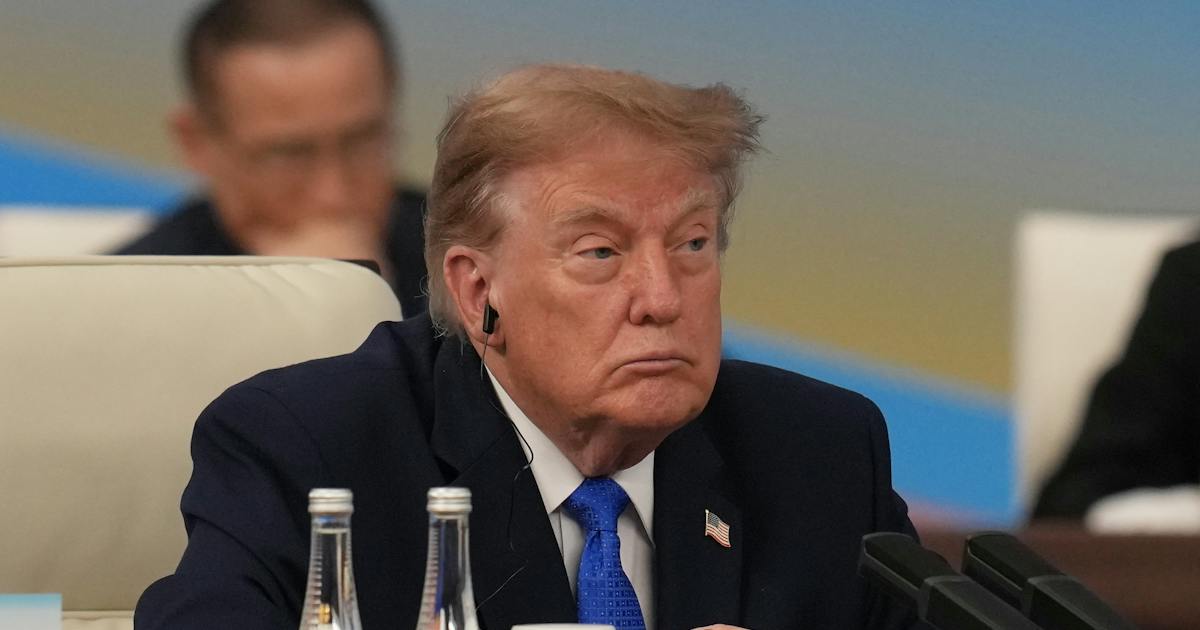
Grandpa’s napping again! President Donald Trump appeared to fall asleep during Chinese President Xi Jinping’s speech at the Asia-Pacific Economic Cooperation summit Wednesday, closing his eyes and falling forward in his chair as Jinping spoke about global trade. EMBARRASSING on the world stage: Donald Trump falls asleep during the APEC summit in China https://t.co/yTmBWYIHxh— Republicans against Trump (@RpsAgainstTrump) November 19, 2026 Trump has struggled to keep his eyes open at a series of public events in recent months, dozing off during a health care announcement at the White House, an Oval Office press conference on fraud, another announcing a new steel plant in Iowa, a roundtable on cybercrime, and the signing ceremony for his executive order changing the childhood vaccine schedule, as well as after getting excited about Russian President Vladimir Putin’s birthday, and repeatedly during the 9/11 memorial event at the Pentagon. This, plus his strange walking pattern and the needle marks on his hands, has medical experts concerned. The man’s health is not trending upward.The president’s allies, however, insist that he’s doing just fine. Wrote White House communications director Stephen Cheung on X Thursday: “Fake News! President Trump was looking at papers in front of him while the speaker made remarks. You can clearly see his eyes move back and forth.” (No, you cannot.) “This is why the people despise media so much. They constantly lie,” Cheung wrote, lying.Jared Kushner failed to disclose his significant financial stake in a company directly profiting from the wars he was sent to mediate.Kushner’s private equity firm Affinity Partners failed to disclose its $32 million stake in Arxis, a Connecticut-based defense contractor, The Atlantic reported Wednesday. The company produces “mission-critical” components of F-35 fighter jets, Navy destroyers, nuclear submarines, and anti-missile systems—the exact kind of assets that have been deployed in the conflicts in the Middle East and Russia-Ukraine, where Kushner, President Trump’s son-in-law, has served as a negotiator for the White House.Affinity Partners purchased its stake in Arxis after Trump was reelected, but the purchase was not disclosed to the Securities and Exchange Commission until November 5, just two days after the midterm elections. Per SEC rules, investment managers that own more than $100 million in certain kinds of securities must disclose them within 45 days. But when Affinity filed its required paperwork in mid-August, the company made no mention of Arxis. Three months later, Affinity amended the form to include information about the defense contractor. Is it possible that Trump’s billionaire son-in-law was concerned that his blatant war profiteering could impact the midterm elections?In its latest quarterly report, Arxis said that it got a “significant portion” of its revenue from suppliers and contractors with the U.S. government, specifically the Department of Defense, and noted that “rising geopolitical tensions” promised accelerated investments in global defense spending. For years Arxis had lost money, but after Trump returned to office, it was suddenly able to turn a profit. Last year, the company made $1.6 billion, and around 47 percent came from defense and space spending.This is far from the first time that Kushner has been accused of blatant self-dealing in his service to Trump. He used used peace negotiations with Russia to concoct a multibillion-dollar deal to benefit this business partners, invested in a firm that saw massive gains from Israel’s ongoing military campaign in Gaza, and used his gig as special envoy as an opportunity to try to raise funds from foreign governments and individuals in the Middle East.Last month, Kushner was accused of overseeing foreign slush funds filled and managed by the leaders of the United Arab Emirates, Saudi Arabia, and Israel and getting paid $50 million by the UAE to get former Secretary of State Rex Tillerson fired. Kushner has denied these allegations. A growing number of schools across the country are looking for search engine alternatives in lieu of Google’s AI ultimatum.The company announced earlier this month that it plans to turn off search engine access as soon as next year for K-12 schools that toggle off its AI tools, claiming the decision is necessary based on the technologies’ recent fusion. But educators were not satisfied by that.Some of the country’s largest school districts—including in Los Angeles, New York, and Chicago—are considering doing away with Google altogether.“If Google doesn’t reconsider their position, we will explore other search options,” Kamar H. Samuels, the chancellor of New York City schools, said in a statement. “We refuse to accept the false binary Google has laid out.”Potential options include DuckDuckGo and Microsoft’s Bing, both of which offer users the option to disable AI-generated answers. Google, meanwhile, has only offered school districts more ways to interact with AI, such as AI Mode and AI Overview, which provides users with chatbot search functions and summarized results, reported The New York Times. “We are actively building these experiences in partnership with educators, listening closely to ensure our products support students and teachers,” Google told the Times in a statement Wednesday, disclosing that the company would turn off its Gemini AI program and search engine for schools “until schools decide which services to enable.”Studies conducted over the last several months have indicated that the risks attached to the use of AI in schools outweigh the potential benefits. A January report by the Brookings Institution’s Center for Universal Education found that AI can “undermine children’s foundational development,” and that “the damages it has already caused are daunting.”New skill development and problem-solving abilities are among the chief concerns when it comes to early-age AI dependence. Children can easily fall into a catch-22 in which they continually offload their work onto the AI, diminishing their self-confidence and self-reliance in the process, according to the Brookings Institution report.“When kids use generative AI that tells them what the answer is,” Rebecca Winthrop, one of the report’s authors, told NPR in January, “they are not thinking for themselves. They’re not learning to parse truth from fiction. They’re not learning to understand what makes a good argument. They’re not learning about different perspectives in the world because they’re actually not engaging in the material.”Read about Google’s initial demand:After school on October 20, 2025, 16-year-old Taki Allen was waiting with three friends outside Kenwood High School in Baltimore County, Maryland, for a ride home from football practice. Allen was eating a bag of Doritos. Suddenly, at least six Baltimore County Police Department vehicles arrived at the scene, and officers leapt out, guns drawn, forcing the boys to the ground and searching them. The teens hadn’t done anything wrong. But Omnilert Gun Detect, an artificial intelligence weapon-detection system that scans security footage for firearms, had used the school cameras to misidentify Allen’s bag of chips as a gun.Allen and his classmates Yui-Osa Ogbeide, Devon Thompson Jr., and Keith Winfield III are all Black. The Lawyers’ Committee for Civil Rights Under Law filed a lawsuit on their behalf Tuesday against the police department, the Baltimore County board of education, school administrators, and several individual officers. “The encounter was terrifying and life-threatening,” the lawsuit says. “With armed police encircling them for no apparent reason, each student feared for his life and the lives of his friends.”After failing to find anything in the search, one police officer reportedly told the students, “AI is not the best,” and another said, “Fucking Omnilerts.” As the officers were leaving, another said, “Hey, thanks for not running away, that would have been a real problem.”The lawsuit showed that the principal texted school staff and administrators after the police left to laugh about the incident.The lawsuit also points out that the Omnilert Gun Detect system was patented in 2022, “barely a year” before it was implemented in Baltimore County schools. After it identified Allen’s doritos as a firearm, it sent a text message to a group of school administrators and police, who reviewed the alert and canceled it. But 10 minutes later, the school principal sent a screenshot of the footage in the security alert to a co-worker, who sent it to the police department, who then responded at the scene.The Omnilert Gun Detect parent company, Omnilert LLC, has claimed that the AI system “distinguishes guns from inert objects such as cell phones, hand tools, common office objects and more” in order to “diminish false positives.” Maryland’s Office of the Inspector General for Education, however, found that 99 percent of alerts in Baltimore County schools have been false positives.“These students were failed not only by a technology that is prone to false alerts, but also by the very adults meant to keep them safe when we send them to school. Instead of this protection, they were met with guns and traumatized,” Damon Hewitt, president and executive director of the Lawyers’ Committee for Civil Rights Under Law said. “And it could have been even worse.” The president’s latest judicial nominee is apparently not well versed on the U.S. Constitution.Texas Supreme Court Justice James P. Sullivan refused to acknowledge the parameters of the Twenty-Second Amendment during his confirmation hearing in the Senate Judiciary Committee Wednesday—even after Delaware Senator Chris Coons spelled it out for him.“Since we’re just talking about the importance of taking the oath to uphold the Constitution—Mr. Sullivan, can you just tell me what the Twenty-Second Amendment provides?” asked Coons.But Sullivan could not.“Senator, if I’m remembering correctly—and I carry it over my heart because sometimes it isn’t in my brain—but if I’m remembering it correctly, it is—” Sullivan said, squinting as he struggled to conjure the words before he whispered, “Oh boy, oh boy.”“No person shall be elected—” Coons interjected, offering him a clue as to how the amendment begins.“Ah yes, I’m sorry, thank you, thank you genuinely, Senator. ‘No person shall be elected more than twice,’ I believe, ‘to the office of the president,’” Sullivan said.“Has President [Donald] Trump been elected and served now twice as president?” asked Coons.“President Trump has been certified as the winner in the 2016 and the 2024—” Sullivan said.But Coons wanted a clearer, yes-or-no answer.“Is he eligible to run for president again in 2028?” pressed Coons.“So, Senator, as a nominee for a federal district court, it would be a violation I believe of Canon 5 for me to opine on something like that, and so respectfully I’m not so sure that I can—I can certainly tell you how I’d think about approaching a problem like that, but this seems like both—it certainly seems like it’s the sort of thing that is a subject of ongoing political debate,” Sullivan said, referring to a portion of the American Bar Association’s Code of Judicial Conduct that prohibits judges or judicial appointees from endorsing or opposing political candidates.“That’s a very disappointing answer,” Coons responded. “It strikes me as just bracingly clear on the face of it.”“I don’t think it is a subject of political debate,” the Delaware lawmaker continued, adding that “the question whether someone can serve a third term as president of the United States, I think, is only unresolved in the mind of President Trump.”OMG -- Trump judicial nominee James P Sullivan (a Texas Supreme Court justice!) reveals he doesn't know what the 22nd amendment says, but then after Chris Coons explains it to him, he refuses to say it'd be illegal for Trump to serve an illegal third term 🤦 https://t.co/YwkDcVa70C— Aaron Rupar (@atrupar) November 18, 2026 Trump has repeatedly said he was “not joking” about pursuing a third term in office. He first used that phrasing in March 2025, during a phone call with NBC News’s Kristin Welker, when he said that he was actually very serious about potentially circumventing the Constitution in order to try to lead the country for another four years after his second term ends.In an April 22 interview with Time magazine, the president said: “There are some loopholes that have been discussed that are well known” for keeping him in power. (There are not.)Read more about Trump’s 2028 obsession:
Trump, 80, Fully Falls Asleep During International Summit
Full Article
Original Source
Read the full article at Newrepublic →KhanList aggregates and links to publicly available news content. We do not host full articles from third-party sources. Always verify important information with original sources.