
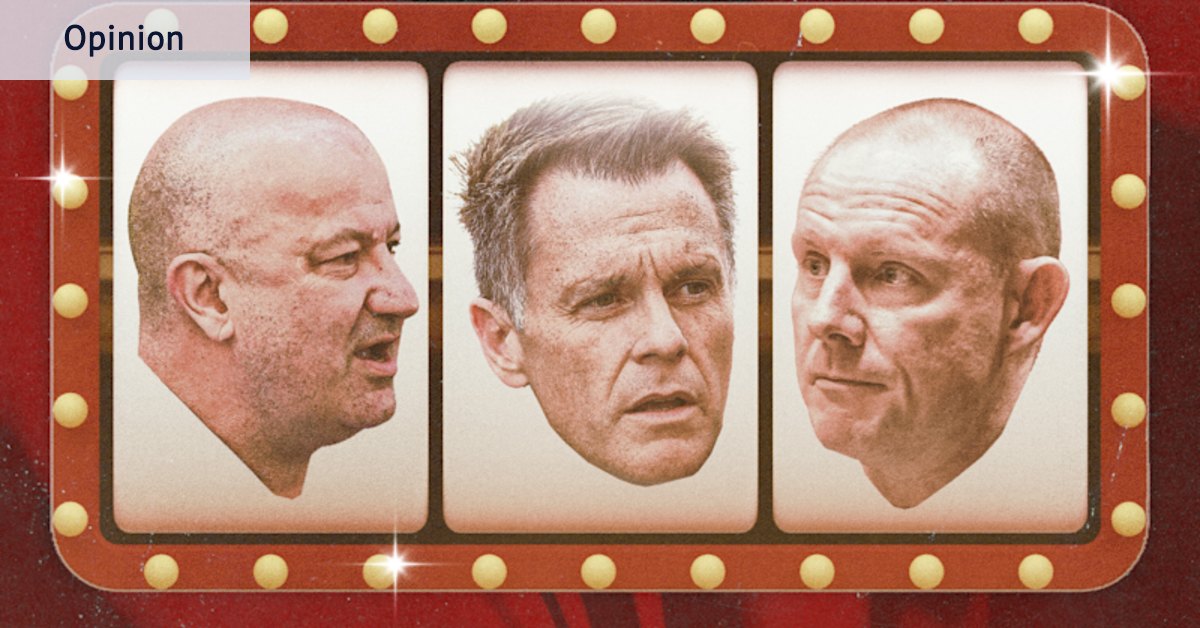
OpinionState political editorAugust 27, 2026 — 5:00amAt budget estimates on Wednesday, NSW Racing Minister David Harris crowed that the gambling reforms he’d announced a day earlier were the biggest in more than three decades.He’s probably right. How grim.The gambling reforms of Premier Chris Minns (centre) have disappointed many on the Labor side of politics, including Unions NSW boss Mark Morey (left) and Inner West Mayor Darcy Byrne.Aresna VillanuevaThe reforms unveiled by Harris are a victory for political timidity. Together with the wet lettuce that the Albanese government unveiled this month, they mark a tent-pole moment for mediocrity.Not that anyone should have expected more.The most significant difference between the Albanese government and the NSW Labor Party is that while some in the federal caucus actually called for change – it was the late Labor MP Peta Murphy who kick-started the push for reform with her report recommending a total ban on gambling ads and inducements – the Minns government has never shown any desire to seriously pursue pokies reform.It was Minns’ refusal to offer former premier Dominic Perrottet bipartisan support for cashless gaming which in effect killed it as an anti-money-laundering and harm-minimisation response. It is not an exaggeration to say Minns’ government has largely viewed the push for poker machine reform – including from the Herald – as an irritant. An issue to be neutralised.I suspect the government would have preferred to dismiss calls for mandatory cashless gaming and a reduction to the 87,000-odd poker machines across NSW as pious carping. The problem, however, is that the Labor Party rank-and-file disagrees.At the most recent NSW Labor Party conference in July, the government ceded to a motion calling for a “significant reduction” in the number of pokies in the state and a super profits tax on major clubs. Neither was in the package announced on Tuesday, but the cross-factional pressure applied by figures such as Unions NSW boss Mark Morey and Inner West Mayor Darcy Byrne helped to at least light a blowtorch. Harris says the super profits tax is still on the table.And so we have this package, greeted by reform advocates with a resigned “better than nothing” and by the club lobby with a silence that, as Byrne said, tells you everything you need to know.There are some good things in there. Reform campaigners have long called for a statewide self-exclusion register. And the ban on VIP programs is a significant and welcome change. My colleague Harriet Alexander had written about some of these programs, such as the Marconi Club in Bossley Park’s Diamond Suite, where patrons have been required to turn over at least $500,000 a year on the pokies to qualify for entry to the members-only lounge. During budget estimates, Harris conceded they were effectively operating a “loophole” through existing bans on gambling inducements.But amid growing public sentiment favouring serious reform, the reality is that the clubs got what they wanted. The decision to roll out mandatory facial recognition technology is a major win for the lobby, which has promoted it as an alternative to cashless gaming for years. Indeed, it is already in place in many large clubs. How’s that working out?The devil will be in the detail, but there are many questions about how it will work in practice. What guardrails will prevent clubs from using facial recognition to target gamblers with marketing, for example? How will clubs enforce the self-exclusion register? And what, if any, penalties will there be for clubs that don’t?It is worth noting that part of the pushback to cashless gaming, when it was championed by Perrottet, was that it was an invasion of privacy. God forbid.Perhaps the saddest part was Harris’s insistence that it doesn’t matter very much that NSW has the highest number of poker machines per capita of any jurisdiction on planet Earth. When asked whether he had a target in mind for the number of pokies that should be allowed in the state, he said that number “matters less” because of the measures the government is taking.“So that means that what we have to do is – rather than removing machines that actually won’t make a difference to people experiencing harm because they’ll still have access to a machine – we have to make every machine safe,” Harris said. The logic starts to crumble under even cursory interrogation.First, if that is the case, why is the government promising, for the second time, to increase the rate of entitlement forfeiture – the number of poker machine licences a pub or club must give up when moving them from one venue to another – from one in three machines to one in two? Second, and most obviously, why is the industry so keen to hang onto them?There is nothing else going on here but fear of a backlash.But at some point, as both major parties watch their primary vote circle the drain, they’re going to need to grapple with the idea that there are worse things than a marginal-seat campaign by the clubs lobby. Perhaps what voters really want is a political class that recognises the tangible problems in our society, and has the backbone to do something about it.Michael McGowan is The Sydney Morning Herald’s state political editor.Get a weekly wrap of views that will challenge, champion and inform your own. Sign up for our Opinion newsletter.More:Poker machinesOpinionFor subscribersALPGamblingDominic PerrottetChris MinnsFrom our partners
True believers wanted serious gambling reform. We got the hokey pokies
Full Article
Original Source
Read the full article at Smh →KhanList aggregates and links to publicly available news content. We do not host full articles from third-party sources. Always verify important information with original sources.