
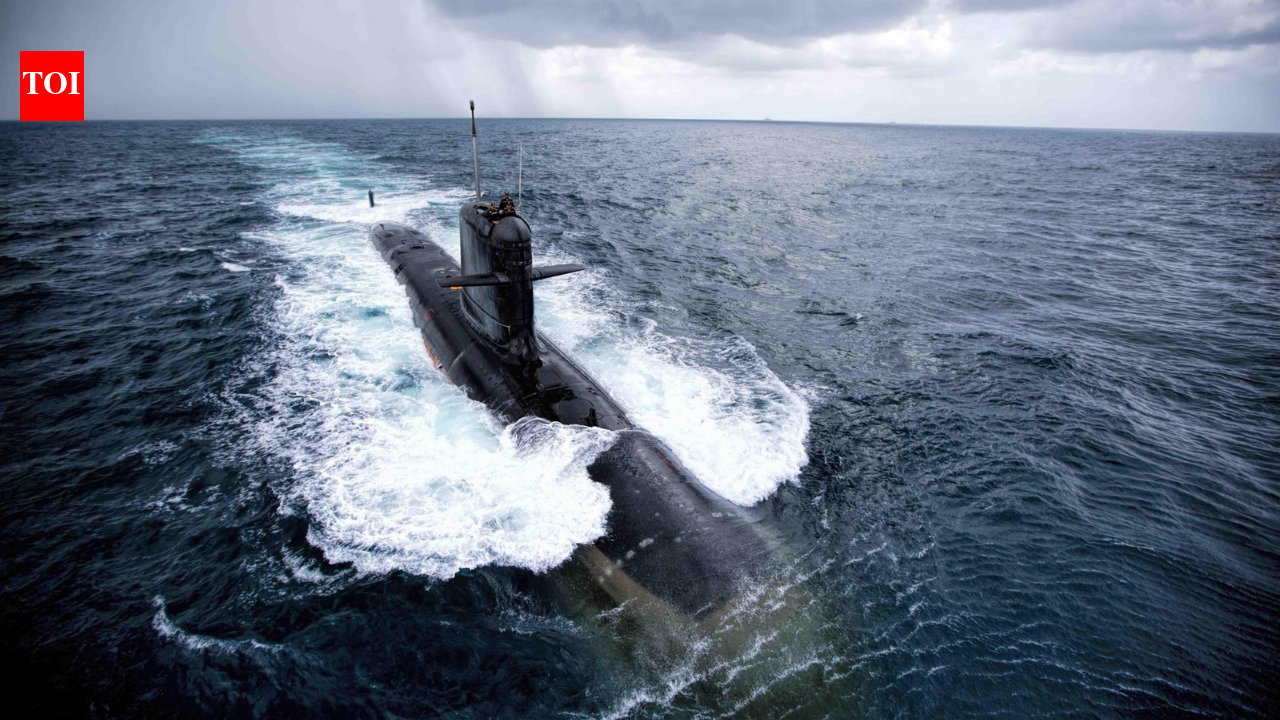
An Indian Navy Kalvari-class submarine underway on the surface. (Image credit: Indian Navy)The Navy’s conventional submarine fleet is ageing at a time when the need for new undersea vessels is growing. Yet plans to replace and expand this critical arm of the Navy remain years away from delivery, raising concerns about a widening gap in underwater combat capabilities.The Navy currently operates 16 conventional diesel-electric submarines across three classes (Kalvari, Sindhughosh and Shishumar) alongside three strategic submarines.Its plan to induct 24 conventional submarines by 2030 has fallen behind schedule. Four Sindhughosh-class boats have been retired, including INS Sindhughosh, the lead vessel of the class, while only six Kalvari-class Scorpene submarines have been inducted. The Shishumar-class boats have undergone mid-life upgrades, but average around 35 years in age, and capability gaps remain. With more older submarines due to be retired in the coming years, the pressure to replenish the fleet is mounting.A 30-year submarine-building plan drawn up in 1998 by Vice Admiral AK Chatterji envisaged parallel foreign and domestic construction programmes, with the aim of building up the fleet by 2030. That ambition, however, has fallen well behind schedule.India’s strategic submarine programme has progressed faster. INS Aridaman, the third Arihant-class ballistic missile submarine, has strengthened the country’s nuclear triad, alongside land-based missiles and aircraft. It is designed to carry up to eight K-4 nuclear-capable missiles, each with a range of 3,500 km. A fourth ballistic missile submarine has been launched at Visakhapatnam, while the larger S-5 class is planned for the future.Submarines are the hardest leg of the nuclear triad to track because they can remain concealed deep underwater. This makes them crucial to a credible nuclear deterrent, allowing a country to retain the ability to retaliate even if its land-based assets come under attack.Their value extends beyond nuclear deterrence. Earlier this year, a US submarine reportedly tracked and sank the Iranian frigate IRIS Dena off Sri Lanka without the warship detecting the underwater threat. The episode highlighted the advantage submarines can have over surface vessels when operating undetected.For conventional submarines, one of the most important technologies is air-independent propulsion (AIP), which allows them to remain submerged for two to three weeks without surfacing or snorkelling to recharge their batteries. Boats without AIP must snorkel more frequently, increasing their vulnerability to detection by aircraft and surface vessels. Only the six Kalvari-class submarines are slated to receive a DRDO-developed AIP system.The most significant procurement effort is Project 75I, a tender worth around Rs 70,000 crore for six to nine submarines. Mazagon Dock Shipbuilders and Germany’s Thyssenkrupp Marine Systems (TKMS) have cleared the technical evaluation stage, with India moving towards final cost negotiations for at least six Type 214 submarines equipped with AIP. However, deliveries will take years, with the first submarine expected about seven years after the contract is signed.India is also looking to expand domestic manufacturing of submarine weapons. Hyderabad-based VEM Technologies has signed an agreement with TKMS to manufacture heavyweight torpedoes in the country.Project 76, an indigenous conventional submarine programme, is expected to follow, with the proposed submarine family incorporating a modified DRDO-developed AIP system.The Navy also plans to develop nuclear-powered attack submarines under Project 77. The Cabinet Committee on Security has approved two such submarines, worth Rs 35,000 crore, with the first expected by 2036-37.The Navy also plans to lease a nuclear-powered attack submarine from Russia to strengthen its capabilities in the interim.The Navy expects to acquire at least 22 domestically built submarines under these programmes.
Trouble beneath the waves: India’s submarine fleet is ageing and replacements are years away
Full Article
Original Source
Read the full article at Timesofindia →KhanList aggregates and links to publicly available news content. We do not host full articles from third-party sources. Always verify important information with original sources.