
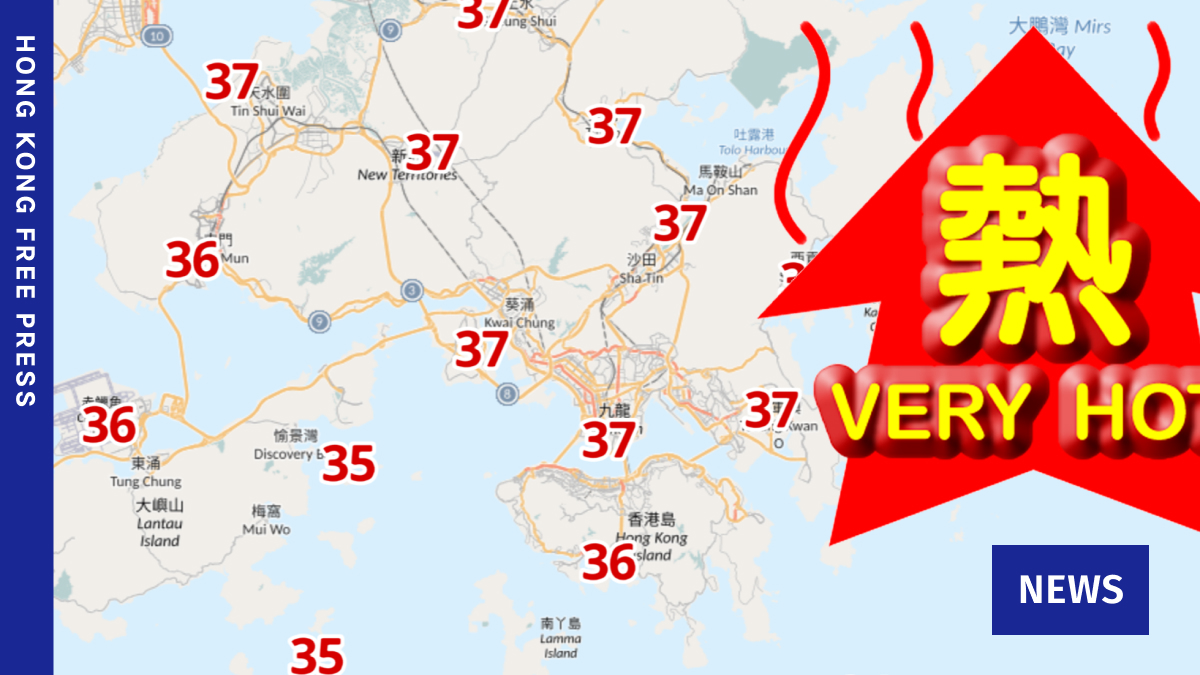
Temperatures reached a record-breaking 36.9 degrees Celsius at the Observatory (HKO) headquarters on Sunday, as a heatwave influenced by Tropical Cyclone Dolphin continued to affect Hong Kong. Temperatures as of 3pm, August 9, 2026. Photo: Observatory. Official reference temperatures for the city’s long-term records are recorded at the HKO headquarters in Tsim Sha Tsui. Sunday’s reading marks the highest temperature recorded since records began in 1884. Temperatures elsewhere in the city exceeded 38 degrees Celsius. “With Tropical Cyclone Dolphin moving towards the vicinity of Zhejiang and moving inland, its outer subsiding air will persistently bring extremely hot weather to the territory today to Tuesday,” the Observatory said. “High temperature weather is expected to continue midweek this week,” it added. Temperatures on, August 9, 2026. Photo: Observatory. The heat will give way to rain by Wednesday, the HKO added: “Upper-air disturbances will bring unsettled weather to southern China in the latter part of this week. Showers will increase and high temperature weather will be alleviated slightly over the region.” El Niño event The HKO warned earlier that the city may experience record-breaking high temperatures this year and next year due to climate change and forecasts of a “super-strong” El Niño event. El Niño is a natural climate phenomenon whereby sea surface temperatures in the central and eastern equatorial Pacific become abnormally warm. A farmer harvests rice under extreme heat in a paddy field in Hong Kong’s Tai Po area on July 25, 2024. Kyle Lam/HKFP. This causes the east-to-west trade winds to subside, keeping warmer than normal air in the eastern and central parts of the tropical Pacific. This, in turn, temporarily raises global average temperatures, especially when combined with human-caused climate change. Last month marked Hong Kong’s second-rainiest July on record, with a total of 20 amber rainstorm warnings and five red rainstorm warnings issued. The Intergovernmental Panel on Climate Change has warned that the intensity and frequency of heatwaves have continued to increase since the 1950s due to human-caused climate change. The prevalence of greenhouse gases like carbon dioxide – which trap heat in the atmosphere – raises the planet’s surface temperature, with hotter, longer heatwaves putting lives at risk. See also: How extreme heat became the deadliest silent killer among world weather disasters Hong Kong has already warmed by 1.7 degrees Celsius since the Industrial Revolution, research NGO Berkeley Earth says. Heat and humidity may reach lethal levels for protracted periods by the end of the century, according to a 2023 study, making it impossible to stay outdoors in some parts of the world. Safeguard press freedom; keep HKFP free for all readers by supporting our team Support HKFP | Policies & Ethics | Error/typo? | Contact | Newsletter | Transparency & Annual Report | Apps Make a one-off donation. Tom founded Hong Kong Free Press in 2015 as the city's first crowdfunded newspaper. He has a BA in Communications and New Media from Leeds University and an MA in Journalism from the University of Hong Kong. He previously founded an NGO advocating for domestic worker rights, and has contributed to the BBC, Deutsche Welle, Al-Jazeera and others. Tom leads HKFP – raising funds, managing the team and navigating risk – whilst regularly speaking on press freedom, ethics and media funding at industry events, schools and conferences around the world. More by Tom Grundy
Tropical Cyclone Dolphin: Hong Kong sees hottest day on record as Observatory HQ records 36.9°C
Full Article
Original Source
Read the full article at Hongkongfp →KhanList aggregates and links to publicly available news content. We do not host full articles from third-party sources. Always verify important information with original sources.