
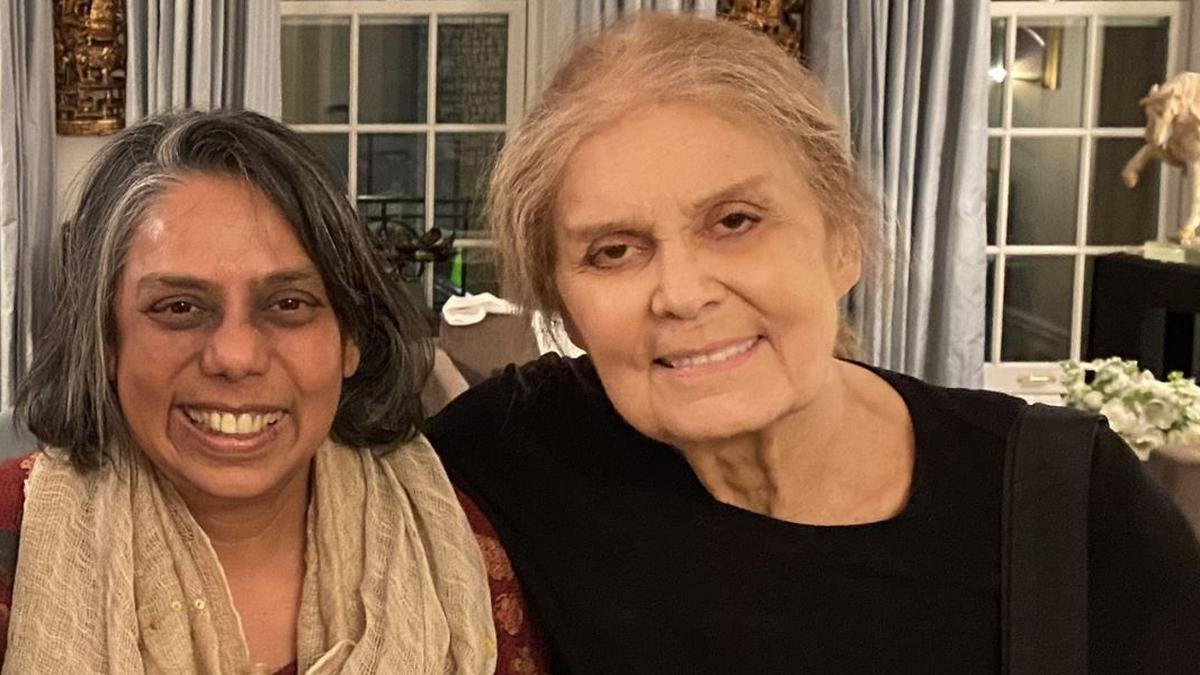
Venice was full of light when the news came that Gloria had died. I was there for the Vital Voices Venice Dialogue, among women confronting authoritarianism across continents. Grief entered the room, but it did not leave me alone. Almost every woman there had known Gloria or been changed by an idea she set loose in the world. One remembered her wit; another, her attentiveness; another, the permission she gave her to trust her own experience.As the stories moved around the room, sorrow became companionship. I thought: this is what Gloria would have wanted. We were not turning her into a monument. We were doing the work, listening to one another, seated in a circle.A passage to IndiaGloria came to India in her 20s, in1956, drawn by the Theosophy of her mother and both grandmothers and inspired by Gandhi’s non-violent struggle against British colonialism. She began her Chester Bowles scholarship at Miranda House in Delhi, but within two months left the security of college life to travel with Gandhian organisers responding to caste violence in villages. She wrote in a later essay that her feminism was shaped by what she learned then.There, she watched the Gandhians listen before trying to persuade and saw injured communities step back from seeking revenge. Gandhi’s organising principles stayed with her. She taught me that change begins at the bottom and transforms the top; that if you want people to listen, you must first listen to them.She carried those lessons into feminism and distilled their egalitarian spirit into a phrase of her own: “We are linked, not ranked.”India remained part of Gloria’s inner map. Gandhi was at the centre of it, but so were women who widened his inheritance, like the freedom fighter Kamaladevi Chattopadhyay, whom Gloria said was her last teacher. She saw his ideas in operation at SEWA, led by lawyer-activist Ela Bhatt, who organised poor self-employed women into the largest trade union of unorganised workers in the world. They confirmed that history is made not only by the “great man” at the top, but by people discovering their collective strength.Meeting GloriaThat belief brought us together. A mutual friend told Gloria how I organised survivors of sex trafficking through my Forbesganj and Kolkata-based NGO Apne Aap Women Worldwide. Then she emailed me, in 2007, to ask whether I had time to take her through my work.That year, I took her in an auto-rickshaw to the Subhash Camp settlement where I worked in Delhi, thinking I had little to show. It began to drizzle. We stood on the steps of a half-built kuccha brick house as several women formed a circle and I translated. My first impression of Gloria was of a curious person who cared. But I was unsure how to bridge the gulf between continents, race and language.Then Gloria spoke her truth. She had left America to escape marriage to her fiancé and had an abortion in England on the way to India. She kept it secret for years, until she met women sharing their abortion stories. She said that telling her secret set her free and taught her the power of collective courage.It changed how I organised. I learnt that sharing our truth as we experience it is better than long theoretical lectures. From Gloria I understood, for the first time, that the most radical thing you can do is be understood.Words in armsOur bond grew because we were writers and activists. Neither of us believed words were separate from action. Gloria knew that language reveals power. She challenged the phrase “sex worker” and asked audiences to say “prostituted woman.” It turned a label into a question: who prostituted her, who bought her, and which inequalities made her available for sale? Words could conceal injustice or expose it. Gloria Steinem, along with Ruchira Gupta, met women who were pushed into prostitution, in Kolkata and Bihar’s Forbesganj. | Photo Credit: Special arrangement In Kolkata, in 2012 and 2014, she walked with me through red-light areas and sat with women without hurry. In Bihar’s Forbesganj, she listened to women and girls resisting caste destinies of prostitution. She carried their voices into her work. She stood beside Apne Aap, chaired our international advisory board, joined our Last Girl Awards and helped us insist that no woman or girl is for sale.We travelled and wrote together, including a New York Times blog and the book As If Women Matter (2014). We argued, laughed and learnt. My Forbesganj, Kolkata and Delhi homes became her India home; hers became my New York home. My favourite image is Gloria opening her door and saying, “Welcome home.” Friendship lived in shared meals, unfinished sentences, questions and editorial meetings.We toyed with headlines for my memoir, No More Cages, One Heart, Two Countries, Uprooting Hierarchy…, and never agreed. I used to ask her about being accused of being a CIA agent, and she would smile and say that she had worked to take students to youth festivals as a student to earn some money. It was a job, and she did not regret it. But she added that she was always against American imperialism, believing that the world was a spaceship with everyone on it and borders were fictional, like migratory patterns. Her favourite books were Bruce Chatwin’s The Songlines (1987) and Sven Lindqvist’s Exterminate All the Brutes (1992). The Pro Choice March for Women's Lives, co-led by American feminist leader Gloria Steinem, in Washington D.C., in 1986. | Photo Credit: Getty Images Gloria Steinem attends the Women’s March on Washington in 2017, in Washington, D.C. | Photo Credit: Getty Images We had long conversations about how feminism in the Global South differed from the West, and she would say, “we have a lot to learn from the original matrilineal cultures of the East.” We discussed how the control of women’s bodies was necessary to reproduce caste or race, and how the most fundamental of all hierarchies was patriarchy, which we learnt at home. And when I asked her about Israel and Palestine, she said she didn’t believe in states formed along religious lines. Gloria Steinem at the Women's March rally in Washington, D.C. | Photo Credit: Getty Images A growing circleOn her last birthday, this March 25, Gloria wrote me a card: “I am glad our lives have overlapped. My birthday, not yours.” It was a tender sentence, and so like her. She imagined life not as a solitary line, but as circles crossing other circles.In an introduction to my forthcoming book of paintings, My Forbesganj Garden, she wrote that “the cycle of life is in nature.” One we must protect. And told me: “Don’t worry about what you can do, do what you can. Only time will tell if it’s big or small. But do it as if it matters.”At our last meeting, this summer, we spoke about reincarnation and she said one life was enough for her.She looked frail but promised to live to 135 and see Donald Trump out of power. She used to call him nothing but a toupee. Her humour helped us survive politics without surrendering to it.In Venice, women who knew her — actor Jane Fonda, environmentalist Susana Muhamad, fashion designer Diane von Furstenberg, technology executive Megan Smith and political strategist Huma Abedin — remembered that promise with an ache. Yet Gloria was present in our stories, in the conviction that listening is a form of organising and in our refusal of hierarchy. As I spoke, I felt that the circle did not remove grief. It held it. (From left) Ruchira Gupta, Gloria Steinem, and actor Ashley Judd attend the Apne Aap dinner in September, 2017 in New York City. | Photo Credit: Getty Images Gloria’s chair is empty, but the circle has grown larger. Our lives still overlap — in every woman who speaks, every woman who listens, and every last girl who tells a man, “You are not the boss of me.”She always said we have opened the doors for you, now walk through. I am not passing the torch but kindling your torch. And, all of us will hold our torch and keep them burning. The writer is an activist author, founder of anti-sex trafficking organisation Apne Aap and a New York University professor.
Tribute | I saw Gloria Steinem turn Gandhi’s lessons into a global feminist movement
Full Article
Original Source
Read the full article at Thehindu →KhanList aggregates and links to publicly available news content. We do not host full articles from third-party sources. Always verify important information with original sources.