
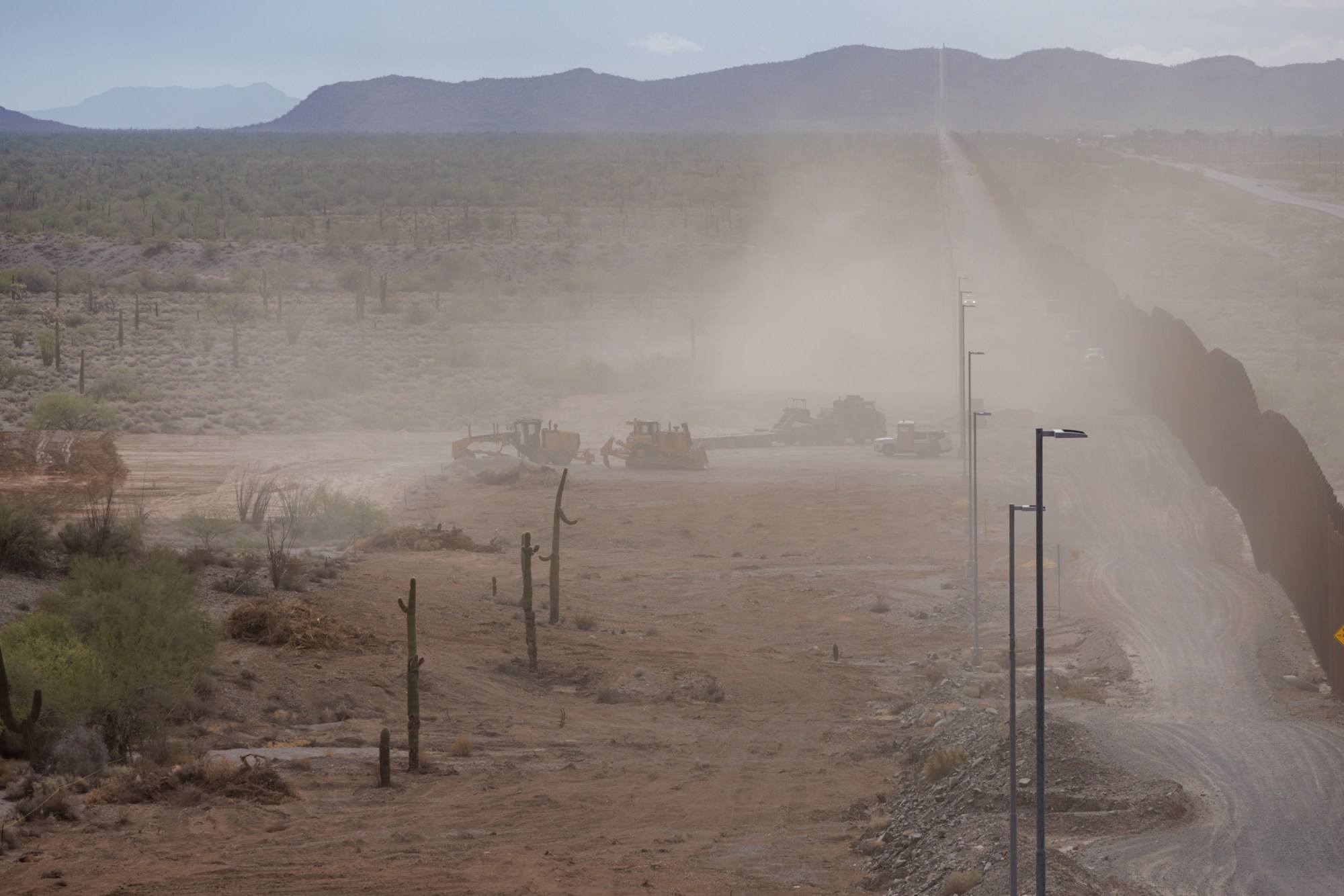
Lorraine Eiler stood in the blazing August sun, surrounded by reporters, to offer a warning. The Trump administration was racing to erect a second border wall across Organ Pipe Cactus National Monument, southwest of Tucson. If the bulldozers came, she said, they were bound to disturb the final resting places of her family and Hia-Ced O’odham tribal ancestors. “People used to live here,” the 89-year-old said. Fifteen days later, her fears were realized. ProPublica has confirmed that Native American remains were unearthed in Organ Pipe amid soil overturned by border wall contractors. The discovery, unreported until now, was made on Sept. 8, the National Park Service said in a statement. “Following established protocols, the University of Arizona conducted an assessment and confirmed that the remains are human and align with tribal cremation practices,” the agency said. The Native American Graves Protection and Repatriation Act governs the steps agencies must take following an inadvertent discovery of Native American remains on federal land. Those steps include halting any activity that contributed to the discovery until tribal communities are consulted. “The National Park Service is committed to respecting tribal rights and traditions,” the agency went on to say, adding that it was “working diligently to identify the culturally affiliated tribe and ensure the respectful return of the remains, so the tribe may observe their religious and cultural practices.” Eiler was alerted to the discovery by a cultural affairs specialist with the Tohono O’odham Nation, a larger tribe whose reservation is east of Organ Pipe, and later by the Organ Pipe superintendent’s office. Her family discussed what to do next. Ultimately, they decided to hold off on reburying the newly unearthed remains until construction in the area stops, fearing the work will disturb more sites. “Who knows what more will come up,” Eiler said in an interview. “They’re going to find remains wherever they dig.” Hia-Ced O’odham elder Lorraine Eiler stands in the shade of a giant saguaro cactus in Organ Pipe National Monument in 2022. Roberto “Bear” Guerra Customs and Border Protection contractors have bulldozed a wide swath of vegetation parallel to the international divide. The agency has fashioned staging areas for heavy equipment by knocking down, uprooting and attempting to transplant select specimens of the monument’s native plants. Eiler was told the remains were found by a park service archaeologist near the base of a saguaro cactus that was still standing. In a statement, CBP said it was advised of the discovery six days after it was made, that its cultural resource specialists examined the area and found no other remains, and that “no additional construction has occurred at this location to date.” The discovery comes amid tensions between the Department of Homeland Security and tribal communities in the Sonoran Desert. In April, border wall contractors bulldozed through a large, well-marked earthen etching, known as the Las Playas Intaglio, that was believed to be at least 6,500 years old. (CBP said the incident was accidental.) Soon after, the department awarded a $1.3 billion contract for construction of a 62-mile border wall across the entirety of the Tohono O’odham Nation. The tribe is fighting the project in federal court and has erected “no trespassing” signs to keep border wall contractors off its land. As ProPublica recently reported, DHS has responded by deploying masked federal agents as escorts for its work crews and conducting aerial surveillance of tribal members. The head of CBP has justified the need for a wall by describing the reservation as “one of the most dangerous smuggling and trafficking corridors on the Southwest border.” Verlon M. Jose, the tribe’s chairman, expressed gratitude that the park service had notified his office of the discovery, but mourned the fact that it was necessary. “When you have mass destruction and disturbance of land taking place where there are clearly sacred sites, cemeteries and other areas of cultural importance, these types of discoveries are bound to happen,” Jose said in a statement. “Every time this happens it is a wound to the heart of all members of the Tohono O’odham Nation — these are our ancestors, our family members — whose remains are being desecrated.” U.S. Rep. Adelita Grijalva, who appeared with Eiler and the chairman at the August news conference, blasted the government for failing to heed their warnings. “Tribal leaders and elders have warned DHS about the devastating consequences of bulldozing through their ancestral lands, beginning with the destruction of the Las Playas Intaglio,” she said in a statement. “For months, those warnings have fallen on deaf ears. Now, we are seeing exactly what they feared: sacred sites destroyed and ancestral burial grounds desecrated.” James T. Watson, curator of bioarcheology in the Arizona State Museum at the University of Arizona, analyzed the remains recovered in Organ Pipe in the field. While he was not authorized to discuss the details of his findings without park service approval, Watson said in an email that he confirmed the remains were human. The evidence suggested they were cremated in a manner consistent with precolonial practices in the region dating back 1,500 years, he wrote. Under NAGPRA, the graves protection act, Native American remains inadvertently uncovered on park service lands must be immediately secured, Watson explained, and the superintendent of the jurisdiction must notify “all relevant lineal descendants” with “potential cultural affiliation or ancestral ties to the land.” “Work in the immediate discovery area must remain suspended for at least 30 calendar days,” he wrote, while the park service consults with tribal representatives “to determine the disposition and physical treatment of the remains.” Workers clear desert flora to make way for construction of a double border wall in Organ Pipe National Monument. Anna Watts In a region as rich with archaeological sites as the American Southwest, the inadvertent disturbance of Native American remains occurs with some regularity. What sets the discovery in Organ Pipe apart are the extraordinary powers the Department of Homeland Security wields to expedite wall construction in the borderlands. Following the Sept. 11, 2001, terrorist attacks, Congress passed the Real ID Act, which included a provision empowering the secretary of DHS to waive any law that might slow border wall construction. In the two decades since, DHS has invoked its powers 66 times, with 60 of those instances occurring under President Donald Trump’s two administrations. When DHS uses this authority, it typically waives dozens of laws at a time. That was the case in 2019 when the department set its sights on Organ Pipe. A waiver issued by then-acting Secretary Kevin K. McAleenan set aside more than 40 of the nation’s most stringent environmental and cultural resource protection laws, including the National Environmental Policy Act, the Endangered Species Act, the Clean Water Act and others. Also on that list was the Native American Graves Protection and Repatriation Act, the landmark 1990 law that acknowledged the nation’s long history of desecrating Native American burials and required that ancestral remains and cultural objects be returned to tribes. In an internal 2019 report obtained by The Washington Post, park service officials identified nearly two dozen archaeological sites in Organ Pipe as at risk of damage or total destruction by government contractors. Of particular significance is a desert oasis known as Quitobaquito Springs. Less than 200 feet from the international border, the springs provide one of the only reliable sources of groundwater and shade for miles around, and they were a longtime gathering place, grazing site and home for O’odham families. “Archaeological evidence of human presence at Quitobaquito extends back thousands of years, at least to Archaic times,” the survey found, adding that the springs represent the “only known Hia C-ed O’odham village site in the United States.” A park service report in 2024 noted that a cemetery at Quitobaquito holds the remains of at least two families, including Eiler’s, and 34 graves. Throughout the region, remains of 5,500 ancestors that were displaced have been made available for return to the Tohono O’odham Nation, according to ProPublica’s NAGPRA database. “This sort of incident has happened numerous times across our homeland, and it’s always alarming to hear about a case from an O’odham point of view,” said David Martínez, a professor of American Indian and transborder studies at the University of Arizona and a member of the Hia-Ced O’odham and Akimel O’odham tribes, as well as the Gila River Indian Community. “Those remains shouldn’t have been disturbed in the first place,” he said. “While there are protocols existing today to properly care for these remains, ultimately, whatever either the government or the corporate world is pursuing to build, we know that at some juncture that construction will continue, and it always leaves us feeling, I think, a little hollow.” Today, Quitobaquito lies in the shadow of the border wall erected during Trump’s first term. Its construction required detonating explosives in the national monument, blasting apart an area called Monument Hill and outraging tribal leaders. According to Eiler, the remains recovered in September were not found at the springs, though government work crews are working in close proximity to the site. This year, DHS hired Sundt Construction, an Arizona-based company, to build a second wall in the monument. The $443 million contract was finalized in May. (Sundt directed questions concerning the discovery of human remains on its job site to CBP.) According to CBP, the 2019 waiver for Organ Pipe is still in effect, years after completion of the project that prompted it. A second waiver, exempting DHS from many of the same laws and applying to the national monument as well as a wildlife refuge to the west, was issued by Homeland Security’s then-Secretary Kristi Noem last year. “Unfortunately, there is no end date to the effectiveness of the waivers,” said Dinah Bear, a Tucson-based lawyer who served for 25 years as a senior attorney in the White House’s Council on Environmental Quality under both Democratic and Republican administrations. What’s more, she added, “there’s nothing in the statutory language that ties the waivers to a particular project.” The Department of Homeland Security’s waiver powers have been central to a high-profile legal fight over the department’s efforts to build a border wall through Big Bend National Park in West Texas, with a federal judge overseeing the case recently ordering a temporary halt to the project. Borderlands advocates in Arizona are hoping for similar interventions. In Congress, Grijalva is preparing legislation to void existing waivers that have allowed DHS to disregard laws designed to protect tribal sovereignty, sacred sites and environmentally sensitive lands. In the meantime, construction on the border continues. For Eiler, it’s not just the destruction in Organ Pipe that’s troubling. She sees the disturbance of tribal graves resulting from wall construction as reflective of a wider pattern of destruction across the border. “It’s sad because it’s not only happening down there,” she said. “It’s happening all over the United States, and nobody’s saying much about it.”
Tribal Leaders Warned Border Wall Construction Would Disturb Native American Remains. They Were Right.
Full Article
Original Source
Read the full article at Propublica →KhanList aggregates and links to publicly available news content. We do not host full articles from third-party sources. Always verify important information with original sources.