
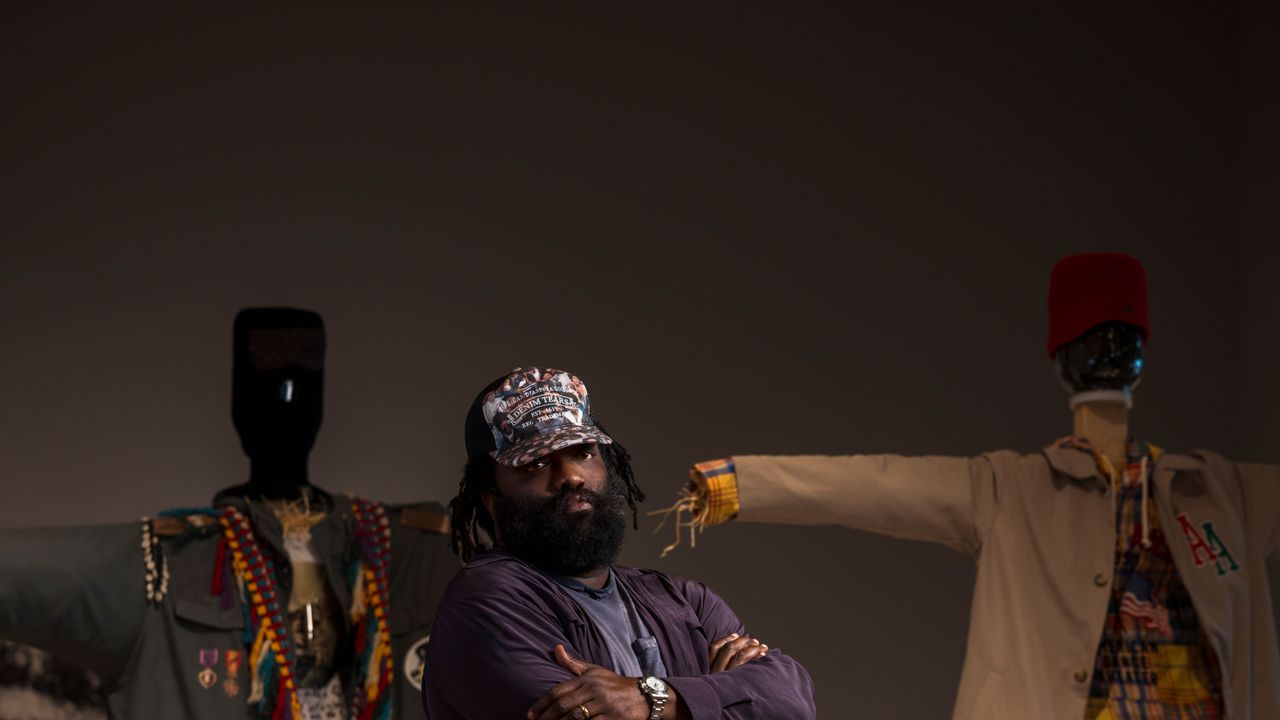
Tremaine Emory likes my beat-up loafers. He tells me this as we sit face-to-face on a small gallery bench inside the SCAD Museum of Art in Savannah, Georgia, buttressed by artifacts from his life. Personal ephemera and designs, including unreleased sneakers, from Denim Tears, the brand Emory founded in 2019, dot one wall, and a humble sampling from his vast collection of T-shirts completely covers the other. Though I am caught off guard by his comment—we are, after all, here with the express purpose of discussing the first-ever retrospective of Emory’s work—I can see how they fit his taste.“I like things that are worn-in. I like things that people have had for a long time,” he says, donning a holey, mauve-colored shirt. The exhibition, titled Tremaine Emory: Denim Tears From the Pool of Black Genius, greets its spectators with a framed pair of beyond-tattered Levi’s 501s. The jeans’ disrepair inspired the name “Denim Tears,” a moniker assigned to Emory by the late Virgil Abloh, because the shreds in his pants made the fabric look like it was weeping. For the past year, Emory—who was born in Atlanta—has been in and out of Savannah working on the project, which spans a foyer and two grand gallery spaces and is tied to the museum’s 15th anniversary. In that time, the designer also took on the side quest of mentoring a small group of Savannah College of Art and Design (SCAD) fashion design majors. “I never got a chance to do that,” Emory says. “So I’m kind of vicariously getting to go to art school.”Photography by Aman Shakya; Courtesy of SCADWhen he asks where my loafers are from, I tell him that I got them at the Coach store I used to work at in Miami ten years ago, and he nods in solidarity. Before he was the creative director of Supreme, much less the founder of a streetwear brand whose cotton wreath motif can be spotted on the likes of Frank Ocean, André 3000, and the many swag gods traipsing around Canal Street on any given day, Emory worked retail at Marc Jacobs. He started as a stockroom associate in New York City, where he was raised, concluding his nine years with the company as a store manager in London. He used some of his relocation stipend to purchase the aforementioned 501s—then brand new—and “wore them every day for a decade.”He jokes that some of the SCAD students he mentored, and continues to communicate with, felt that having a job is “lame.” But looking back, he argues, “I worked retail until I was 35 and I feel great about it. I near-cried when I walked out of the [Marc Jacobs] interview and they told me I was hired.”Photography by Aman Shakya; Courtesy of SCADEmory considers himself an “emotional dude.” The evening prior to our conversation, he shared a lecture stage with his mentor and creative partner, Ade “Acyde” Odunlami, for a conversation moderated by SCAD’s chief curator, Daniel S. Palmer. From the audience, one may have assumed that Emory, whose eyes and expression were concealed by the brim of a floppy scarecrow-like hat, was experiencing a sniffle-inducing allergic reaction to the many gratuitous introductions regarding his body of work. But when a question finally came his way—“Did you ever think you would have a museum retrospective?”—he pinched his eyes and began to cry. “No, I didn’t,” he finally said.The fact that Emory was able to walk on a stage at all is a miracle. In the fall of 2022, he was hospitalized for three months and spent a year in recovery after an aneurysm nearly took his life. “The emotion was more so about the life me and my family and friends had to live to realize this,” he says. “A lot of people that came down [for the retrospective] were the same people that were in the hospital with me.”By his estimation, half of the exhibition wouldn’t exist if it weren’t for the past five years. Health challenges aside, several massive life events defined this last half-decade for Emory. In 2021, his close friend and collaborator, Virgil Abloh, died from a rare and aggressive form of cancer; the suit Emory wore to Abloh’s funeral is also in the gallery. In 2023, he stepped down from his role at Supreme over a dispute about a collaboration he’d made with the artist Arthur Jafa, calling out the brand’s “systemic racism” in a widely shared resignation letter. He also married his Supreme colleague Andee McConnell that year, and later welcomed a daughter, who is being carried by McConnell through the museum, dozing in baby Denim Tears drip.Photography by Aman Shakya; Courtesy of SCADA circle of 15 scarecrows serves as the exhibition’s centerpiece. “I have always liked scarecrows,” says Emory with a shrug, wearing another scarecrow-ish outfit himself. (Only his sparkling Rolex betrays his homesteader sensibility.) The figures are a nod to his Southern roots and, he says, are better than mannequins. Each of the 15 straw-stuffed models is donning pieces from Emory’s name-droppy oeuvre: Denim Tears’s many projects with Levi’s, a fall 2023 guest collection for Dior titled “Dior Tears,” and the storied Supreme collaboration with Jafa, “SYSTEMIC RACISM CONTROLS AMERICA,” that led to Emory’s departure.The scarecrows also offer a bit of wordplay—“scare ‘Jim’ Crow,” explains Emory. Surrounding the main display is a selection of seminal works from renowned Black artists: a drawing from Jean-Michel Basquiat; a narrative quilt from Faith Ringgold; David Hammons’s original African American flag. Cheekily, there are two Polaroids by Andy Warhol—one of Uncle Sam and one of André Leon Talley, to whom one of the gallery spaces and Denim Tears’s most recent drop are dedicated.Image courtesy of Savannah SobrevillaWe get up from the bench to dive into Emory’s covetable wall of 150 graphic tees, which I can’t stop looking at. There are designer shirts that would go for $500 on Grailed, and there is also a shirt from the community basketball team he played in as a kid. He gestures at a navy blue top that reads “Polo” in yellow stitched-on lettering. “My mom bought that for me at the Roosevelt Field Mall in the ’90s. That might be my first Polo T-shirt that was from a Polo store,” he says—as in, not from a TJ Maxx or Marshalls. A respectable portion of these pieces are steeped in years of grime, such as a gray and seemingly still damp crewneck printed with a close-up portrait of Kurt Cobain. Emory recounts how he saw the shirt at the legendary (now-closed) Brooklyn underground shop, Nom de Guerre, and wanted it, but he couldn’t afford it, so he made a habit of stopping by the store for a year to check in on it. One day, the shirt wasn’t there anymore and he panicked. The saleswoman found it in the stock room and told him to keep it. “The first T-shirt I got for free,” he glints.At his own risk of sounding cliché, Emory tells me, none of this would be possible without the relationships he’s fostered over the years. “All this stuff gets made through teams of people—and also hanging out with your friends,” he says. “You build up your rigor and your discipline and your self-belief through a scene. And you can’t forget about the scene when someone pops off from the scene.” In collaboration with Acyde and Brock Korsan, Emory co-founded the lifestyle brand No Vacancy Inn in 2015. The brand curated its own scene, producing pop-ups, parties, and capsule drops with Yeezy, Hood by Air, Palace, Stüssy, and Off-White. Mementos from this time are peppered throughout the space—as are several of those former collaborators, who are wandering the gallery.Courtesy of SCADThe design language Emory and the Denim Tears braintrust have built over seven years can be found throughout the multi-room exhibition. Piles of red clay sit at the feet of the scarecrows and underneath shrines. The clay is native to Georgia and regularly dusted up Emory’s sneakers when he’d visit family there as a child; his grandfather and uncle used it in their work as brick masons. Seeing the mounds scattered about brings to mind Emory’s 2021 collaboration with Asics that featured rust-colored soles and brushed suede cut-outs. The SCAD museum itself, coincidentally, was once a railroad depot warehouse that stored cotton and indigo, which feels fitting for a brand whose most recognizable house code is a white cotton wreath on dark blue denim.The day before Emory and I sat down to chat, a mob of dripped-out fashion students had waited in the museum’s lobby for a special drop: the certified Denim Tears merchandise attached to the exhibition, which was exclusive to the physical SCAD store. The collection’s lowest-priced item, a $57 trucker cap, sold out in less than an hour, and most of the other inventory was depleted by the following day. (The gaggle of hypebeasts also stuck around for Emory’s lecture, and many lingered afterward in the hope of catching a chat with the designer, which he felt privileged to indulge.) The mad dash for the hats came up in conversation when I met later on with a SCAD administrator, who had been stopped by a student that morning, who said he was desperate for one. Since a few had been set aside for the press (guilty), the administrator found a spare and told the student that the cap would be free, so long as he visited the exhibition and emailed his thoughts, which the student promptly did.As Emory told me, “These young people are interested in what me and my team do and make. Anytime someone takes time out to focus on what you’re doing is humbling because they could be doing something else.”
Tremaine Emory Is Feeling Emotional About His First-Ever Museum Retrospective
Full Article
Original Source
Read the full article at Gq →KhanList aggregates and links to publicly available news content. We do not host full articles from third-party sources. Always verify important information with original sources.