
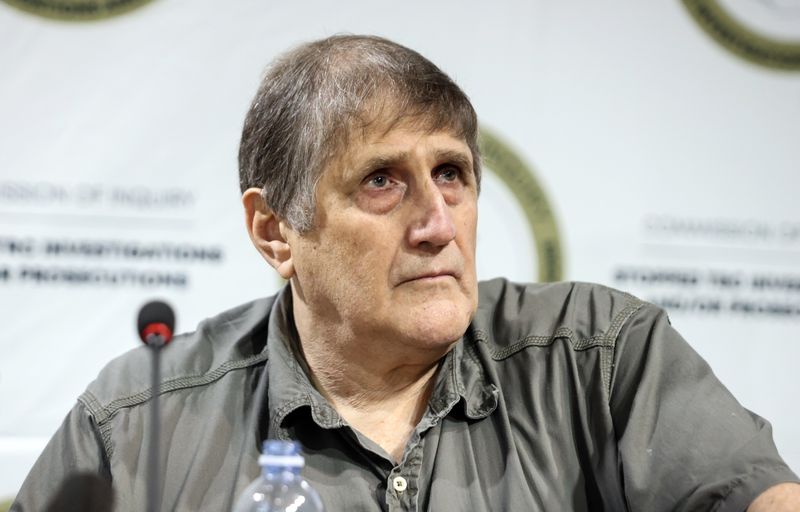
Senior prosecutor, advocate Anton Ackermann, had a sterling track record when he was appointed by President Thabo Mbeki in 2003 to head the newly formed Priority Crimes Litigation Unit (PCLU) set up within the National Prosecuting Authority (NPA) to deal with post-TRC prosecutions.Ackermann had served as the lead prosecutor in the high-profile trial of Wouter Basson from 1999 to 2002, successfully convicted Afrikaner Weerstandsbeweging (AWB) leader Eugene Terre’Blanche in 1997, and secured a conviction against Civil Cooperation Bureau (CCB) assassin Ferdi Barnard in 1998. He was lauded by the great George Bizos as an independently minded prosecutor.Appearing before the Khampepe Inquiry – which is investigating why post-TRC apartheid-era crimes were stalled or politically suppressed – the ailing and ageing lawman testified that Mbeki effectively opened a “backdoor amnesty” during a 2003 parliamentary address outlining new prosecution policies, accusing Mbeki’s executive of overreaching to halt these cases.Mbeki has categorically denied the allegations, placing the blame for the failure to pursue post-TRC prosecutions squarely on the NPA.Advocate Anton Ackermann testifying remotely at the Khampepe Commission. (Photo: YFM / Wikipedia) ‘Incestuous little world of Afrikanerdom’The former apartheid assassin Eugene “Prime Evil” De Kock has now alleged otherwise.De Kock applied for and was granted amnesty by the Truth and Reconciliation Commission (TRC) on 2 June 2000 for six apartheid-era crimes, alongside co-perpetrators former police commissioner General Johann van der Merwe and Brigadier Willem Schoon.General Johan van der Merwe on 25 July 2007. (Photo: Christiaan Kotze / Media 24 / Gallo Images)Ackermann successfully prosecuted De Kock in 1996 following a gruelling 18-month trial that ended with the former Vlakplaas commander sentenced to life behind bars on 89 counts, including murder, conspiracy to murder, and fraud.While this was briefly alluded to at Monday’s hearing, it was not taken further and is bound to resurface when De Kock returns for cross-examination. When applying for a presidential pardon years ago, De Kock described the regime he fought, killed, and took the fall for as “an incestuous little world of Afrikanerdom”. In the end, he was abandoned by his superiors, the political leadership of the National Party, and eventually, his former Vlakplaas colleagues.Removed from society On Monday, De Kock (77) told the inquiry that from October 1996, when he began to serve two life sentences plus 121 years behind bars, his life had been controlled by the NPA and the PCLU. Locked away in isolation for 23 hours a day without access to the outside world, he spent years sitting on all the evidence prosecutors required, he said.Few people had access to De Kock besides Ackermann and his deputies, advocates Chris MacAdam and Torie Pretorius, while he was imprisoned. As an inmate in the C Max section of Pretoria Central Prison, he told the panel, he was collected “six to seven times” at the request of the senior prosecutors and taken to the NPA’s new offices in Silverton.He said that immediately after his sentencing, Ackermann approached him, vowing to use him “to move upward through the chain of command”. However, this never happened.Open contempt On Monday, De Kock did not hide his contempt for the man he claims built a wall of silence around him to protect generals and National Party political leadership. The ANC, he suggested, was justified in its suspicion of Ackermann – as were former Police Commissioner Jackie Selebi and ex-Police Minister Charles Nqakula.Charles Nqakula testifies at the Khampepe Commission of Inquiry on 23 October. (Photo: Fani Mahuntsi / Gallo Images) “You can smell Ackermann,” De Kock told the panel. He said during the meetings at the NPA offices he goaded Ackermann and accused him of protecting generals and politicians.“I told him, ‘Here, take a page and write down a statement.’ But he did not talk, he did not ask me anything, he never made notes, he never took a statement.”And so, no prosecutions took place. No one was held accountable.Echoes of MadlangaDe Kock’s appearance at the Khampepe Commission comes after it heard months of painstaking testimony, generally overlooked by the media apart from high-profile appearances like that of Mbeki.The inquiry is working to uncover how post-TRC prosecutions were brought to a sudden halt, leaving the “Calata group” of victims’ families fighting a three-decade battle for justice and closure.Thabo Mbeki testifies before the Khampepe Commission on 19 October. (Photo: Kopano Tlape / GCIS) Having been paroled in 2015, De Kock has already named key players in multiple public forums – from social media to writer Anemari Jansen’s portrait, Eugene de Kock: Assassin for the State.In the book, veteran police officer Koos Kotze encapsulated the era as one where “the police in the security branch began to behave like intelligence agents for the apartheid state. Unlike the military, SAP [South African Police] members had to obey commands.” “How did it become possible [that] an honourable and proud organisation filled with decent and highly trained members became something that placed fear in the hearts of the majority of the population?” he noted in correspondence with Jansen. The proceedings before the Madlanga Commission carry disturbing echoes of this past. The commission has heard that Crime Intelligence (CI) was captured by criminals who instilled fear in the hearts of the population through violent turf wars, the trafficking of drugs and colluding to defraud the SA Police Service of billions from its budget.The man with the glassesIn 2011, Jansen realised that De Kock was “the man with the glasses that we all saw on TV” in 1996, referring to the nationwide broadcast of TRC hearings.Eugene de Kock at the Truth and Reconciliation Commission. (Photo: Media24) Driving home to her husband and children after her first meeting with De Kock, she reflected, “Was I asleep in the 1980s and early 90s?” Jansen’s search for an answer and her relationship with De Kock is an absorbing and important read.She sketches a detailed portrait of a boy with a stutter, an outsider, who grew up in a God-fearing, patriarchal and rabidly racist society with a strict father who was emotionally unreachable. Back then, schoolchildren were punished by teachers with canes, wooden blackboard compasses and planks.That was then, this is now.Another of those golden threads that has been woven through the Khampepe tapestry of truth-seeking for posterity is that advocate Geoff Budlender represents De Kock. The anti-apartheid veteran in public interest matters – including access to HIV drugs and Government v Grootboom, a precedent-setting case about the constitutional right to shelter – is representing the “face of apartheid” in democratic South Africa three decades down the line.The Roelf Meyer connection Then there’s Roelf Meyer, South Africa’s ambassador to the US, who played a vital role in early negotiations between the National Party and the ANC.He appeared twice before the TRC, in 1996 and 1997 at the hearings into the State Security Council, where he testified alongside former Minister of Police Adriaan Vlok and former Minister of Foreign Affairs Pik Botha.Roelf Meyer testified before the TRC on two occasions. (Photo: Deaan Vivier / Gallo Images / Beeld) In her just-published biography of Meyer, Anneliese Burgess writes, “There were those who had acted entirely from personal conviction, taking the law into their own hands; those who had acted from implied authority, assuming permission they never had explicitly been given.”At the TRC, Meyer denied knowledge of “any organised conspiracy to kill political opponents” adding his portfolio “had not dealt with operational matters”.Today, writes Burgess, he is more precise, telling her: “I was too cautious to ask more questions about the orders that went out. The fact that Adriaan Vlok kept decisions of that nature from me did not excuse me from asking him questions”.Former Vlakplaas commander Eugene de Kock in conversation with Daily Maverick's Marianne Thamm after testifying before the Khampepe Commission on 26 October. (Photo: Felix Dlangamandla) A personal reflectionHow does it feel to shake the hand of a man responsible for the gruesome murder of hundreds of people during the apartheid era? Grasping that hand, you bear in mind the victims.De Kock, too, clearly bears the victims in mind; their ghosts will never leave him. He has asked for forgiveness from the families, he has assisted the TRC Missing Persons Task Team to recover remains, he has disclosed the location of large stashes of arms and done his utmost to atone. He donated the proceeds of the documentary A Long Day’s Journey into Night to the Presidential Reparations Fund.In 2006, Vlok begged De Kock’s forgiveness for using him to prop up apartheid and for allowing him to take the fall alone.Adriaan Vlok’s note to De Kock asking for forgiveness. (Photo: Supplied)Shaking hands with De Kock brought to mind philosopher Hannah Arendt’s concept of “the banality of evil” in her book on the trial of Nazi Adolf Eichmann, the man who organised the transport of Jews to concentration camps in World War 2.Arendt theorised that people who commit horrific crimes are not monsters or “Prime Evil” as De Kock has been labelled – they are ordinary individuals. De Kock did not emerge fully formed into the world. He was shaped by the ideologies and violent forces that surrounded him, participating first as a soldier, then as the state’s assassin and commander of death squads.De Kock was a boy and then a man, as Judge Willem van der Merwe, in sentencing him to life imprisonment, remarked, enabled by a “rotten system”.There, standing in the Khampepe Commission auditorium in the Sci-Bono building in Newtown, Johannesburg, on Monday, was a polite, intelligent and well-read man, witty too, with nothing left to lose.Swedish journalist Martin Johnson, who interviewed De Kock while filming the reopened Cradock Four inquest, described him as an “Albert Speer-lite”. The label references Adolf Hitler’s architect and minister of armaments, who spent 20 years in Spandau prison after serving as the logistical architect of a brutal regime.Eugene de Kock held up a mirror to God-fearing Afrikaner nationalism, exposing the savagery, fear and racism of a system that engineered him into a state assassin. Freed of that straitjacket, De Kock has restored his humanity and place in society. Few others have paid a higher price. DM
TRC Roulette : Apartheid’s scapegoat — the jarring paradox of mass killer Eugene de Kock
Full Article
Original Source
Read the full article at Dailymaverick →KhanList aggregates and links to publicly available news content. We do not host full articles from third-party sources. Always verify important information with original sources.