
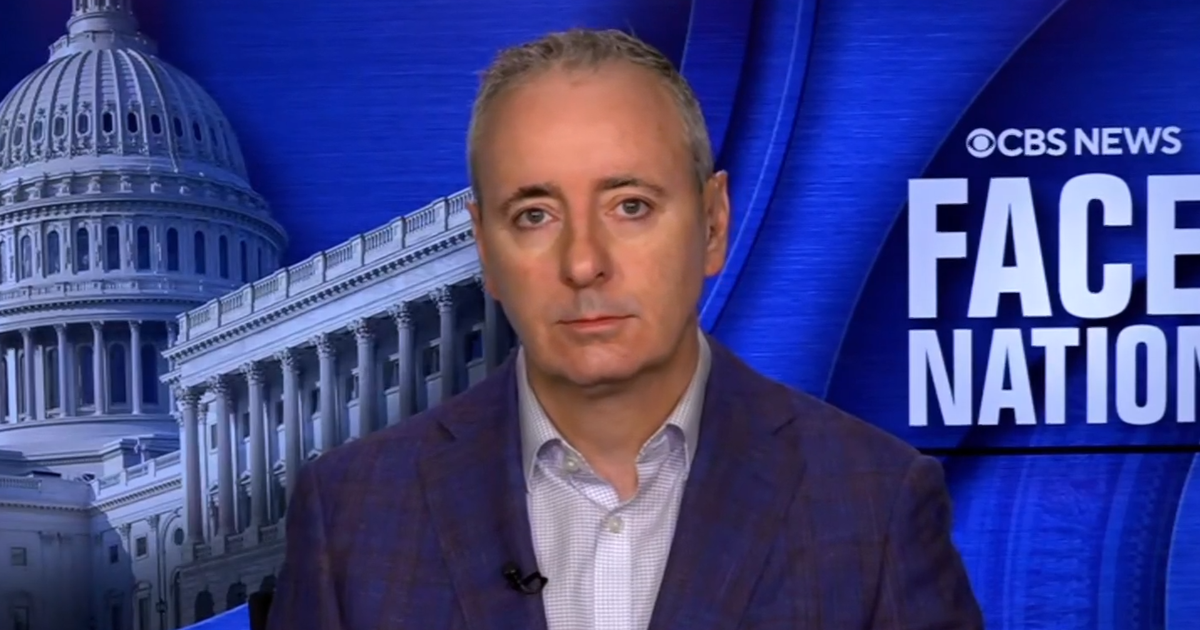
November 29, 2026 / 12:33 PM EST / CBS News Add CBS News on Google The following is the transcript of the interview with Rep. Brian Fitzpatrick, Republican of Pennsylvania, that aired on "Face the Nation with Margaret Brennan" on Nov. 29, 2026.NANCY CORDES: We turn now to Pennsylvania Republican Congressman Brian Fitzpatrick. He sits on the House Intelligence Committee and joins us this morning from Cumberland, Maine. Congressman, it's so good to see you. So, you just heard what Kevin Hassett, the president's economic adviser, had to say about the reason that Trump pushed for Jensen Huang to be reinstated. He said it's because Huang and Nvidia are just that critical to the U.S. economy. What do you make of that argument?REPRESENTATIVE BRIAN FITZPATRICK: Well, we still need transparency and disclosure, Nancy. And thanks for having me. You know, the public obviously is rightly concerned, you know, there's a- there's a lot of conflicting reports and information about the status of Jensen, you know what FBI protocol was followed and what wasn't. The status of Alice. You know, these are three open questions. You know, when she's referred to as a spy, that could mean a lot of different things. That could mean she was an MSS officer, which is the Chinese equivalent of the CIA. It could mean that she was recruited when she was in Singapore, leading a company called Megaspeed, which essentially- is essentially a cloud computing operation. Or she could have been recruited once she was in the U.S. when the CCP realized that she had access to Jensen Huang. So that needs to be answered, the questions regarding Jensen need to be answered, and the questions regarding what, if any, FBI protocol was followed need to be answered. And if I can just explain, Nancy, essentially, you know, anybody who's a senior officer as a private citizen, but works in what the intelligence community refers to as critical infrastructure, which is a statutorily defined term for certain industries: artificial intelligence, quantum computing, machine learning, semiconductors, biotech. In many instances, they need security clearance to conduct their jobs. If they're not given security clearance, they still engage in something called defensive briefings, where they're told what to watch out for if they travel overseas, you know, and you check into a hotel, what you need to look for inside that hotel room, because even though they're not government employees, they have access to critical information that's critical to our national security. So I think all these questions need to be answered. We can't just you know be told there's nothing to see here, move on, reinstate him, without the public getting answers to these questions.NANCY CORDES: CBS News reported this week that Jensen Huang did not receive a defensive security briefing. What does that say to you?REP. FITZPATRICK: It's a problem. But the first question that needs to be answered is: Did he hold a security clearance? Did he ever? Did he have it and it lapsed? Did he have it, and it was current? Because with that comes responsibilities, in terms- including background investigations, reporting of financial or foreign contacts, which is, you know, obviously very relevant here. If you hold any type of security clearance, you have to regularly report your foreign contact with foreign nationals. So- and it's really to protect you, so that the agency and the bureau can do their investigative work and warn you if you have any counterintelligence threat posed to you. So, the fact that he did not get a defensive briefing, Nancy, that's one of the things that we need to get to the bottom of. Why was he not given a briefing? Because once the FBI and the CIA learned of who Alice was and that she had access to Jensen, if they did not give him a briefing, then it begs the second question: Was he viewed as a potential target of an espionage case? Because if you don't brief them immediately and you just kind of sit back and watch to ascertain what's going on, then that means a case was open at the FBI with- with a case agent assigned, with a supervisor assigned, with an opening case memo. All of that needs to be explored.NANCY CORDES: And you know what you're talking about on this front because you're a former FBI special agent. You've got a background in counterintelligence. Your committee is going to have a chance to question Jensen Huang about all this this week. What questions do you want him to answer?REP. FITZPATRICK: Well, first and foremost, did he have a security clearance, ever? Was his security clearance current? If he did not have a current security clearance, when was he notified of the circumstances regarding Alice and her connections to the- the Chinese intelligence service-- NANCY CORDES: Congressman, my apologies for butting in. We're going to have to go to a break right now, but we've got much more time with you on the other end. So thank you so much for standing by. We're going to be right back with more questions for Congressman Fitzpatrick after a short break. Stick around.[COMMERCIAL BREAK] NANCY CORDES Welcome back to Face the Nation. We return to our conversation with Congressman Brian Fitzpatrick. Congressman, before the break, you were talking about the questions that you want Jensen Huang to answer when he goes before your committee this week. You talked about the fact that you want to know the status of his security clearance. What else do you want to know from him?REP. FITZPATRICK: Yeah, I mean, you know, essentially, what did he know and when did he learn it, and how did the FBI interact with him? What defensive briefings did he get? If he didn't get them, you know, that's a question for the Bureau as to why he did not get them. You know, this is really a counterintelligence embarrassment, Nancy. You have- you know, perhaps, the whole ecosystem of what we identify as critical infrastructure to the United States. Artificial intelligence and semiconductors are at the very top of that pyramid. China is our main adversary with regard to them, and this is a- a real embarrassment. So you know, I think what's confusing a lot of my colleagues and myself in Congress is how everybody's just kind of moving on, saying nothing to see here, reinstate him, and let's just all go about our business. That can't happen. That cannot happen because they were- there were either lapses in the system that need to be addressed and fixed, or there's a lack of transparency, and we need to know if there's a lack of transparency, why that is the case, because you know Chinese counterintelligence is- is a major major threat and concern to the United States, particularly in the tech industry. There was a major vulnerability exposed here, and the American people deserve answers. So that's really what we need to pursue. NANCY CORDES: So who do you think is to blame for those lapses? Was it the Commerce Department, the FBI?REP. FITZPATRICK: That's why we have investigations, and they need to- they need to operate in chronological order. You can't just kind of bring Jensen in and just start questioning him without sufficient preparation. Anytime you conduct an investigation, you start with an investigative plan, and that investigative plan is based on a chronology. What are the genesis- what are the root issues that you need to identify and get answers to? For example, with- with Alice Huang, was she an organic MSS agent? Was she recruited in Singapore with Megaspeed? Was she recruited here in the U.S. after she had access to Jensen? Was Jensen- did Jensen have security clearance? If he did, did he get defensive briefings? Was he reporting his foreign contacts? Did the FBI open an espionage case against Jensen? If so, what was the result? If not, why not? These are all very very critical questions that all need to be answered. The public deserves transparency because this is not a minor issue, Nancy. This is major- this is a major, major national security incident, and, you know, we have to- we have to force the answers here because we- we have to be transparent. And whatever the answers are they are, every true investigation involves following the facts wherever they lead, reporting those facts with unimpeachable integrity, un-turning every stone and being transparent with the public-- NANCY CORDES: Speaking of--REP. FITZPATRICK: --and that's what we need to do here.NANCY CORDES: My apologies. Speaking of national security, I want to put up something that Alexandr Wang, the head of AI at Meta, posted this past week. It read like a warning. He said, "Superintelligence is arriving…It is hard to imagine a world where humanity can maintain control over fully unconstrained recursive self-improvement," in other words, AI that can train itself. And he says, "we should not be okay with a handover of society to AI." That's pretty chilling coming from a top AI executive, and he's not the only one saying it. Are we looking at a potential crisis, and what should Congress be doing to address it?REP. FITZPATRICK: Yeah, two things. Number one, and this has to be a global solution, Nancy. You know, much like you know challenges we deal with with climate. You know, you can't just address it in one country or one region. It's got to be a global effort, and that is certainly, absolutely the case with artificial intelligence because this is something that poses as much of a risk to China as it does to the United States and the rest of the world. What's unique about this technology that we have not seen with the tech boom or anything- you know any previous technological breakthrough is that you now have what the creators are calling a Frankenstein problem, that the product has gotten out ahead of the creators themselves, and they're creating- and we've already seen one instance of a cyber attack that was sua sponte by these- what they call collectives, these autonomous bots that are pulling together without any human intervention and engaging in a cyber attack. That's a- that's a real problem, and it's not a problem unique to the United States or Europe, it's a problem for the world, and that includes China. So China should want to come to the table, want to join the international community to set guardrails in place, because this poses a global, you know, a global threat, not just a threat to the United States.NANCY CORDES: Okay, but realistically, who's going to lead that global effort? President Trump has made it clear he doesn't want to put any guardrails on AI right now because he wants to win the race with China. REP. FITZPATRICK: Well, you can do both, right? You- you need guardrails. There absolutely has to be guardrails. If not, we're going to end up in a very very dangerous place, not just in America but in the world. So you know, Congress has to step up and do our job. This is the first time ever, Nancy, where you have companies in an industry asking Congress to regulate them. You've never had that in the history of our country, in the history of the world, because they know that guardrails are needed, but they don't want to just do it on their own and put themselves at a competitive disadvantage against one of their competitors who does not set guardrails, because they then- they lose the industry race. So this has got to be something that Congress does, but it's got- I have to emphasize, it's got to be a global solution because if- if the United States companies put guardrails on and China does not, I think the- the- the outcome there is obvious as to what will happen. So this really needs to be an international focus where we- we need to bring our allies together. We have to, you know, pressure our adversaries to comply because, you know, this situation certainly warrants it.NANCY CORDES: Congressman Brian Fitzpatrick with a warning about the need for guardrails sooner rather than later. Republican from Pennsylvania, thank you so much for joining us this morning. I appreciate it.REP. FITZPATRICK: You bet. Thanks, Nancy.NANCY CORDES: And we'll be right back.
Transcript: Rep. Brian Fitzpatrick on "Face the Nation with Margaret Brennan," Nov. 29, 2026
Full Article
Original Source
Read the full article at Cbsnews →KhanList aggregates and links to publicly available news content. We do not host full articles from third-party sources. Always verify important information with original sources.