
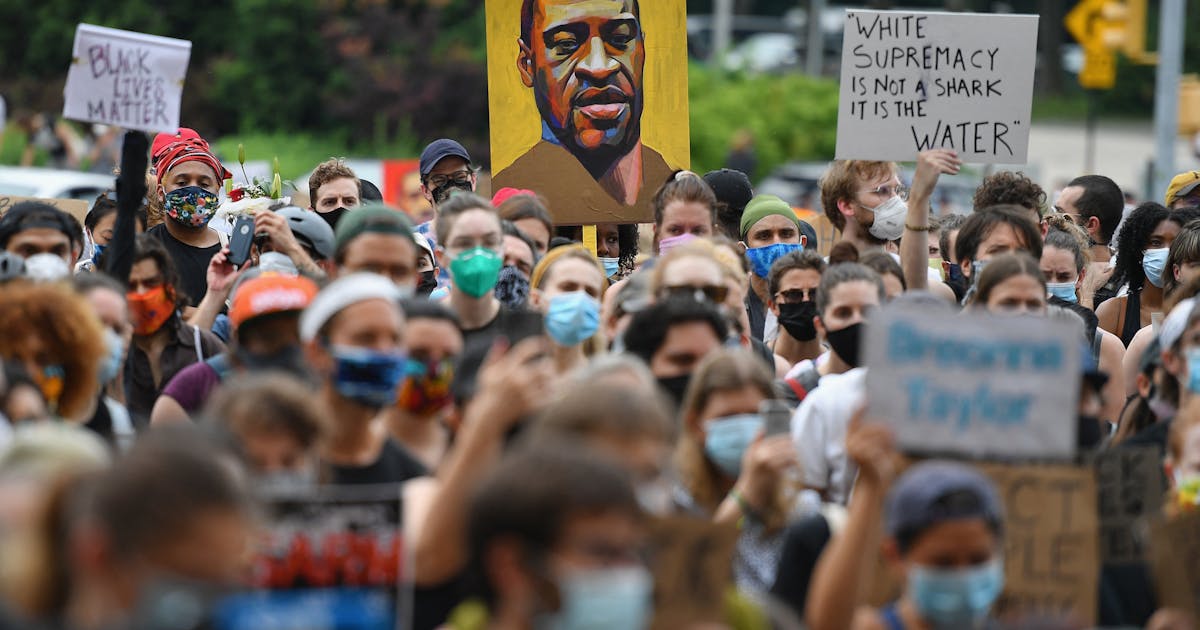
This is a lightly edited transcript of the September 1 edition of Right Now With Perry Bacon. You can watch the video here or by following this show on YouTube or Substack.Perry Bacon: This is Right Now on The New Republic. I’m the host, Perry Bacon. Great guest today. I’m joined by Alex Vitale. He is a professor of sociology at Brooklyn College. He’s also very well known for a book he wrote called The End of Policing, which is a book about police reform and has been one of the intellectual books that undergird a lot of what we talked about, police defunding and abolition and real changes to policing.This book has been read by everybody, including people on the right. I think Ted Cruz asked some—I think it was Ketanji Brown Jackson, I’m forgetting now. Ted Cruz asked somebody who was a Democrat, who was being confirmed, if they’d read the book, and basically was asking the person to disavow the book. So congratulations on that as well, Alex. Good to see you.Alex Vitale: Thank you. And unlike Ted Cruz, I was actually born and raised in Texas.Bacon: OK. Let me start with talking about—the reason I wanted to talk to you was, like, this whole Woke 1.0 discourse that started with Congresswoman Ocasio-Cortez going on ABC News a couple weeks ago, distancing herself from Woke 1.0 without saying exactly what that meant. So we’ve had some discourse about what she could have, or maybe did, mean. But I think what I want to ask you is, it feels to me, six years out from the height of the protest after George Floyd died, that we’re in a moment where police changes, desires to change policing, that whole momentum has backtracked pretty fully, to the point where people like Zohran Mamdani, who we’ll get to in a minute, but people who are on the sort of real left, people who are progressives, are also trying to backtrack from it. That’s my perception, we were in a weak moment for that. 2014 to 2020 was a real momentum around criminal justice reform, and now we’re in a moment where even the progressives have said, “Let’s leave that alone. Let’s talk about affordability only and economics only.” How do you—is that how you see it too? Or maybe you see it differently. What do you say?Vitale: No, there’s clearly some truth to that. There was a concerted and broad-based attack from the right and the center to any of these ideas. And I think there was this moment in 2020 where people didn’t quite know what defund the police meant, and myself and others had access to the mainstream media and got a chance to begin to tell the story about what this could mean. And once they figured out what it meant, they were like, Oh, we got to put a stop to that. We are against that. And so that was it—those mainstream media conversations then became a dialogue between the far right and the center right on this issue. And that just really closed out a lot of space for this conversation.Now, a couple things to think about here. One is that no one at the beginning of 2020 thought we were getting ready to have a national transformation of policing. This was a small movement that was making inroads, that was engaged in grassroots campaigns, and was feeling happy that there was, like, a national network of people who were really talking seriously about what we could invest in instead of policing to create real public safety. But then, with the outburst of the protests in 2020, the expectations for what the movement should be achieving became astronomical and unrealistic, and there was no organizing infrastructure to take advantage of, to build on those heavy demands that were being put out.Now, the other thing I want to say is that, even though we’ve not made much progress in dialing back policing, I would say we have made some progress, especially in school policing. But what we have made progress on are exactly the kinds of alternatives to policing that I talk about in The End of Policing, that others have been advocating for. We have seen a massive expansion in civilian mental health crisis teams. We’ve seen big expansions of community-based anti-violence work. So we have seen some of the positive parts of the equation. We just haven’t seen the parts as much as we’d like in terms of dialing back police power and violence.Bacon: OK. So let me come back—there’s a couple things you said there I want to come back to. So come back to the—because I’ve been reading a little bit about Baltimore, and I think that’s a good example of what you’re talking about, with just that Baltimore has had this decrease in the murder rate, and to be blunt here, they have not decreased the number of police. I think they’ve actually increased the number of police. But they’ve also done a lot of the—they’ve also done the full scope of things to try to reduce violence, have the community more involved. So what you’re saying is, we’re seeing this sort of divest from police, invest in other things—we’ve seen the invest in other things happen, but the divesting from police hasn’t happened. Is that what you’re saying, in other words?Vitale: Exactly.Bacon: Some of the defund thing, the message of defund hasn’t worked in terms of defund police, but it has worked in terms of increased funding in other things that might reduce violence.Vitale: Yeah. And really, in a lot of ways, we have won some of the key kind of intellectual arguments. I think everyone in America now understands that we should not be sending police when someone’s having a mental health crisis. There’s national polling that shows even a majority of Republicans agree with this sentiment. And so in a way, we’ve won these arguments in some ways, and we’re just now trying to get to the implementation of it.Bacon: OK, so you won the argument about that part. But the part about—I read End of Policing a while ago, but give people a summary of—let me, maybe I’m going to do it that way. But anyway, there’s an argument that we want to have the police have a smaller role in our lives, and have a smaller number of police, and that argument has been lost, I would argue, right? Or has not been won, or has not moved much since 2020. How do you assess that part?Vitale: I think that we have seen places where police spending has been flattened. We’ve seen even a few places where it’s been reduced, like Newark, New Jersey, that has been enjoying tremendous reductions in violence because of the investments in community alternatives. And of course, here in New York, Mamdani campaigned quite clearly, and he was the only candidate in both the primary and the general election who said, I don’t want to hire more police. That’s not the solution to our problems. Instead, we need these other investments. So not cutting the police budget, but holding it steady, or at least the headcount. And that’s important, and I think that signals a politically viable possibility for a way to move forward on this.Bacon: Are you closer to abolish the police, defund the police? What’s your ultimate goal here? What’s the conclusion of The End of Policing? I think there’s a clue in the title. But anyway, what’s the goal in The End of Policing, the book you wrote?Vitale: It’s to try to get the police out of our lives in every way we possibly can, but to do it in a responsible fashion, that’s based on building up new infrastructures of public safety that are evidence-based, that show results. And as we build those infrastructures, we reduce our reliance on an institution that has been a huge source of inequality, injustice, and brutality in American society. And an abolitionist framework is really based on the idea that the institution of policing is fundamentally unjust, even when we do it in a kinder, gentler way. Like, a less racially biased war on drugs is still a completely unjust way of dealing with America’s drug problems.Bacon: So are you an abolitionist, just to be clear?Vitale: Yes.Yes, I’m an abolitionist, but I don’t feel like my job is to go around getting people to say they’re abolitionists, or to talk about abolition. My public-facing work does not typically even use the word abolition. I’m trying to talk to people about public safety. I’m a criminologist who is worried about public safety. We don’t have enough public safety, and our over-reliance on policing is not the best way to achieve that.Bacon: So the reason I wanted to ask that was, in part—are we hung up on looking back, from 2020? The terms defund and abolition, were those terms seized by the center-left, the center-right, and the right in a way that sort of hijacked—the way you’re just—like, when I talk to people about these issues, when I say, “We want to gradually reduce police funding and gradually increase funding of other things,” and, you live in a safe neighborhood—is your neighborhood full of cops? In general, no. Your neighborhood is full of upper income people who can afford what they want to afford. That’s what we want for everyone. Crime is not going to be ultimately solved by having cops everywhere. It’s going to be solved—and yes, I want, murderers should not walk the streets. What I do want to have is more violence prevention that’s not about cops, and have people living fuller lives where they’re not looking to commit crimes in the first place. When I say it that way, they can hear me. But I have to say, “Yes, you should not just say defund in a swing district first.” I feel like I have to lead with that now. So do you wish the words defund and abolish were never heard from, or—Matt Yglesias couldn’t have read them, or Abigail Spanberger, whoever, you know, who just exploit those words?Vitale: Yeah, Matt is not a good faith actor here. No matter what we called it, he was going to come up with some pithy reason why it was unviable. So look, defund the police was a three-word phrase that fit on a cardboard protest sign, that fit on a Twitter hashtag. And it was important in the way in which it explicitly rejected the idea of mainstream police reform. After Ferguson and the Ferguson uprising, the killing of Mike Brown, there was all this discourse from Obama on down about, we’re going to reform the police with implicit bias training and body cameras. And that stuff doesn’t work.Bacon: And we’ve seen it with ICE now. I think people have moved to that view, us giving ICE body cameras where they don’t have to show the film, and they’ve announced in public, “We’re not going to release the film unless it’s good for us.”Vitale: There is no mechanism of accountability to use the film.It’s just pointless, right? So it’s just window dressing to make us think it—they tell you what it is. It’s to restore public trust in the police. It’s not to make the police better. It’s not to reduce the violence. It’s to get you and me to trust them. And that is the wrong objective, and it has failed, both in the trust and in reducing what really matters. So defund the police was important for that. It signaled this radical shift in the analysis. But it didn’t carry the other side of the equation, which is the invest side. And so a lot of people were left thinking, We’ve been told we can have one thing for public safety, and that’s a bunch of guys with guns running around shooting. And now you want to take away the one thing we’ve been told we can have. And we weren’t strong enough and clear enough to be able to make the case convincingly that what we’re really talking about is creating new infrastructures of public safety.So do I regret the word? Not per se, but I think—and this is where the AOC thing comes back in—was there a lot of unhelpful discourse that was disconnected from actual organizing, from actual community struggle, that leaned into a lot of radical language without a real analysis, without a real political program to achieve victories? Yes. There was a lot of that throwing words around and trying to make people say the right word, without doing the real work on the ground in the neighborhoods talking about public safety. So what I wish is that we’d had a lot less of that, and a lot more structured institutional support for community-based organizing around how to make our schools safer, how to better deal with mental health and substance abuse issues in our neighborhoods, and how to address violence from a community-led perspective.Bacon: Why didn’t the phrase—I remember in 2020, some of my leftist friends who were more aware of it than I was did say, there’s another phrase, invest, divest, invest. Why did divest—because that’s also two words. So divest, invest did not take out the way defund did. Do we know why, or was there some messaging consulting?Vitale: We should not discount the level of anger on the streets in the United States in 2020.That had been building. It had been building from the Jena Six. It had been building through Ferguson. It had been building. There was a lot of anger at police and prosecutors. And so yeah, some of that anger gets channeled into demands and discourse that in the end maybe wasn’t the most strategic or helpful, but it was coming from a legitimate anger that was really felt out on the streets. We saw millions of people pouring out into the streets, engaging in serious, disruptive political action. So we don’t want to say that’s somehow illegitimate, right? We just weren’t ready. We hadn’t built the political infrastructures to be able to take that anger and to make it more productive than it was. So rather than, like, litigating something that I and others had no control over, let’s talk about what we should do going forward. So that’s my view. I don’t have any interest in, like, finding out who the people were that we should throw under the bus because they used the wrong language.Bacon: The reason I’m asking is—you live in New York, I don’t, but to me, one of the most progressive leaders in the country—I do a lot of politics reporting, so, one of the most progressive leaders in the country, someone who might run for president as a progressive candidate, the words that came out were, “Woke 1.0 was crazy.” And so that’s why I want—so that implication that we need—she, and a lot of the discourse since then, has been, people said stuff then they shouldn’t have said, and we need to find who said the bad stuff. And I want to be precise about what was said that was wrong, and on some level to unpack it a little bit. I want to look forward, but I think it’s—Vitale: Well, I’ll give you an example, right? Folks on the ground in Minneapolis, before George Floyd, had an organized campaign to do invest/divest. They had a program with dollar amounts, specific programmatic interventions that they wanted. And then 2020 happens, and there is a panic among the political class, and you have city council members saying that they’re going to vote to abolish the police, or something. That was not what was being proposed. And they were in no position to deliver on a demand like that. And if they had instead said, We’re prepared to vote for a set of programmatic interventions that are going to make our community safer, and we’re going to help pay for that in part by dialing back our over-reliance on policing, that would have mirrored what was actually happening, and I think it would have been a more responsible thing to say.Bacon: Let me make sure I emphasize two points here. First of all, the difference between police reform in the way it’s been done by Obama, and in the way you’re for it—explain to people clearly. I guess the term I have heard used is non-reformist reform. Talk about the difference between the reforms or the changes in policing you’re for, and the changes in policing that more, I’ll call them centrist Democrats, are for. This is a very important distinction, I think.Vitale: Yeah. So if you go back and you look at President Obama’s task force on 21st century policing, that was developed in the aftermath of the Ferguson uprising, you see very clearly from the get-go the language of what we call procedural reform, which is designed to tighten up police procedures to, as I mentioned before, restore public trust in the police. This is proceduralism. This is box checking. This is pointless training. It’s body cameras that produce footage that no one can ever see.Bacon: Why is it bad to have more trust in the police?Vitale: Because some of what the police do is unjust and should be stopped. I don’t want people to trust narcotics officers. I just did a podcast on The French Connection, the film that won best picture in ‘71, starring Gene Hackman, about this major drug bust that happens in the ‘60s, based on a real story, and they capture all these drugs, and everyone’s like, Oh, see, we got to get the bad guys. We got to get the drugs off the streets. But then if you look at the film American Gangster, which is also based on a true story, those drugs that were confiscated in The French Connection were stolen out of evidence by police and sold back out onto the streets, and was used as a pretext for arresting thousands of Black and brown people. And destroying their lives, and I would argue their communities.So why on earth would we want to restore public trust in the war on drugs? It was created with a racist goal in mind, right? Folks in the Nixon administration who created the Drug Enforcement Agency have come forward and said, We were in the meetings, and this was all about a racist attack on Black people. It had nothing to do with public health or public safety. So I don’t want to restore public trust in narcotics officers. I want to create a politics that says that police should have nothing to do with drugs. We should do what Portugal and some other places are doing. This is a public health issue. And it turns out that this is true for a huge amount of what police do, that we don’t need them to be—between a quarter and a half of all people killed by police in the United States are having a mental health crisis. Police should not be responding to these things, and the cities that are pulling them out are showing fantastically positive results. They’re saving money. They’re saving lives. It’s more just. So we don’t need to reform how police handle mental health calls. We need to quit sending the police. And so in my book, I take all these areas of policing, show why they’re unjust, and show why the solution is just to quit using them, and to use something else to address that problem.Bacon: So in other words—put this—so one vision of police reform is, we are going to make changes to create the veneer—Vitale: We’re going to give narcotics units anti-bias training.Bacon: Yes. So to create the—one vision of reform is, we’re going to suggest that we can make the police nicer and more gentle, and the other version is, we’re going to get the police out of various tasks. We’re going to reduce the role of policing in society, basically. So these are two, and one of these visions obviously will probably require more police than the other—I mean, your vision—Vitale: That’s right. No, in New York City, the NYPD goes on almost a quarter of a million calls of an emotionally disturbed person. That’s the terminology they use. We just don’t need them to do that. It is a huge driver of overtime, of police headcounts, and let’s just reduce the headcount by that 200,000 calls.Bacon: OK, so that’s the difference between a defund position. So whatever term we’re going to use for police, people like you—so if we’re not going to use the term abolitionist right now, what term should I use for people like you?Vitale: You can call it abolition. I’m not afraid of that as a label for myself. But what’s important is to describe what I’m actually talking about. Which is, it’s an analysis about a long-term strategy for change that’s about making us safer.Bacon: OK. And so when you use the term public safety—I’m very focused on public safety. I think part of it is, like, how do you have an argument with someone who says—because I think a lot of people’s views about public safety means police. How do we get people to rethink—a safe city is not—when I think, when people think safety, they think men with guns. Not just also the police, but also, even with ICE, we’re having to explain that ICE is not making you safer. So how do we get away from—say, a safe community is one where everyone has what they need is what we’re trying to get to. But how do we convince people that a safe community is not one where there’s lots of—at least the three—even safe communities in America, like gated communities, have the threat of armed men coming. So how do we get people to rethink what safety means? You used the term public safety a few different times, and I think people mean, think, public safety and the police are the same thing.Vitale: Yeah. So first, I want to kind of cover two areas here. One is that we have limited our conception of public safety to the kinds of things that we send the police for, right? There’s a robbery, there’s a shooting, there’s a burglary, right? But somehow what’s not included in that is corporate pollution, unsafe food, wage theft by employers. When these things actually kill more people and steal more money than all that other kind of policeable crime combined. So we focus too much on the wrong thing, and this is not an accident. This is by design, I would argue. The other thing is that we have told people that the only way they can produce safety in their community is policing. We’ve given them this—I would say it’s a kind of terrorism to tell people, Either accept all these people with guns in your community, or you get nothing.And so, given that horrible choice—what’s amazing is how many people, given that choice, still say, No police. Which we know in a lot of poor communities, people are like, “I would just rather not have any police.” That people actually say this and believe this. But how do we overcome this? So my advice, typically, when I’m asked to come and meet with folks, is to say, “You got to start with a needs assessment. You got to go out and talk to people about what their public safety concerns are,” some of which are based in reality, and some are based on watching too many television news shows where, when it bleeds, it leads, and if there’s not enough local murder and mayhem—They’ll go find some in Indiana or whatever, on the local news in New York. So you got to do a needs assessment, and then you need to put together a menu of options that are rooted in actual functional examples around the country, around the world. Oh, turns out a lot of people are concerned about opioid overdoses. Turns out policing has been a total disaster, complete failure. Actually has made the problem worse. So what could we do? It turns out there are lots of things we could do, right? We could look at harm reduction strategies. We could look at legalization schemes. We could look at public education that’s not run by police, right? Drug testing. There’s lots of things we could do to save lives. But we don’t do those things. We just send the police to make more pointless narcotics arrests.So when we do the needs assessment, when we get stuff on the table, then we can talk concretely to people about, “Oh, you’re concerned about young people getting in fights. Maybe there’s some shootings. OK, we noticed that there’s a community center down the street that is shuttered.” And they’re like, Oh yeah, they told us 20 years ago there was no money for the community center, but we could have a special narcotics unit and a gang task force instead. And if we say to people, “Would you rather have a fully functioning youth community center, or another gang suppression unit in your community?”—and when we give people that choice, it turns out the vast majority of them would rather have the community center open.Bacon: Now let me put on my dumb pundit voice. I’ve already done it once, we’re doing it again. Did you know, Alex, that if you do a poll, that Black people—and did you know that you’re not Black, Alex? But Black people, if you ask them in a poll, will say that they prefer more police rather than fewer, and they live in Black areas, and sometimes those areas have high crime. So aren’t you just an out of touch white liberal who is talking about things that don’t really affect you? I’m just—Vitale: Yeah.Bacon: I’m going to give the full—this is the implication of what people are saying. So I’m just going to say it fully and get you to respond to it.Vitale: Yeah. And of course my personal life situation is much more complicated than—Bacon: Yeah, and I actually don’t know.Vitale: —but that’s irrelevant. It shouldn’t matter. So the fact is that, yeah, that reflects decades of disinvestment and criminalization. And so that’s the choice people have been told they have to make. And of course, you laid out the choice in exactly that way: police or nothing. But it turns out, when we actually do polling that says, “Would you rather have the specific concrete thing other than policing?” the numbers are much better. And so my job is to give people those other choices, to harness the national and international perspective, to look at the evidence. So when a community asks me to come in, as they do all the time, I can say, “Have you thought about this?” Or, “Did you know there is a program doing this, but they have no funding and no support, and the police are trying to undermine their work? Maybe we should lean into that, properly support it.” And then people are like, “Oh, yeah.” It’s giving them the alternatives, and also giving them permission to ask for what they really want.Bacon: Two more questions. The first is, you’re in New York City, so Zohran did not quite give the AOC “Woke 1.0 was crazy,” but he did say, I’m opposed to defund. Defund is not something I agree with. I work with the NYPD every day. They’re a vital part of public safety in New York. Do you view him—I guess I view him as backtracking as well, and I view that as a worrisome thing, because he’s a DSA member in a fairly blue area, and if he can’t hold the line on this, then nobody can. How do you view the mayor you’re experiencing right now? And I think you were on some kind of advisory committee after he won. So talk about what you’re seeing in your city, and if I should be worried about that, as someone who wants to see more real changes happen.Vitale: So during the campaign, I, along with many other people, was asked to review the proposal for a Department of Community Safety. I have some fingerprints on that, and introduced him around to people. And then after he won, I was appointed to the mayor’s transition team, for the Committee on Community Safety, and I continue to act as an informal but regular advisor to the mayor’s office on public safety issues. So I just declare all that. The mayor said during the campaign, I don’t want to increase the police, and I have some areas where I’m concerned about—gang policing, sex work policing, protest policing seems problematic and needs some change, and we maybe need to get rid of some units. And what I really want to focus on is creating a Department of Community Safety that’s going to do exactly these investments that the invest/divest movement has been calling for. So that’s great, and he has appointed a deputy mayor of community safety to help get this department up and running, and they have staff now, and I talk to them all the time, and they are developing these things. They’re taking what already existed in city government, and they’re trying to fix it, expand it. They’ve got hundreds of millions of dollars of new money to try to make this work.But on the other hand, the other side of the equation, nothing is being done about abusive policing. Broken windows policing is running wild. The complaints are running wild. There’s no accountability, and there’s no dialing back of these problematic areas of policing. I’m not happy about that. And I’ve been very public about not being happy about that. And when there was talk of hiring more police, because that’s what the police commissioner wanted, I was in The New York Times and other outlets, and working with people and organizations to put a stop to that, which we did, which is great. He did hold the line on hiring more police. My best read of this is that he will feel politically in a stronger position to push back on policing when this Department of Community Safety is really up and running, and these on-the-ground infrastructures of safety are stronger and have more public support. This Department of Community Safety was very popular during the campaign, and there are a lot of people who want it to succeed. And I’m concerned that the city council speaker, Julie Menin, is trying to block it. But that’s what we need. So yes, I’m speaking out about the harmful policing stuff, but I’m also still heavily invested in the possibility of building out these new investments.Bacon: So just to tell you where I see this—you were giving an answer about how you thought he would move forward on these things, and I thought you were going to say after he won a second term. But you said after the department, and I think I might be more right about this than you—we’ll see—but I think the actual constraint is, the police commissioner can be removed. My prediction would be, the day he wins a second term, or three days after that, the police commissioner will be asked to find some other job. But I think she’s—Vitale: I think she’s going to become such a political liability for him, actually. By allowing out of control policing, she’s actually creating political problems for him in the neighborhoods. So I think there’s a point—and she’s opposed to his overall agenda, and she represents the interest of the billionaire class, and so—Bacon: That’s why she’s going to be there the whole time, I would argue. But anyway, we might disagree.Vitale: Maybe, maybe. Yeah, I’m not making a concrete prediction. This is just my read of the situation.Bacon: And the final thing is, is there a place in the world—because I think you’ve done a good job making the point that policing—is there a place in the world that is doing public safety the way you would want to see it done?Vitale: There are lots of places that are doing one or two parts of it here, and another two parts here. Belgium joined a couple of countries recently in decriminalizing sex work, and bringing them into employment schemes and benefit schemes and giving them workplace protections. Portugal has decriminalized all drugs. I was there recently. It just looks incredibly successful. Public health measures have improved dramatically as a result of that. And we’ve seen cities get rid of school policing and bring back counselors and programs that target the highest needs, highest risk young people. I think what Newark, New Jersey is doing on violence reduction is amazing, and New Orleans and Baltimore similarly, and other places, including small places like Richmond, California. So there are lots of cities moving in the right direction, I think.Bacon: As you’re speaking, I thought about San Francisco as the one I think is moving in the wrong direction, right? They’re the ones cracking—Vitale: Yeah, they are, really.Bacon: I saw my former employer, The Washington Post, wrote a story praising the new mayor, and I was like, “Oh, that’s a sign he’s doing something wrong.” And he’s cracking down on any kind of drug, any kind of mental health, drug use, you know?Vitale: Yeah. And they messed up the civilian mental health response. They kept it too close to the police and fire department. It doesn’t have community trust. It’s not achieving the objectives. But if you go to Denver, where they created a robust civilian-only team, the results are fantastic, and crime is even going down in the neighborhoods they operate in.Bacon: Alex, anything else you want to add about this policing discussion, which I think has gotten—I think you’ve even got us back to where we should be a little bit, so I’m just curious if you have—Vitale: Yeah, no, I think it’s important to have a reality check that after 10 years of police reform, police are killing as many or more people than they ever have, that the racial disparities—Bacon: Around 1,000 a year, right? In the US?Vitale: More than 1,000. Significantly more than 1,000 a year, and that’s the numbers that we’re able to account for with no police assistance, right? They refuse to even tell us how many people they’re killing. So there are estimates that are much higher. And also, the racial disparities remain in place. And this is an unjust endeavor that we need to unwind. And I think that communities have very mixed feelings about policing, and there’s no telling when another George Floyd-type incident might bring us back to where we were in 2020. These things are unpredictable and episodic, but they do occur, right?Bacon: Alex, thanks for joining me. Tell people where they can find your work.Vitale: So I’m on Substack, Alex Vitale, and I’m on most social media platforms.Bacon: Good. Alex, thank you for joining me. Appreciate it. Good to see you. Bye-bye.Vitale: You bet. My pleasure.
Transcript: How Progressives Can Revive the Police Reform Movement
Full Article
Original Source
Read the full article at Newrepublic →KhanList aggregates and links to publicly available news content. We do not host full articles from third-party sources. Always verify important information with original sources.