
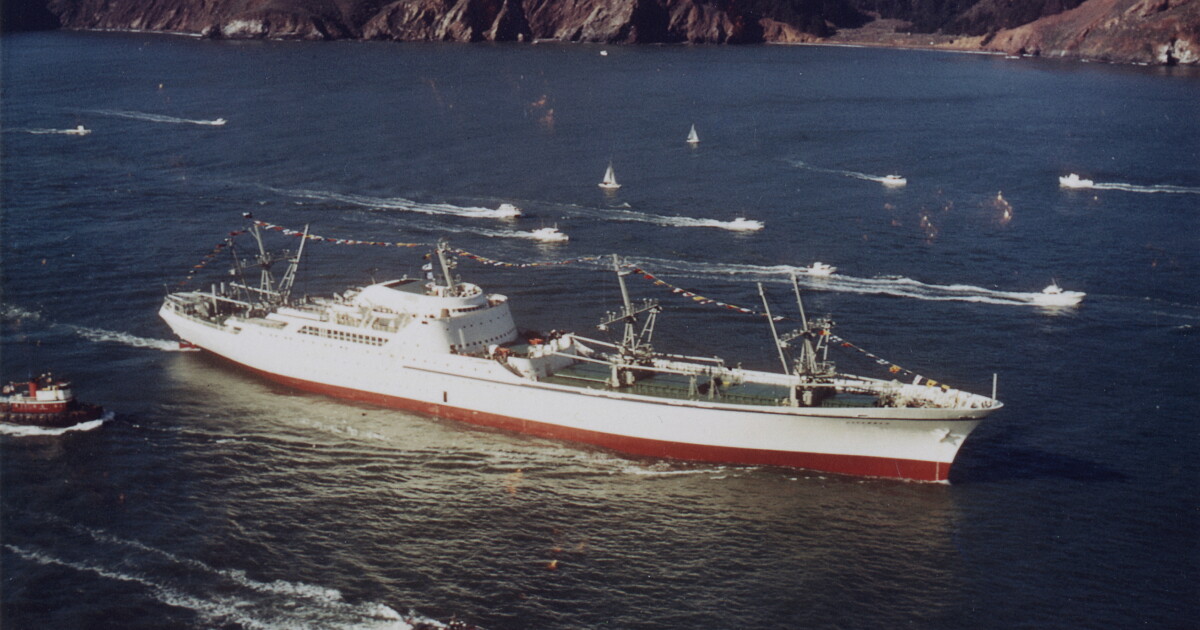
It's possible that by 2035 there may be as many as 50 nuclear-powered cargo ships plying the seas. In anticipation of this, the Pink Corridor Project is evaluating how to set up safe and secure nuclear shipping lanes between the US and Britain.Unlike a "Green Corridor" powered by renewable fuels or green hydrogen, a "Pink Corridor" takes its name from the color code used by the energy and shipping industries to designate nuclear power.Nuclear cargo ships aren't new. The US government built the NS Savannah in the 1950s as part of its "Atoms for Peace" program, which aimed to promote the peaceful use of nuclear technology while reducing the threat of nuclear war. The project envisioned an era when the world's goods would crisscross the world powered by the emission-free atom.However, that never came to pass. There were many reasons for this, but one major obstacle was that the launch of the NS Savannah was putting the cart firmly before the horse.It didn't matter how state-of-the-art the pioneering passenger freighter was, how sleek her lines, or how posh the accommodations. What mattered was that the project ignored the fact that a ship is nothing but the tip of a very long logistical, regulatory, and infrastructure spear. Without the proper port facilities, regulations, safety protocols, and other essentials, nuclear cargo ships are as impractical as steamships without coal or oil refueling stations.To tackle those precise operational barriers today, Lloyd's Register (LR), A.P. Moller – Maersk, the Port of Felixstowe in the UK, and South Carolina Ports (Charleston) in the US are using a conceptual vessel design derived from previous work with Core Power on floating nuclear reactors. This baseline allows them to evaluate the operational, safety, regulatory, and security feasibility of deploying nuclear-powered commercial container vessels on transatlantic trade routes – specifically between Charleston and Felixstowe.Working with a ship that uses an advanced civilian nuclear reactor, the project is looking at what port facilities will be needed and the radiation safety measures tailored for a high-density container terminal.A large part of this work centers on safeguards and security. Since these ships will operate in the North Atlantic, high-seas hijacking is extremely unlikely, and physical intrusion into a reactor vessel in port presents immediate hazards to an intruder. Instead, security focus centers on tracking nuclear fuel and securing reactor management systems against both physical and cyber threats.A large part of this work centers on safeguards and security. Since these ships will be operating in the North Atlantic, hijacking is extremely unlikely, and anyone breaking into a reactor vessel in port would suffer a very fast and unpleasant end. Instead, security is more a matter of tracking fuel and keeping reactor spaces secure from not only physical but cyber attacks.Safety is a trickier question. Decades of naval experience have resulted in reactor and ship designs to protect against radiation threats in all but the most extreme cases. Far more difficult is reconciling maritime safety rules, US civilian nuclear regulations, and UK standards, .In other words, it's harder to alter regulatory paper than it is to cut steel.Alongside safety protocols, new liability frameworks are being looked at so that commercial nuclear ships can be insured at reasonable market rates."The Pink Corridor joint development programme is an important step for the application of nuclear technology in merchant shipping, said Nick Gross, Global Containerships Segment Director, LR. "By taking a practical, collaborative approach, the project will examine the security and safeguards that would need to be addressed for safe operations. The partnership brings together industry-leading players across shipping, ports and classification, reflecting the growing interest in nuclear technology as a route to more sustainable maritime operations."Source: Lloyd's Registry
Transatlantic "Pink Corridor" project explores nuclear shipping corridor
Full Article
Original Source
Read the full article at Newatlas →KhanList aggregates and links to publicly available news content. We do not host full articles from third-party sources. Always verify important information with original sources.