
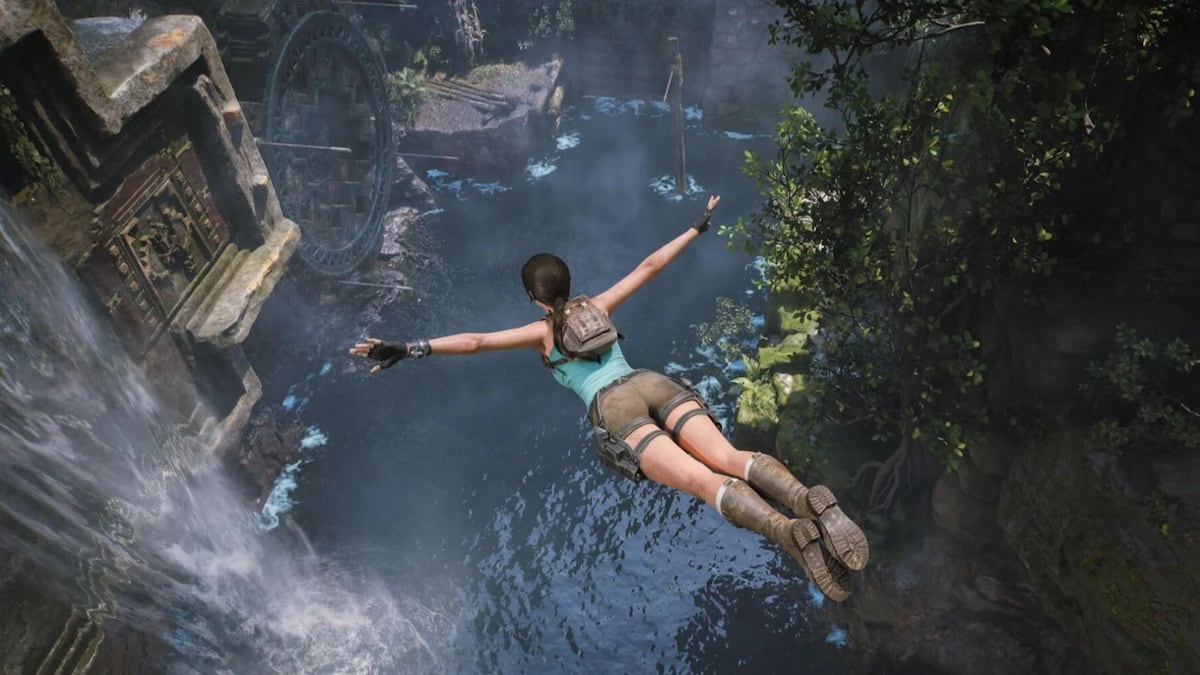
She might have celebrated with her favorite dish: beans on toast. Or perhaps she treated herself to a chocolate-and-orange cookie, the other delicacy she loves. The truth is that on October 24, Lara Croft deserved at least a small break from so many adventures. Accustomed to piling up milestones, last Saturday she marked a special one: 30 years since the release of the first Tomb Raider. A passionate lover of history, the archaeologist has spent three decades writing the story of the video game alongside her own. And, arguably, of popular culture, judging by 100 million copies sold, 2,300 magazine covers, exhibitions, films, and songs she has starred in. “You’d be amazed how persuasive I can be, even with dangerous men,” she said in one of her games. The facts back her up. She does not even need to draw her famous twin pistols.First, she had to win over her own industry. At a time when Peach awaited rescue from Super Mario and Princess Zelda pinned her hopes on the warrior Link, Tomb Raider brought a strikingly obvious change for 1996: women could take the lead. And men would identify with them too. “They were afraid players would reject her. Instead, she became distinctive. I suppose some wanted to protect her. But I want to believe many saw her as powerful, cool,” says Paula Sáez Pérez, author of the book La última exploradora: un recorrido por la saga Tomb Raider (The Last Explorer: A Journey through the Tomb Raider Saga). “She helped ensure we no longer question that in video games today,” adds Miguel Aguerralde, author of Tomb Raider: el viaje de Lara Croft (Tomb Raider: The Journey of Lara Croft).Gradually, she also made clear she hadn’t come to be wed to anyone or anything — except exploration. Facing freezing temperatures in tiny shorts and a tank top hardly helped the mission. “They weren’t thinking about female players, but about boys. Still, it was welcome that she was so self-assured and there were no developed romance arcs [and the fictional Lara even has a birthday on Valentine’s Day]. The idea that she was overly sexualized is a bit simplistic: for the time she wasn’t that bad, and characters then weren’t very deep. Although things like the infamous ‘pyramidal breasts’ or marketing with suggestive images are fair criticisms,” Sáez says. In any case, while she toured about 30 countries — from the Colosseum to Kilimanjaro, from Antarctica to Yucatán — the adventurer began another journey: moving away from being a sexual object toward iconic status. The two new video games in development and the television series in production are meant to cement that from 2027. For now, among her many Guinness records, she already holds the title of the most versatile female digital character ever.“When she appeared on the scene, video games had heroes, and female mascots,” Sáez Pérez sums up. The origins of the work achieved another feat: it came out of three years’ work by a team of six people. A handful by the standards of the time, and even fewer given the game’s scale: it pioneered building a three-dimensional environment to move through freely. The person responsible for designing those levels was Heather Gibson, the team’s only woman, although Lara Croft’s creator was developer Toby Gard.Gard’s idea changed several times: to avoid the Indiana Jones homage becoming a copy, he chose a woman. He drew inspiration from the punk heroine Tank Girl, from Jamie Hewlett’s comics, and from singer Neneh Cherry. Initially, he thought of Lara Cruz, a South American mercenary. But developer Core Design wanted her to be British: the surname came from among the most common entries in the phone book. Early sketches show Lara in military uniform and holding a bouquet made of severed heads. In the end, she was made more elegant: a millionaire daughter of aristocrats. It’s not for nothing that she carries the title Countess of Abingdon.It was an immediate hit. “There are photos of team members sleeping under desks; after the success they released a game a year,” Sáez Pérez recalls. “It also worked because of the concept itself — adventure and action, an immersion in a movie — when the norm was platformers like Sonic and Mario or fighting games like Street Fighter. Another hook was the high difficulty level,” Aguerralde emphasizes. Sales continued to skyrocket with the second installment in 1997 and the third, 12 months later, which added another milestone: it was among the first video games to offer multiple routes to complete the same level.By 1999, three years after its launch, Tomb Raider had become a phenomenon. Lara Croft appeared on clothing, deodorants, scooters, luxury pens, and playing cards. She was dressed in Gucci or Alexander McQueen, turned up at U2 concerts, and energy drink Lucozade temporarily renamed itself Larazade. Janet Swallow, vice president of licensing at distributor Eidos in those years, cites two emblematic cases in a promotional dossier: they rejected a request from a racehorse owner who wanted to rename his horse Lara Croft for fear the animal might fall going over the first fence; they did, though, authorize a Dutch tulip breeder to name a variety after the archaeologist. At the height of her fame — afraid of nothing beyond her aunt’s corgi, because of a traumatic childhood bite — Lara seemed unstoppable. But after so much tomb raiding, she discovered her own.At the end of the fourth installment, The Last Revelation, a pyramid collapsed with the explorer still inside. Perhaps developers did not plan an eternal rest, but they did pause after the frenetic pace. Core Design began receiving angry messages from fans. “PlayStation told them: ‘No, that’s not happening,’” Sáez Pérez says. The market was clamoring for more Lara Croft video games. Her big-screen debut, starring Angelina Jolie, widened the phenomenon. Then came Chronicles, with an experimental narrative device: at the wake, several characters shared memories that the player could experience. Next came perhaps the darkest and most criticized entry, The Angel of Darkness. Still, both left marks: the PC edition of Chronicles included the game’s level editor, which the gaming public still tinkers with today. The latter title introduced stealth movement and attack mechanics that are now common in many action games.However, for a few years the archaeologist grew less persuasive. There were hiatuses, remasters, and a tricky puzzle even for Lara: how to revive the franchise? “I think her success is because she’s a relatable character. Through the games you see different dimensions of Lara — from self-confidence to geeky traits — there’s a lot to make you want to support her but also feel connected to her in different situations,” reflects Raul Siqueira, game director at Crystal Dynamics, the studio now in charge of the saga.The road back to glory therefore involved reconnecting with the audience: the saga’s original fans, but new ones as well. In Tomb Raider II, back in 1997, the archaeologist could spend downtime in her mansion. Some players invented a challenge: get the butler, Winston, to follow them into the freezer and then leave quickly, closing the door behind them. Years later, in 2016, Crystal Dynamics thanked that enduring passion with a nod: in an expansion for Rise of the Tomb Raider, players could find a letter from the poor man complaining about the incident, which had left him “shaking” and a bit upset. And the saga’s own rebirth, with the trilogy that began in 2013, listened to what was happening outside — and, finally, to the other half of the world. Tomb Raider, named the same as the original, reset the story from zero. For the first time, it was conceived by a female writer: Rhianna Pratchett (Terry Pratchett’s daughter).“It would have been preferable if many more women had worked on a character like her, because in the end it shows,” Sáez Pérez says. In that 2015 installment, in particular, an unprecedented Lara appeared: younger, scared, complex, more human. “It was the first time she was taken seriously,” the expert notes. Although there was criticism that her apparent fear of firearms quickly turned into cold proficiency, Sáez Pérez says that was not the writer’s decision but one made for gameplay reasons. The fact is it kick-started another successful phase: there were two more installments, a film starring Alicia Vikander and the announcement of an upcoming series, with Sophie Turner attached and written by Phoebe Waller-Bridge (Fleabag). Next year will also bring Legacy of Atlantis, yet another reimagining of the original game, and Catalyst, the saga’s continuation, is scheduled for 2028 and promises the “largest Tomb Raider world to date.”Otherwise, Catalyst’s synopsis contains all the franchise pillars: forgotten tombs, ancient mysteries, spectacular landscapes, puzzles to solve and, of course, lots of action. The number of polygons that make up the character has skyrocketed (from 250 to over 200,000); the presence of women in game development has increased, though not by much — at least judging by the most visible faces leading the new video games. Today’s Tomb Raider titles offer many accessibility options and details such as the ability to listen to dialogue in Quechua or Yucatec. The essence, however, remains exploration, a thirst for puzzles, and adventure. “I’m not good at conversations,” Lara admits throughout the series. On another occasion, she remarked, “We’re facing a myth — except that it’s all real.” She was referring to King Arthur’s tomb. But, in reality, she could have been talking about herself.Sign up for our weekly newsletter to get more English-language news coverage from EL PAÍS USA Edition
Trailblazing, sexualized, legendary: Lara Croft and ‘Tomb Raider’ celebrate 30 years of adventure
Full Article
Original Source
Read the full article at English →KhanList aggregates and links to publicly available news content. We do not host full articles from third-party sources. Always verify important information with original sources.