
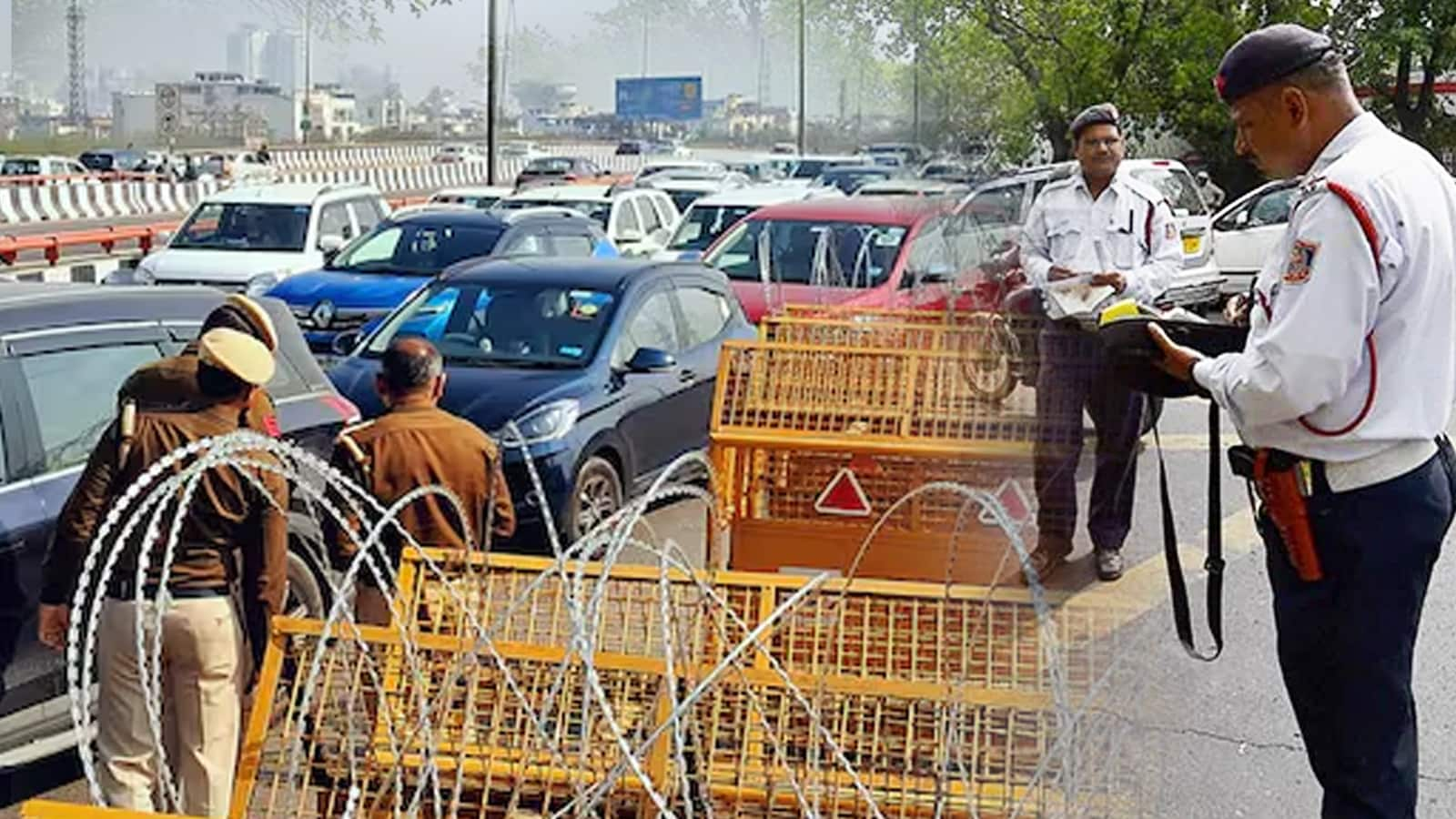
New Delhi: The first day of Delhi's new anti-air pollution restrictions saw heavy traffic snarls at the city's borders on Sunday, with vehicles queuing up for checks, even as air quality deteriorated to the poor category, marking the worst reading of the season so far and the highest in 198 days.Heavy congestion was seen at several entry points, particularly along the Delhi-Gurugram and Delhi-Noida borders, as traffic police and enforcement personnel conducted checks on vehicles entering the national capital.Long queues of vehicles were reported near the MCD toll booths and other NCR entry points, with commuters facing bumper-to-bumper traffic as officials stopped vehicles that did not meet the prescribed emission standards.The restrictions come as Delhi's AQI stood at 261 (poor) on Sunday, matching the reading recorded on July 12. It last crossed 250 on April 17, when AQI was 263.Of the 57 monitoring stations across the city, 22 centres' air quality was in 'the very poor category', while 21 were in the poor category and the remaining 14 recorded moderate air quality.Jahangirpuri recorded the worst AQI at 378, nearing the severe category, which begins at 401. PM2.5 was the predominant pollutant in the national capital.The deterioration in air quality coincided with the implementation of a series of special winter pollution-control measures, including restrictions on vehicles registered outside Delhi that conform to BS-IV or older emission standards, a ban on dust-generating outdoor construction activities, doubling of parking charges and a 50 per cent cap on physical attendance in government and private offices.The restrictions, which will remain in force for varying periods between November 1 and February 28, are aimed at reducing vehicular emissions, dust pollution and traffic congestion during the winter months.To strictly enforce these measures, the teams are conducting round-the-clock checks, identifying vehicles violating the restrictions through automatic number plate recognition cameras installed at entry points and other key locations.The Delhi transport department has deployed around 250 enforcement personnel at key entry points, toll plazas and identified pollution hotspots to ensure compliance with the restrictions.A total of 39 teams have been stationed at 13 major toll plazas, including DND, Rajokri on NH-48, Ghazipur, Singhu border, Tikri and Badarpur.Officials have also been directed to take action against non-compliant vehicles, including issuing e-challans and impounding vehicles as per rules.The traffic congestion also sparked reactions online, with several commuters expressing frustration over long queues at the borders and questioning whether the restrictions would translate into a meaningful improvement in air quality."If you are travelling to Delhi in the next few days, you will have to bear the brunt of this type of traffic. Plan accordingly. Delhi-NCR's air quality will have zero improvement because of this step," a social media user posted.Another commuter said: "Three hours stuck at the Delhi border. What is the use of us even coming? The event I was supposed to attend was already halfway through. These restrictions are meant to reduce pollution, but commuters are being left stranded in endless traffic jams. And the funny thing is, it may not even prove effective in improving air quality."The restrictions also prohibit all dust-generating demolition and outdoor civil construction activities from November 1 to January 31, except for specified essential public infrastructure projects subject to prescribed conditions. A complete ban on construction and demolition activities, barring specified exemptions, will also be imposed from December 10 to January 20.Parking charges at authorised parking lots across Delhi have been doubled from November 1 to February 28, while government and private offices have been asked to restrict physical attendance to 50 per cent, with the remaining employees working from home. Essential and emergency services have been exempted.To reduce traffic congestion, Municipal Corporation of Delhi offices will function from 8.30 am to 5 pm, while the state government offices will operate from 10 am to 6.30 pm.According to the Decision Support System (DSS) for air quality management, transport emissions in Delhi accounted for 16.4 per cent of the pollution contribution on Sunday.Delhi's industries contributed 3 per cent, residential sources 4 per cent, construction 2.2 per cent, energy 1.2 per cent, road dust 1.2 per cent and other sectors 1.1 per cent.Among the neighbouring NCR districts, Jhajjar contributed 9.2 per cent, Gurugram 4.8 per cent, Bhiwani 2.7 per cent, Rohtak 2.2 per cent and Bulandshahr 0.3 per cent, according to the DSS estimates.Stubble burning contributed up to 18.5 per cent to Delhi's pollution, while other sectors accounted for 24.3 per cent, the estimates showed.The Air Quality Early Warning System has forecast that Delhi's air quality is likely to remain in the poor category from November 2 to November 3. The outlook for the subsequent six days indicates that air quality is likely to remain in the poor to very poor category.With winter setting in and pollution levels expected to remain elevated, the effectiveness of the new restrictions will be closely watched in the coming days, particularly as enforcement at the city's borders raises concerns over traffic management and the impact of the measures on commuters.(Except for the headline, this story has not been edited by NDTV staff and is published from a syndicated feed.)
Traffic, Chaos At Delhi Borders As Anti-Pollution Curbs Kick In
Full Article
Original Source
Read the full article at Ndtv →KhanList aggregates and links to publicly available news content. We do not host full articles from third-party sources. Always verify important information with original sources.