
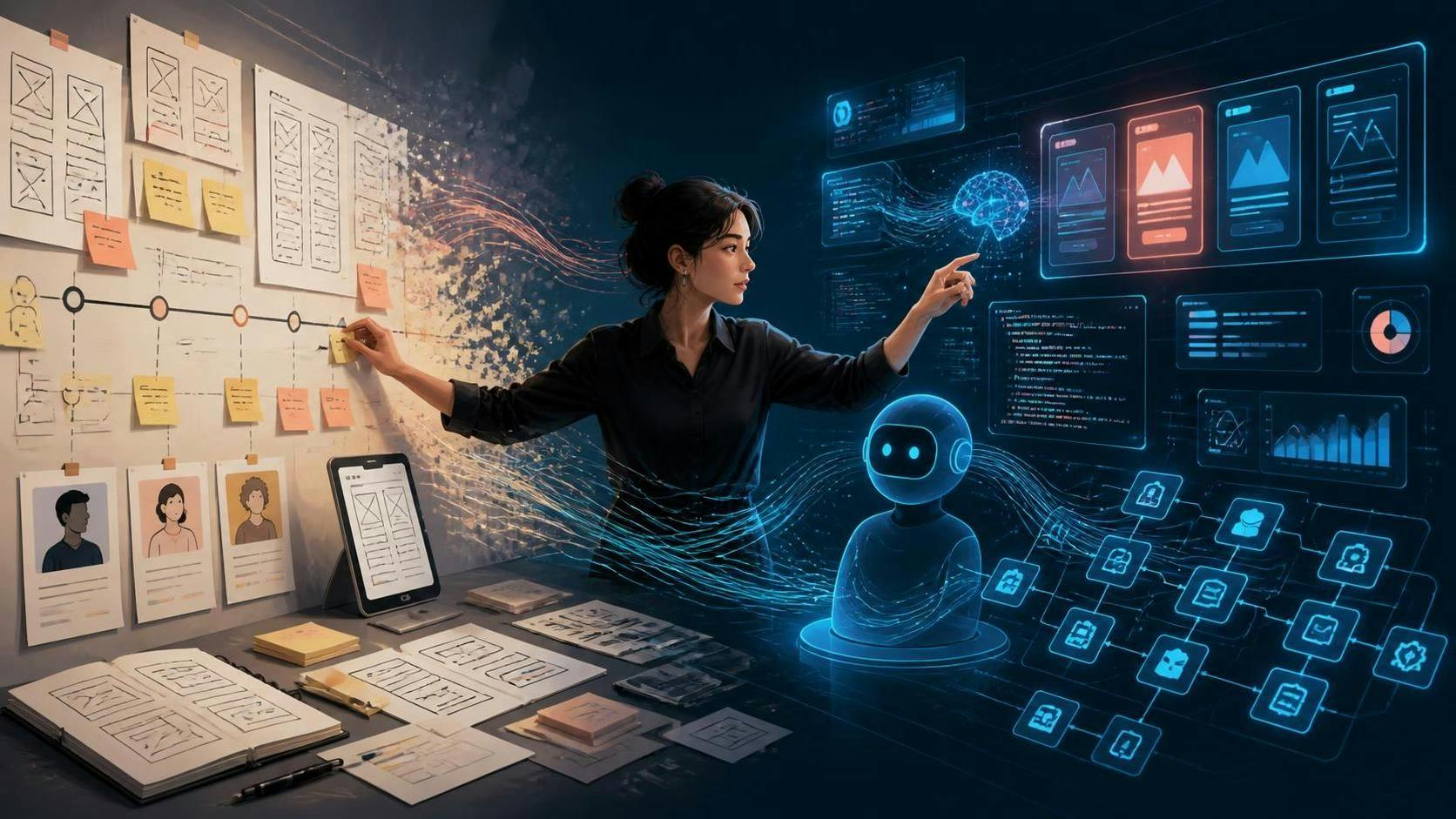
The following is just one man’s opinion. However, having spent years in User Experience Consulting, I have been exposed to more projects, industries, business models, technologies, and organizational environments than a typical full-time employee might encounter in a single company. That experience and unique perspective have led me to a conclusion that may be uncomfortable for many UX professionals: Traditional UX, as we know it today, may be largely extinct within the next two years. That does not mean user experience will disappear. Quite the opposite. The need to understand users, design useful products, and create intuitive interactions will remain more important than ever. What is likely to disappear is the traditional UX discipline, with all of the familiar processes, roles, tools, and deliverables that have defined the profession for several decades.UX methodology has evolved fairly slowly. Research, personas, journey maps, wireframes, prototypes, usability testing, and design systems became established parts of a recognizable process. While other disciplines changed rapidly, such as content strategy, software development, cloud technology, analytics, automation, and data science, traditional UX evolved at a much slower pace.Then AI entered the picture.AI is not simply another tool added to the UX toolbox. It is changing how products are conceived, built, tested, personalized, and maintained. Most major UX tools are already attempting to incorporate AI into their workflows. Designers can generate layouts, produce prototypes, summarize research, create content, identify patterns, and explore alternatives in seconds.Many UX practitioners are trying to do the same. But there is a fundamental difference between using AI to accelerate existing UX activities and understanding how AI is changing the larger environment in which products are created. That larger environment is increasingly dominated by technology.The old model separated responsibilities fairly clearly. Researchers studied users. Designers created interfaces. Writers developed content. Developers implemented the experience. Analysts measured performance. Product managers made decisions across the system. That separation has been steadily breaking down.AI is compressing the distance between strategy, design, content, code, data, and production. A practitioner who can understand the user problem, manipulate data, prototype an interaction, generate working code, test an experience, and interpret behavioral results is becoming far more valuable than someone who can perform only one traditional step in the process.This is why the next evolution of UX is not simply “UX with AI.”It isUX Engineering. A UX engineer does not need to become a full-time software engineer or abandon human-centered design. But they do need to elevate their technology skill set to a level that would have been unusual and rare at the beginning of the UX industry.That means understanding how products are actually built. It means becoming comfortable with HTML, CSS, JavaScript, APIs, databases, analytics, automation, prototyping environments, accessibility, and increasingly, machine-learning concepts. It also means understanding technical constraints well enough to design solutions that can move beyond a presentation deck or a static prototype.This shift will face substantial resistance. People naturally defend the methods that built their careers. Organizations reinforce familiar job descriptions. And when a discipline has operated in a certain way for decades, new expectations can feel less like progress and more like a threat to professional identity.But the market does not preserve roles simply because they have historical importance. The UX professionals who adapt will not necessarily be the people who abandon design. They will be the people who expand their definition of design. They will connect user needs to technical possibilities, business outcomes, data, and implementation. They will use AI not merely to produce more artifacts, but to make better decisions and create more effective products.Those who refuse to adapt may still find occasional work under traditional UX titles. But their opportunities are likely to become narrower, more competitive, and increasingly vulnerable to automation.The real warning is not that UX is dying. It is that a traditional definition of UX is dying.The future, and frankly, the present, already belongs to practitioners who can think like researchers, designers, technologists, strategists, and builders at the same time. UX will survive, but the people who thrive in it will need to evolve faster than the discipline ever has before.
Traditional UX: Is It Coming to an End?
Full Article
Original Source
Read the full article at Hackernoon →KhanList aggregates and links to publicly available news content. We do not host full articles from third-party sources. Always verify important information with original sources.