
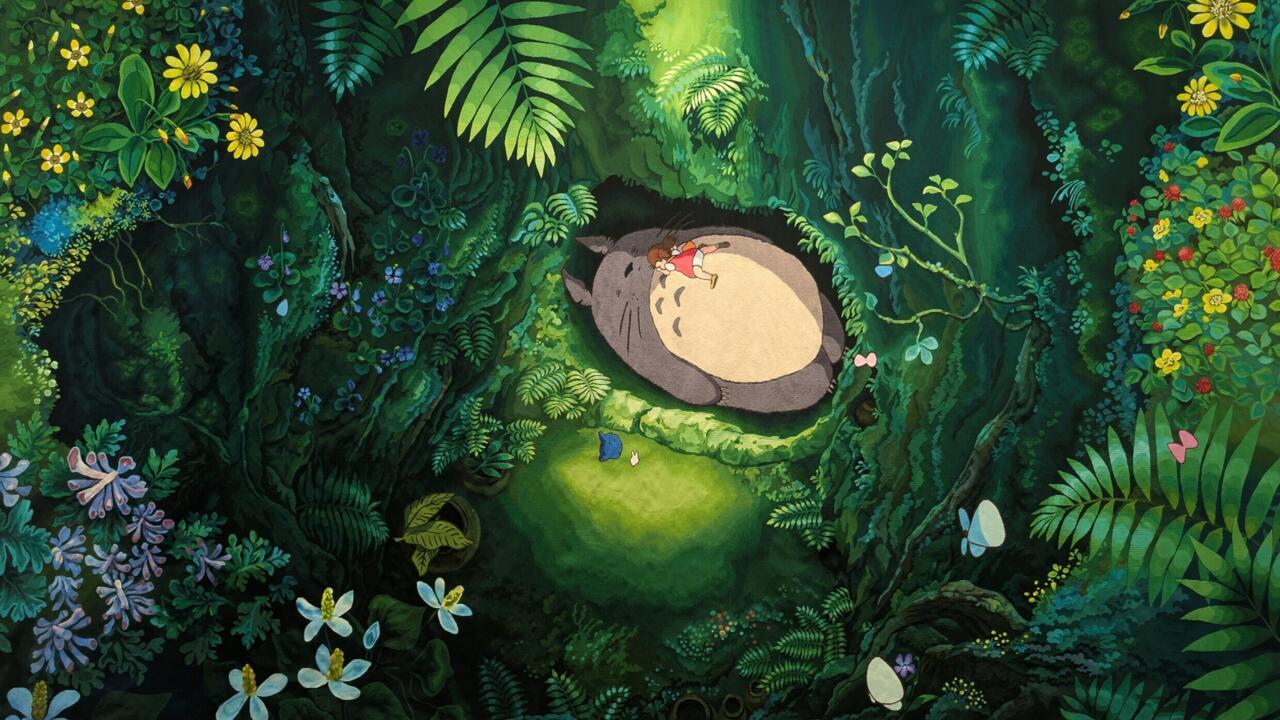
The French town of Aubusson is renowned for producing some of the world's finest tapestries. Now its weavers are using centuries-old techniques to reimagine scenes from the fantastical films of Japanese animators Studio Ghibli – and unearthing some unexpected connections in the process. In Aubusson, a small town in the middle of France, weavers have passed down the same techniques through the centuries. In 2009, the area's signature craft was recognised by Unesco as an intangible cultural heritage of humanity. Today a dedicated museum in Aubusson, the Cité internationale de la tapisserie, is responsible for preserving some of the finest examples, as well as commissioning new works that combine contemporary designs with traditional skills. Its latest project draws on an art form that at first appears to share little with 600-year-old tapestries: Japanese anime and the films of the legendary Studio Ghibli. Weaving a tapestry is like playing music. Studio Ghibli woven into Aubusson tapestryZeenat Hansrod "What connects Aubusson tapestry to Japanese animated movies and the work of Studio Ghibli is craftsmanship," said Alice Bernadac, the museum's curator. "Both involve a lot of invisible work and incredible know-how. It's where these two worlds can meet today." She admitted it was challenging to transpose the work of Ghibli directors Hayao Miyazaki and Isao Takahata into a different medium. "Animated movies are, obviously, made of moving images and we had to choose images that could be sealed forever in tapestry. The greatest challenge was to bring that Aubusson touch while not betraying the original material. It's always a thin line to work on," Bernadac told RFI. Visitors admire an Aubusson tapestry, "The banquet of No-Face", adapted from Studio Ghibli's animated film "Spirited Away". © Hayao Miyazaki/Studio Ghibli NDDTM, 2001/Cité internationale de la tapisserie, 2023 She added that the team watched Ghibli films with and without the sound in order to focus on the images and not the plot. "I grew up with these movies. What was frustrating was giving up on images you liked but were not best to be adapted in tapestries." Seven scenes were eventually selected for the series "Aubusson weaves Hayao Miyazaki and Isao Takahata", from Princess Mononoke, Spirited Away, Howl's Moving Castle, My Neighbour Totoro, The Tale of the Princess Kaguya and Nausicaä of the Valley of the Wind. The museum's experts found some surprising similarities between the films and the conventions of French tapestry. "There are a lot of connections between the work we selected for the set of tapestries and the history of Aubusson tapestry," said Bernadac. She points to verdure, a style featuring lush greenery and landscapes that is emblematic of the area's tapestries. Weaver Aiko Konomi working on the colour scheme for "Mei and Totoro’s Nap", a tapestry based on "My Neighbour Totoro". © Cité internationale de la tapisserie/Zoé Forget "The way Studio Ghibli's films depict nature has been an important feature in the set of tapestries we are currently making," the curator said. Two images from Princess Mononoke and My Neighbour Totoro were selected because they "are very reminiscent of those ancient tapestries". "We also found unexpected connections, like in the tapestry depicting the sorcerer Hauru from Howl's Moving Castle lying in his bed," said Bernadac. The image recalls Sleeping Beauty, a famous tapestry woven by another French manufacturer, Gobelins in Paris, in the 1910s. "They both have a striking resemblance in the way the main character is pictured lying in bed, surrounded by an abundance of details." The sorcerer Hauru lies in bed, a scene from "Howl's Moving Castle" woven in Aubusson tapestry. © Studio Ghibli-NDDMT, 2004/Cité internationale de la tapisserie/Nicolas Roger, 2023 ‘It’s like losing a member of the family’: Bayeux bereft without its tapestry From screen to loom Measuring between between 17 and 32 square metres, the tapestries are impressive in scale. "The tapestries are monumental because we wanted the visitors to have an immersive experience like being in a cinema with a huge screen, transported into the rich imaginary world of Studio Ghibli," said Bernadac. Each one was a huge undertaking. One tapestry based on a scene from Princess Mononoke, spanning 5m by 4.6m, required six to eight months of preparatory work before weaving even began. Specialised artist Delphine Mangeret created full-scale technical models of the designs, called cartoons, for weavers to place beneath their looms and use as a guide. She next liaised with dyers and selected the colour palette and materials. Delphine Mangert working on a preparatory cartoon for the tapestry "Mei’s and Totoro’s Nap". The model is placed underneath the loom and helps guide the weavers. © Qui Plus Est, 2024 Crafty Bayeux artisans give traditional French lace a modern touch Then the weavers began their work. It took a team of three to four weavers around one year to complete each of the tapestries. Five of the seven have been finished so far. "Every Aubusson tapestry is woven entirely by hand. So it's quite a lengthy process, even if in Aubusson weavers are quite fast," explained Bernadac. Two final works, one featuring a scene from Nausicaä of the Valley of the Wind and the other based on sequences from The Tale of the Princess Kaguya, are yet to be completed. The former is expected to be finished in 2028, nine years after the museum first agreed the project with Studio Ghibli. This kind of craftsmanship is also expensive. The project will cost approximately €1.8 million in total, partly funded by donations. The Nausicaä tapestry alone is estimated to cost €220,000, with the museum aiming to raise €40,000 through crowdfunding. The design for "The Secret of the Fukai", inspired by "Nausicaä of the Valley of the Wind", which is yet to be woven. © Studio Ghibli-H, 1984/Cité internationale de la tapisserie, 2025 'Like playing music' Bernadac believes it is important to show visitors the work that goes into the tapestries. "We want to bring them with us in Aubusson with the weavers, with the dyers, with the spinning mills, with these six centuries of know-how," she said. For a tapestry to be classified as an Aubusson, it must be woven in or around the town using traditional techniques. Weavers at the Atelier Tapisserie Guillot in Aubusson working on "Ashitaka and Yakul in the Forest", based on a scene from "Princes Mononoke". © Cité internationale de la tapisserie, 2021 Denim returns to its roots in southern French town of Nimes "Aubusson tapestry is not about reproducing perfectly an image in tapestry," said Bernadac. "Weaving a tapestry is like playing music. No musician is going to play a song exactly the same way. And it's the same here. "So the result will be not just be a copy of the original work. It will be a new artwork. And that's really what's special about Aubusson."
Traditional French tapestry captures fantastical world of Japanese anime
Full Article
Original Source
Read the full article at Rfi →KhanList aggregates and links to publicly available news content. We do not host full articles from third-party sources. Always verify important information with original sources.