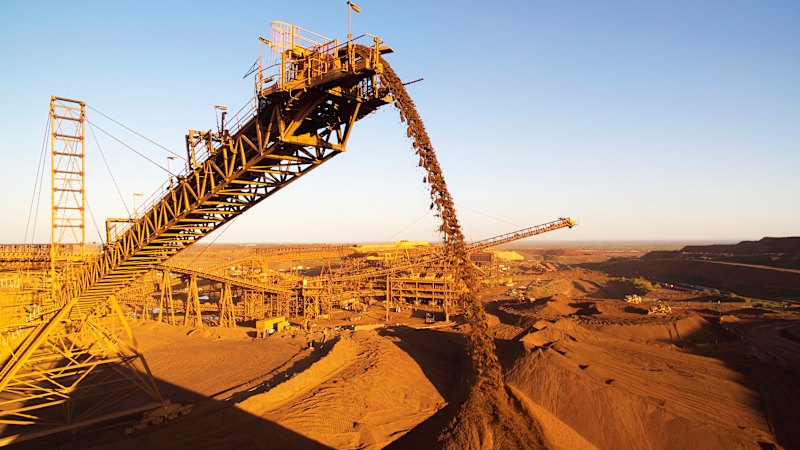
Billionaire Andrew Forrest’s Fortescue Metals Group has become the latest major mining company targeted by China’s push to force down iron ore prices, putting future revenue from Australia’s most valuable export commodity under pressure.Fortescue, the nation’s third-largest iron ore producer, on Friday confirmed it was locked in contract discussions with China Mineral Resources Group (CMRG), Beijing’s centralised buyer created to leverage the country’s massive purchasing power against foreign suppliers.Fortescue’s Cloudbreak mine in WA.Fortescue insisted it would continue to push for a swift return to normal market-led conditions despite mounting pressure from Beijing.“It’s the latest example of trade friction affecting the iron ore industry, undermining the stable supply of iron ore to China,” Gus Pichot, Fortescue’s chief executive of growth and energy, told analysts on Friday.“We hope to see a return to normal market conditions as soon as possible.”Iron ore, the key raw material use to make steel, is Australia’s single biggest export, generating more than $100 billion a year in export earnings, meaning even a minor decline in pricing could have a significant impact on state and federal government revenue and the broader economy.Andrew Forrest speaking at Boao Forum in Perth on Monday.Ross SwanboroughIron ore routinely accounts for as much as 5 per cent of Australia’s gross domestic product. China is the biggest buyer of the commodity from Australia by far.However, the stand-off over pricing and future supply terms with Fortescue presents the latest test of China’s attempt to use its enormous purchasing power to drive down the cost of iron ore. Since its establishment in 2022, CMRG has sought to consolidate the bargaining power of Chinese steel mills in contract negotiations with suppliers, including Australia’s BHP, Rio Tinto and Fortescue.Fortescue has declined to confirm or deny reports, published in Reuters and Bloomberg, that suggest Beijing has told steel mills and traders to restrict or delay imports of some of Fortescue’s specific iron ore products in a bid to gain leverage.BHP, the largest Australian mining company, came under pressure from CMRG during contract negotiations last year. According to media reports at the time, CMRG ordered Chinese steel to halt any new dollar-denominated purchase deals for BHP iron ore.Speaking at an event in Perth last week, Forrest did not mention CMRG, but said Australia had never been a “fair-weather friend” to China, and implored the two countries to “always negotiate fairly”.“Together we built mines, we built railways, we built the ports of the Pilbara. Together, we built the iron ore industry that supports nearly 400,000 jobs and many, many more families directly and indirectly,” he said.“Each nation becomes stronger as each succeeds.”Fortescue on Friday said it continued to engage in respectful, patient and good-faith negotiations with CMRG, but a return to “normal market conditions” would be the best outcome for Chinese steel mills and their Australian trade partners that had been their reliable suppliers for decades.The company said China remained its major market, but it would also continue exploring alternative destinations for its iron ore, such as major growth economies of South East Asia and India.China, Australia’s biggest trading partner, has appeared increasingly willing to use its market clout to exert pressure on its suppliers of key commodities. In 2020, Beijing slapped an unofficial ban on Australian coal amid a diplomatic stoush with then-prime minister Scott Morrison, leaving dozens of coal ships stranded at sea for months, unable to dock at Chinese ports.The Market Recap newsletter is a wrap of the day’s trading. Get it each weekday afternoon.From our partners
‘Trade friction’: Beijing is turning up the heat on Australian iron ore
Full Article
Original Source
Read the full article at Smh →KhanList aggregates and links to publicly available news content. We do not host full articles from third-party sources. Always verify important information with original sources.