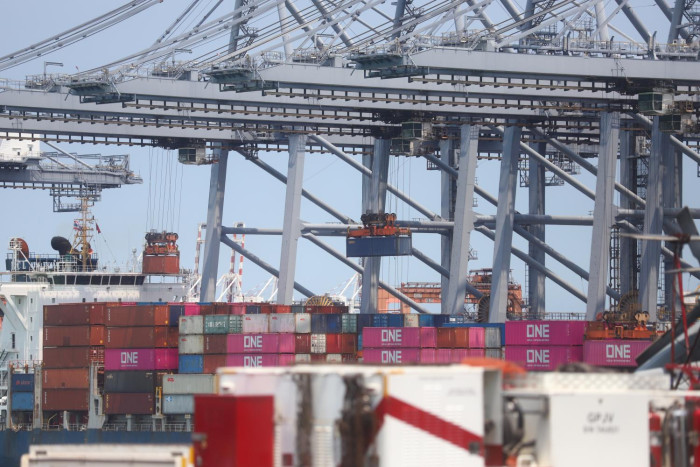
Shipping containers at Laem Chabang Port in Chon Buri. Nutthawat Wichieanbut Thailand's widening trade deficit may appear alarming at first glance, but a deeper analysis suggests it is more a sign of economic transformation than deterioration.The surge in imports has been driven largely by machinery, production equipment, industrial raw materials and electronic components -- inputs that businesses need. Trade analysts argue as long as rising imports are for productive investment that strengthens the export base, lifts industrial output and generates higher economic growth, the trade deficit may reflect the country's transition towards a more investment-driven, higher value-added economy with enhanced competitiveness. FLOOD OF IMPORTS Imports are surging, driven by intensifying global trade competition and a dependence on foreign products and raw materials that remain scarce or unavailable domestically. The Federation of Thai Industries (FTI) has raised concerns about the impact of these imports, particularly those that fail to meet local standards, and is urging the government to tighten regulations while promoting greater use of local content in investment projects. Pimjai Leeissaranukul, chairwoman of the FTI, said imports should be viewed in two categories, with the first involving general consumer goods, many of which are entering Thailand without proper certification. On July 27, FTI representatives met with Industry Minister Varawut Silpa-archa to discuss stricter enforcement against substandard imports. The ministry reported more than 700,000 non-compliant items had already been seized. Authorities are coordinating with the Customs Department and e-commerce platforms to prevent uncertified products from being sold online. "From now on, the government will intensify controls on e-commerce platforms, ensuring that only products bearing the TISI [Thai Industrial Standards Institute] mark are allowed for sale," Mrs Pimjai said. Beyond enforcement, the FTI is calling for policies that encourage greater use of local raw materials in new investment projects. She emphasised the importance of negotiating for higher local content and contribution, as well as securing technology transfers from foreign investors to help Thai manufacturers develop capabilities they currently lack. The second category of imports involves products Thailand cannot produce itself, particularly in advanced technology sectors. High-tech electronics, such as semiconductor and hard disk components, are imported by multinational firms such as Western Digital for assembly in Thailand before being exported back to the US. These products are often exempt from tariffs under Section 301 of the US Trade Act, which allows Washington to impose duties on countries engaged in unfair trade practices. "Thailand does not own these technologies. As exports rise, imports of high-tech components inevitably increase as well," said Mrs Pimjai. "Even with efforts to promote 'Made in Thailand' products, it remains difficult to rely solely on domestic raw materials." While Thailand's electronics exports have grown, this does not necessarily reflect stronger output from Thai-owned factories, which continue to lag behind in competitiveness, she noted. The energy sector presents another challenge. Thailand remains dependent on crude oil imports to fuel its transport and industrial needs. In the first quarter of 2026, oil imports, including crude and refined products, fell by 2.1% year-on-year to 1.04 million barrels per day. However, the value of these imports remained high, averaging 78.2 billion baht per month, compared with just 11.5 billion baht in monthly refined oil exports, according to the Department of Energy Business. Refined oil exports dropped sharply by 16% year-on-year to 126,711 barrels per day, following government restrictions aimed at ensuring sufficient domestic fuel reserves amid geopolitical tensions, including the Israel-US conflict with Iran that erupted in late February. DOMESTIC VALUE-ADDED Nattaporn Triratanasirikul, deputy managing director of Kasikorn Research Center (K-Research), said the rising trade deficit is a result of soaring imports as high-tech industries, including electronics and data centres, have brought in materials and components. Imports of finished goods are also growing as Thai consumers' preference for foreign products, including cheaper Chinese goods, rose as a result of price sensitivity and the availability of those products on e-commerce platforms. The increasing import value is also a result of the rising cost of energy and raw materials amid the prolonged conflict in the Middle East that has disrupted the world's major shipping routes, she said. "The growing trade deficit should not be a serious concern if those imported items are used to serve investments in Thailand that could result in higher GDP, and are not purely for domestic consumption," Ms Nattaporn told the Bangkok Post. In the 1980s, Thailand also recorded surging imports and a ballooning trade deficit when the electronics and automotive industries were being developed. The automotive sector, once the backbone of Thai industry, has dipped competitively as cheaper Chinese cars flood the market, while the government shifts its focus to supporting high-tech segments such as data centres. "A solution to the current dilemma is improving Thailand's capability in value-added manufacturing and technology development," she said. "As long as these growing imports are used to serve domestic investments for export goods, or anything that could translate into higher GDP, it is not a cause for concern." Unless value is added domestically to these imports, Thailand will remain only a host of manufacturing infrastructure and the country's competitiveness will shrink in the eyes of foreign investors, said Ms Nattaporn. She called on the government to broaden support to other potential industries beyond data centres. For example, the auto sector has ample domestic manufacturing capacity as well as a strong supply chain, and it should be entitled to further competitive enhancement, said Ms Nattaporn. Tris Rating raised a similar concern, noting Thailand risks remaining primarily a host for the physical infrastructure of data centres unless the country develops stronger domestic capabilities in higher-value industries. According to the credit rating agency, Thailand's data centre investment pipeline is large by regional standards, supported by commitments from global hyperscalers and co-location operators. However, the long-term economic benefits will depend less on investment volume and more on Thailand's ability to capture value beyond land, power and construction, noted Tris. NO WORRIES A Finance Ministry source who requested anonymity said Thailand's trade deficit is not yet a cause for concern as the country is likely to post a slight trade surplus for the full year, once crude oil prices start to decline in the second half of the year due to increased supply. The Fiscal Policy Office (FPO) forecast import values in US dollar terms to grow by 19% this year, which is consistent with the direction of accelerating private sector investment, including higher imports of machinery, tools and capital goods, as well as the effect of elevated energy import prices during the second quarter. Export growth in US dollar terms this year is expected to expand by 12.5%. "Thailand's current account balance this year is expected to post a slight deficit of US$500 million, or 0.1% of GDP, due to rising global crude oil prices stemming from the war in Iran," said Vinit Visessuvanapoom, director-general of the FPO. The FPO estimates the average crude oil price for 2026 at $82 per barrel, with prices declining in the fourth quarter through to early 2027 as global oil supply tightness eases, although it will remain volatile and inconsistent. Global oil demand has declined this year, particularly due to reduced purchases from China, said Mr Vinit. LOOK BEYOND THE DEFICIT Poj Aramwattananont, chairman of the Thai Chamber of Commerce, said exports jumped 20.8% year-on-year in June, the 24th consecutive month of expansion. Despite global economic uncertainty caused by geopolitical tensions, trade wars and the shifting policies of major economies, exports increased by 17.6% year-on-year in the first half, underscoring the sector's strength and competitiveness, he noted. Imports exceeded exports, resulting in a trade deficit for the first half of the year, said Mr Poj. "We should look beyond the trade deficit and instead analyse the quality and structure of imports and exports for a clearer picture of the real economy," he said. According to the Commerce Ministry, more than 72% of imports comprised raw materials and semi-finished goods, as well as capital goods such as machinery, parts and equipment for production and investment. Consumer goods made up 9% of total imports. The import categories with the strongest growth included electronics and components, circuit boards, electrical machinery, industrial machinery and raw materials for the manufacturing sector. These categories indicate rising imports are primarily tied to investment, production capacity expansion and the procurement of raw materials to support manufacturing and export activities, rather than being solely driven by consumer demand, said Mr Poj. Moreover, export growth was broadly distributed across multiple regions, including both existing markets and new markets. The US continued to post strong growth, while shipments to Southeast Asia, Japan and the European Union also expanded at satisfactory rates, he noted. Several secondary markets such as Australia, Latin America and South Asia also maintained growth momentum, reflecting the ability of Thai businesses to diversify risks and adapt to global uncertainty. Regarding product categories, exports have been primarily driven by industrial and technology-related products, including computers and parts, electrical appliances, machinery and electronic products. In contrast, many agricultural products continue to face pressure from declining commodity prices and challenging global market conditions, reflecting a gradual shift in Thailand's export structure towards higher value-added, technology- and innovation-driven products. Mr Poj said these developments indicate a broader global shift from worldwide value chains to regional value chains, driven by geopolitical tensions, protectionist measures and a global restructuring. As a result, Thailand is evolving from an exporter to a regional hub for manufacturing, investment and value chains, he said. "While the trade deficit may be a short-term concern, the figures reflect a long-term structural transformation of the Thai economy in terms of export markets, product composition and investment," said Mr Poj. "The challenge is not simply to restore a trade surplus, but to preserve and enhance long-term competitiveness." BOLSTER COMPETITIVENESS As the global economy undergoes a structural transformation, Thailand should strengthen its competitiveness through integrated policies that connect trade, investment and industrial development, he said. For example, Mr Poj urged the swift conclusion of Agreements on Reciprocal Trade negotiations with the US, as well as free trade agreement (FTA) talks with the EU and UK to open new markets, reduce trade barriers and expand opportunities for Thai businesses to access markets with high purchasing power. The government should also continue to attract high-quality investment through the Board of Investment's promotional measures for targeted industries, while encouraging Thai companies to expand investments overseas, particularly within Asean, he said. These investments would help establish regional production networks, strengthen raw material sourcing and improve market access, thereby enhancing Thailand's role in regional value chains and lifting the country's long-term competitiveness, said Mr Poj. In addition, the government should safeguard Thailand's credibility in the global trading system by ensuring strict compliance with international standards governing rules of origin and the use of trade privileges. The administration also needs to promote trade by removing unnecessary barriers and creating a business environment favourable to trade and investment, he noted. "Thailand must view trade and investment as two sides of the same coin. Sustainable export growth can be achieved only through a strong manufacturing base, high-quality investment, expanded market access through FTAs and deeper integration into regional value chains," said Mr Poj. "If Thailand can capitalise on the global economy restructuring, it will create significant opportunities to enhance the country's long-term competitiveness." Shipping containers at Laem Chabang Port in Chon Buri. Nutthawat Wichieanbut A battery EV factory in Rayong operated by Omoda & Jaecoo (Thailand). Analysts called for greater government support of the automotive sector.
Trade deficit marks a sea change
Full Article
Original Source
Read the full article at Bangkokpost →KhanList aggregates and links to publicly available news content. We do not host full articles from third-party sources. Always verify important information with original sources.