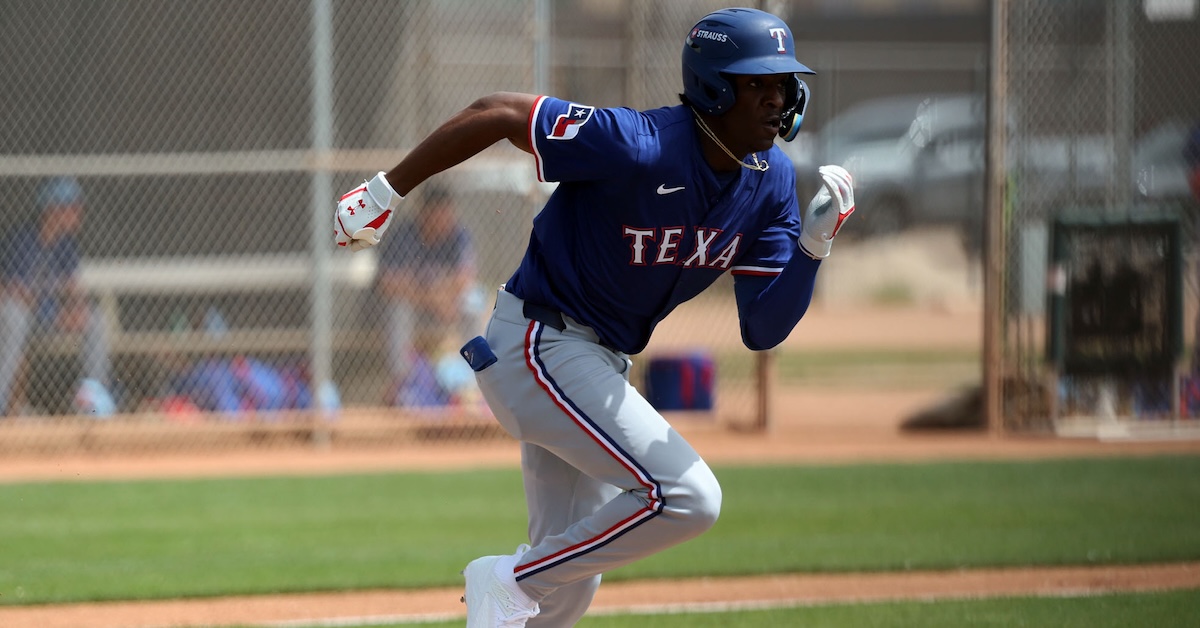
Sebastian Walcott As August 3 draws closer, we’re continuing to update the farm systems of some of the clubs we expect to be buyers at the trade deadline. These teams are both contending for a playoff berth and in clear need of a significant upgrade, the kind that will likely require parting with a top farmhand or two. Today, we’re evaluating the Texas Rangers. The new list accounts for the graduations of Gavin Collyer and Robby Ahlstrom, includes the team’s new draftees, and reflects some of the biggest developments down in the minors this season. It hasn’t been a great year for most of the upper-level pitchers on our offseason Rangers list, but there are a couple arrow-up hitters in the mid-minors and some very intriguing talent blossoming on the complexes. It’s a farm in flux, packed with eye-of-the-beholder players, which makes this a particularly interesting org for prospect heads to monitor at the deadline. The Situation Aging, banged up, and barely playing .500 ball, the Rangers nonetheless find themselves atop the AL West. Though they’re two games up on the Astros and 2.5 up on the Mariners, our Playoff odds only very recently tilted their divisional chances above pre-season favorite Seattle’s. Right now, we estimate that they’re about a 50/50 shot to win the division, and their chances of reaching the playoffs at all are up around 67%. That isn’t normally the résumé of a big deadline buyer, particularly since this isn’t a case of a talented squad weathering an unexpected rough patch: Coming into the year, we pegged the Rangers as a .500 team. And yet, there’s a strong case to make that Texas should act aggressively because this era of Rangers baseball is drawing to a close. Corey Seager is 32, recovering from an abdominal injury, and showing signs of decline amidst the worst year of his career. Brandon Nimmo is 33. Jacob deGrom is 38 and Nathan Eovaldi is 36. Josh Jung feels young and vaguely prospect-ey still, but he’s actually 28 and his injury history is nearly as checkered as Seager’s. MacKenzie Gore is only around for one more year. This core will never be better than it is right now. Needs: Starting Pitcher, Bullpen Depth, Catcher There are two kinds of players you can trade for at the deadline: guys who can help you get to October, and guys who can help you win in October. While the latter are the better, more desirable players in practically every circumstance, they’re also rarer and more difficult to obtain. Conveniently for Texas, players in the former category would do quite a bit of good here. This is perhaps clearest when evaluating the Rangers rotation. Even the 2026 versions of deGrom, Eovaldi, and Gore are compelling playoff starters. Texas would obviously benefit from a luxury addition like Reid Detmers, but what the club really needs is a better fifth starter than Cal Quantrill. There aren’t many internal candidates on the horizon: Jack Leiter is recovering from ankle surgery and theoretically should be available later this summer, but that shouldn’t reassure anybody. Cody Bradford is on the mend, but he’s still working in fairly short stints in his rehab assignment. Winston Santos and David Davalillo, good options on paper at the outset of the year, do not seem ready to contribute meaningfully. Even the generic no. 4/5 starters on the market look like a real upgrade. You Aren't a FanGraphs Member It looks like you aren't yet a FanGraphs Member (or aren't logged in). We aren't mad, just disappointed. We get it. You want to read this article. But before we let you get back to it, we'd like to point out a few of the good reasons why you should become a Member. 1. Ad Free viewing! We won't bug you with this ad, or any other. 2. Unlimited articles! Non-Members only get to read 10 free articles a month. Members never get cut off. 3. Dark mode and Classic mode! 4. Custom player page dashboards! Choose the player cards you want, in the order you want them. 5. One-click data exports! Export our projections and leaderboards for your personal projects. 6. Remove the photos on the home page! (Honestly, this doesn't sound so great to us, but some people wanted it, and we like to give our Members what they want.) 7. Even more Steamer projections! We have handedness, percentile, and context neutral projections available for Members only. 8. Get FanGraphs Walk-Off, a customized year end review! Find out exactly how you used FanGraphs this year, and how that compares to other Members. Don't be a victim of FOMO. 9. A weekly mailbag column, exclusively for Members. 10. Help support FanGraphs and our entire staff! Our Members provide us with critical resources to improve the site and deliver new features! We hope you'll consider a Membership today, for yourself or as a gift! And we realize this has been an awfully long sales pitch, so we've also removed all the other ads in this article. We didn't want to overdo it. A similar sentiment applies in the bullpen. Jacob Latz has been great as a closer — the Rangers won’t be desperate to find this year’s version of Jhoan Duran or Mason Miller — but it’s hard to imagine them making a run through October with Peyton Gray and Jakob Junis as their top setup men. Even if you mostly trust those guys, there’s precious little depth behind them. As a unit, Texas’ bullpen is 15th in FIP, 27th in groundball rate, and 26th in strikeout rate. Those last two in particular look like a dicey combo in the playoffs. The Rangers are also in the unenviable position of needing to find a catcher midseason. This didn’t look like a glaring weakness until very recently, but Danny Jansen hurt his elbow and is considering undergoing season-ending surgery, while Kyle Higashioka is also out indefinitely with a flexor strain. We don’t know if the Rockies would seriously consider moving Hunter Goodman, but Texas, arguably more than any team, should be kicking the tires in Denver. The same applies to Ryan Jeffers and really anything resembling an everyday catcher not nailed down on other clubs. The Rangers’ needs are otherwise less acute on this side of the ball. There isn’t a replacement out there that offers more than what a healthy Seager and Jung can provide, and so the front office is mostly left to cross its fingers and hope they return as the most potent versions of themselves. Squint and you can see an average regular or better everywhere else. State of the Farm The arrow is down a little here relative to the offseason. The Rangers had five prospects on our February Top 100 list, and a baker’s dozen received a 40+ FV grade or better, but the pitchers in that tier haven’t progressed much. Caden Scarborough deserves a lot of grace for his uneven 2026 season — it feels wrong to fret much about a guy’s fastball velocity when he’s returning from cancer treatment — and he held his place on our midseason update. But while the rest of the crew — Davalillo, Santos, Jose Corniell, Leandro Lopez, and Marc Church — all looked poised to contribute this year, they’ve combined to throw all of six innings in Arlington. The reasons why read like a failure to launch manual. Davalillo’s control fell completely apart in Triple-A, and he’s sprinkled in a lot of 91s and 92s on the gun in recent outings, a combination troubling enough that we dropped him from the Top 100. Santos fell off the list as well, in large part because he’s not getting results. He’s long been a personal favorite, and I still like his athleticism, arm strength, and changeup. At some point, though, you have to get hitters out, and it was untenable to keep a pitcher with a high-minors ERA north of 6.00 in that kind of orbit. Corniell’s stuff, which looked crisp in his return from injury last year, has backed up and he’s again on the IL. Lopez started giving up homers for the first time in his career this spring, and he too is on the shelf. Church’s grade was an aggressive projection on a reliever with good stuff; he’s continued to battle injuries and the strike zone, and was outrighted off of the 40-man earlier this year. Meanwhile, the two hitters who ranked above the 40+ FV tier this offseason have also missed a lot of time. Sebastian Walcott has only played in 10 games this year, though he recently made his triumphant return from a UCL tear a little ahead of schedule, and has wasted no time reminding us why he’s one of the game’s best prospects. Paxton Kling has been out since mid-June with a wrist injury; before getting hurt, he’d put up decent surface-level numbers, albeit with more swing and miss and less power growth than I’d anticipated. There’s enough uncertainty here to slide him. The positive energy in this system is mostly coming from the kids. Yolfran Castillo remains a stand out, as he’s hitting in Low-A and looks like an above-average defensive shortstop. His measurable power is up only slightly year over year, but he’s making a ton of contact and, more importantly, he has one of the most projectable frames in the low minors. His teammate, Paulino Santana, remains on the 40+ track, as he’s managed to hit for power in Low-A while slightly improving some of his scary contact metrics. He’s also physically projectable and could grow into real thump. Arguably the two most interesting players in the system spent the summer in Surprise. The two-way guys both had productive years and, delightfully, we’re not much closer to seeing where on the field Seong-Jun Kim fits best long-term. He looks like a no. 4 pitching prospect, sitting 92-96 with impressive command for his age, particularly for a guy splitting his attention. On the other side of the ball, he still projects as a contact hitter and long-term fit at shortstop. I remain skeptical that he has the physicality to pull off double duty over the long haul, but for the time being, the game hasn’t told him to pick a lane just yet. Josh Owens, meanwhile, has the physicality but might not have the contact skill. The power is legit, but he’s whiffing 35% of the time on the complex, and precious few hitters have missed that often at that level and gone on to have any kind of career. His fastball/slider mix looks pretty darn good on the mound, though, and it’s starting to look like that’s where his future lies. I’m already itching to see what kind of strides he can make as a pitcher — he isn’t yet throwing a change in games — if or when that becomes his full-time job. The ACL club had a couple of other pleasant developments. Jay McQueen, a 20th-round, $280,000 flier out of a Mississippi high school in the 2025 draft, joins the list. While raw at the plate, McQueen has average power, he made a viable amount of contact on the complex and he showed some ability to move the bat head up and down. He’s a high-variance fourth outfielder prospect. Jacob Johnson gets some of the longest tail on a two-seamer I’ve encountered, and he pairs it with a slider that flashes above average. While he’ll need a beat to harness his fastball, he’s already got uncommonly good feel for locating the bender. After sneaking onto the main section of the offseason list, his arrow is up a little bit as well; like McQueen, he was recently promoted to Low-A Hickory. For those who really like a sleeper, there’s Breyner Figuereo. He signed with the Cubs as an outfielder in the 2025 international class but was released after one season. The Rangers signed him, put him on the mound, and now he’s touching 98 with good feel for spin from the left side down in the DSL. He’s been aggressively fast-tracked onto the main section. In the mid-minors, a couple of honorable mention bats have taken big steps forward. I’ve worn a hole in my shoe kicking myself for not listing Rafe Perich on the main section this spring. I liked him on the backfields in March of 2025, but lost my nerve after he posted pedestrian numbers as an older player in Low-A. He’s gone nuts at two levels in 2026, and his age (he’s 24) no longer looks so scary now that he’s giving Texas League arms a rough ride. A switch-hitter with plus raw power, he’s hit 10 homers in 44 games since a midseason promotion, with a barely a dip in his ability to make contact. We gave him a look as we built our recent Top 100 update and didn’t quite see a fit there, in part because he’s no more than a fringy defender at third, where he has a long, slow release and tends to scatter his throws. Still, if he can offer power off the bench and fill in at a couple of spots, that’s a big win for the Rangers amateur and dev groups. Hector Osorio also slots in. He’s a hitterish outfielder who has suddenly bashed 21 homers out of nowhere. While I think some of the league and ball contexts explain a good deal of the power surge, you still have to pull the fly balls, which Osorio is proving that he can do. Texas prioritized intriguing, risk/reward players in the draft. They also spent big early: Their first three draftees received bonuses north of $2 million, and then only one other guy in the entire class signed for more than $200,000. Gio Rojas was the best high school pitcher in the class and a potential no. 2/3 starter, though his delivery is more violent than you normally see out of a high school pitcher. Connor Comeau, who had committed to Texas A&M, has big lefty power projection, but less promising feel for contact. Brody Bumila is hurt and will have elbow surgery in Texas after his signs. He’s a spring pop-up arm with triple digit heat, freakish size, a precocious changeup, and a breaking ball that needs some pitch design love; we’ll see if this is the right org for him. Hudson Calhoun is a walk-prone reliever with a bat-missing fastball; he tucks in at the very end of the updated list. A couple of other minor notes: Aidan Curry goes from the bottom of the 40 FV tier to near the top, as he’s throwing more strikes while working deeper into games in Double-A. Rotation mate Dalton Pence climbs with him. I was a little too bearish on the lefty’s command projection and chances to start in the spring, and in any case he alleviated some of the concerns I had about the moving parts in his delivery by making his motion more fluid and compact. If his slider continues to play like a plus pitch (I’m a little skeptical), Texas will really have something here. Finally, a quick word on three recent early-round picks. AJ Russell, Malcolm Moore, and Dylan Dreiling are all holding steady. Russell looks ever more like a reliever, as he’s still heavily reliant on his fastball and prone to missing badly even with that pitch; he also hasn’t yet completed the fourth inning in any of his starts. Dreiling’s surface numbers have jumped considerably at Double-A this year, but once you adjust for context and take a look under the hood, he’s still tracking like a fourth outfielder. Moore, meanwhile, has struggled since a midseason promotion to Frisco, where his chase and strikeout rates have climbed markedly. Here are the players graded as 40 FVs and above on the updated list: Top 29 Texas Rangers Prospects Rank Name Position Age FV Trend Variance ETA 1 Sebastian Walcott SS 20.4 55 High 2027 2 Yolfran Castillo SS 19.5 50 High 2029 3 Caden Scarborough SP 21.3 50 High 2028 4 Gio Rojas SP 19.1 45+ NEW High 2030 5 Connor Comeau 3B 18 45 NEW High 2031 6 David Davalillo SP 23.9 45 ↓ Med 2027 7 Winston Santos SP 24.3 45 ↓ Med 2026 8 Seong-Jun Kim TWP 19.2 45 ↑ High 2030 9 Cam Cauley SS 23.5 40+ Med 2026 10 Rafe Perich 3B 24.2 40+ NEW High 2027 11 Josh Owens TWP 19.6 40+ High 2030 12 Brody Bumila SP 18.5 40+ NEW High 2031 13 Paxton Kling CF 23.2 40+ ↓ Med 2028 14 Paulino Santana RF 19.7 40+ High 2029 15 Jose Corniel SP 23.1 40+ ↓ Med 2026 16 AJ Russell SIRP 22.1 40 Med 2028 17 Dylan Dreiling LF 23.3 40 Med 2027 18 Aidan Curry MIRP 24.1 40 Med 2027 19 Emiliano Teodo SIRP 25.5 40 Med 2026 20 Dalton Pence SP 23.9 40 ↑ Low 2027 21 Elian Rosario 3B 17.8 40 High 2031 22 Leandro Lopez SP 24.1 40 High 2027 23 Malcolm Moore C 23 40 Med 2027 24 Ismael Agreda MIRP 22.8 40 High 2028 25 Breyner Figuereo SP 18.2 40 NEW High 2032 26 Izack Tiger SIRP 25.5 40 Med 2028 27 Enyel Lopez SIRP 20.9 40 High 2031 28 Josh Stephan SP 24.7 40 Low 2026 29 Carter Baumler SIRP 24.5 40 High 2026 The team’s full list, complete with scouting reports and tool grades, can be found on The Board. It’s rare, though not necessarily tricky, to find a backstop midseason. Contending teams don’t like to do it, as they’d understandably prefer not to have their starting catcher acquaint himself with a brand new pitching staff in the heat of a pennant race. The Rangers have to do that anyway, though, so they might as well see if they can find an everyday regular for the job. Clubs with catching to spare — Colorado, Minnesota, Miami, and perhaps Washington spring to mind — would presumably love to pry away Castillo or Scarborough, and may be able to make it work if they throw in some pitching to sweeten the deal. If not, Santos and Davalillo look like intriguing change-of-scenery candidates. Among the prospective secondary pieces, the arrow-up arms in Frisco look attractive. Curry and Pence each have a chance to start and runway for growth (perhaps a little more velo as he fills out in Curry’s case, a better change in Pence’s). For the more adventurous sorts, McQueen and Figuereo have impact traits and enough risk to keep the price point fairly low.
Trade Deadline Prospects Guide: Texas Rangers
Full Article
Original Source
Read the full article at Blogs →KhanList aggregates and links to publicly available news content. We do not host full articles from third-party sources. Always verify important information with original sources.