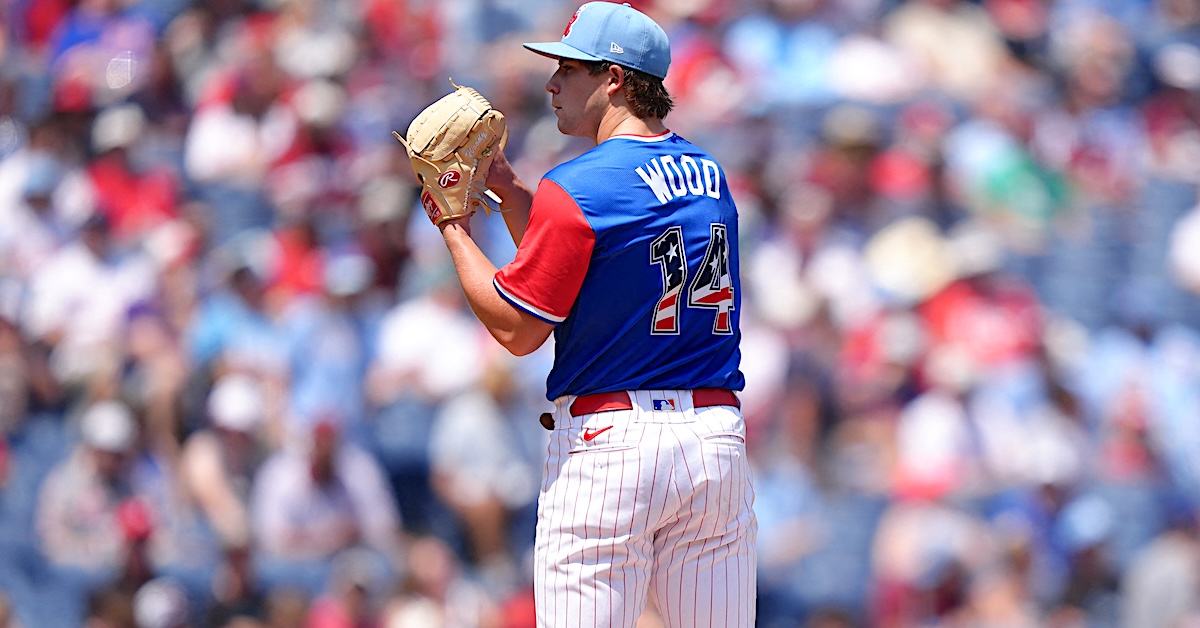
Kyle Ross-Imagn Images As August 3 nears, we are taking a fresh look at the farm systems of some of the clubs we expect to be buyers at the trade deadline. These teams are both contending for a playoff berth and in position to make a buyer’s-style trade for a star big leaguer, the kind that will likely require parting with a top farmhand or two. Today, I’m covering the Philadelphia Phillies. In tandem with an evaluation of the team’s needs and deadline posture, I’ve updated Philly’s prospect list to account for graduations, incorporate the team’s new draftees, and reflect developments on the farm. The Phillies have a top-heavy system with a few key, arrow-up pitching prospects. The Situation Philadelphia’s mini post-Break slide has it in the middle of a crowded NL Wild Card field. The unfamiliar way in which the Nationals and Marlins are nipping at the team’s heels in the division standings is adding to building tension. The top of the rotation is so nasty that, if the Phillies make the playoffs, they could tango with anyone. But their roster is so top-heavy that it feels like they’re hanging on by a thread as they try to grind out a portion of the season that rewards and requires depth. With an executive who has a history of (successfully) mortgaging the future in service of the present, the Phillies have a farm system that will need to be gutted if they’re going to seriously address all of their needs. Needs: Pitching Depth, Viable Shortstop Defender, Righty Outfield Bat, Backup Catcher Three of Philadelphia’s starters can look like Cy Young contenders on any given night, and everyone else has been fringe-y, including Aaron Nola and Andrew Painter. Considering this, the Phillies need to add a starter who is not only an upgrade to their no. 5 spot, but who they think can then comfortably shift into an effective bullpen role come playoff time. Over to the offense, it’s possible the Phillies can kill two birds with one stone if Trea Turner is willing to (and capable of) moving to the outfield, which is easier said than done. Turner has been white hot for the last six weeks — .297/.340/.524 with a 133 wRC+ since the start of play on June 17 — and again looks like the kind of hitter who you’ll live with playing error-prone defense at shortstop if it means MVP-caliber performance on offense. But the shortstop market (headlined by Zach Neto) has bigger names than the righty-hitting outfielder market (marquee’d by… Lane Thomas?), and the Phils lineup will look better if it can land a star there, and change Turner’s position. There could be enough catchers available to create a buyer’s market for the Phillies to take advantage of. They at least need to improve their backup situation, which has been marred by injuries. J.T. Realmuto’s offensive production has continued its decline in the first season of his three-year, $45 million deal. Anyone who hits enough to merit a timeshare with him, and operate as a bench bat on occasion, would be a better fit than a pure backup, with Twins switch-hitter Victor Caratini as the needle-threading option. You Aren't a FanGraphs Member It looks like you aren't yet a FanGraphs Member (or aren't logged in). We aren't mad, just disappointed. We get it. You want to read this article. But before we let you get back to it, we'd like to point out a few of the good reasons why you should become a Member. 1. Ad Free viewing! We won't bug you with this ad, or any other. 2. Unlimited articles! Non-Members only get to read 10 free articles a month. Members never get cut off. 3. Dark mode and Classic mode! 4. Custom player page dashboards! Choose the player cards you want, in the order you want them. 5. One-click data exports! Export our projections and leaderboards for your personal projects. 6. Remove the photos on the home page! (Honestly, this doesn't sound so great to us, but some people wanted it, and we like to give our Members what they want.) 7. Even more Steamer projections! We have handedness, percentile, and context neutral projections available for Members only. 8. Get FanGraphs Walk-Off, a customized year end review! Find out exactly how you used FanGraphs this year, and how that compares to other Members. Don't be a victim of FOMO. 9. A weekly mailbag column, exclusively for Members. 10. Help support FanGraphs and our entire staff! Our Members provide us with critical resources to improve the site and deliver new features! We hope you'll consider a Membership today, for yourself or as a gift! And we realize this has been an awfully long sales pitch, so we've also removed all the other ads in this article. We didn't want to overdo it. State of the Farm The Phillies farm system is good enough that they can address all of their needs, but shallow enough that doing so would likely mean leaving the cupboard pretty bare. Painter and Justin Crawford (who both graduated from the prospect lists but are still controllable, long-term players) could be on the table in trade talks. I continue to like Painter’s long-term potential more than I do Crawford’s. The struggles of those two guys, plus Aidan Miller’s injury, hurt the very top of this system. Miller probably has less real-world trade value than our FV grade would indicate he does. Our rule of thumb when lining these guys up is to put the season-long injury players at the back of the FV tier they’d otherwise belong in based on their talent. For things like Tommy John surgery, that’s easy. But for players who are going through something odd, something unique, it gets more complicated. It’s easy for us to have Miller ranked where we do on a public-facing prospect list, but if you were acquiring him in trade, the medical evaluation piece would be a huge aspect of it. We’ve elevated Gage Wood’s grade into the 55-FV tier, and he’s now the top prospect in the system. He is good enough to help the Phillies right now in some capacity, the problem is that he threw just 37 innings at Arkansas last year and only a few more in pro ball after the draft. He’s already at 63 2/3 innings so far in 2026, and he’s worked five innings in a start just one time. Though the Phils could use another starter, Wood’s workload considerations make it more likely that he’d be called up in a relief capacity. He should make a big impact right away thanks to the quality of his fastball, and I’d advise against trading this guy unless it was for a significant long-term piece. The other Top 100 change on this update is the addition 20-year-old Mexican righty Ramon Marquez who, for the second year in a row, has posted some of the most cartoonish swing-and-miss numbers in the minors. He has an elite changeup (in peak Devin Williams territory, its miss rate is statistical noise up at 69%). This is what Marquez’s stuff looks like at its best. His velo is up two ticks compared to last year, and you can see how the line on his fastball rockets over the top of barrels when he executes it to the right spot. His breaking ball’s movement has migrated such that it’s now being classified as a cutter, but it is still functionally a gyro slider. And of course there’s that changeup. Ramon Marquez Pitch Specs and Performance Pitch Type Movement Velo Strike% xwOBA Miss% Chase% Fastball Uphill/Tail 94-97 66% .248 32% 21% Changeup Sink/Tail 81-84 62% .151 69% 37% Cutter Gyro 88-91 68% .338 42% 42% Marquez pounds the strike zone even though his delivery is so violent that the droogs from A Clockwork Orange would cringe if they saw it. This, combined with the fact that Marquez hasn’t checked the innings-count box yet — he’s worked just 54 frames this year — creates some relief risk. But if his velo and pitch performance hold up across 120 innings or so next year, then we’re looking at one of the best pitching prospects in baseball. He joins the Top 100 sitting next to last year’s second overall pick, Tyler Bremner. Here is the updated Phillies system ranked through the 40-FV tier, including where I’d have this year’s rookie graduates valued among the group. Remember the entire list is over on The Board, with updated tool grades: Phillies Updated Prospect List In addition to the current Top 100 prospects, the juicy players in this system fall into three main categories. There’s the “High Variance Group” of risky players with big upside, the “Likely Role Player” contingent with modest ceilings but high floors, and the “Buy/Sell Low” cluster of injured or floundering players. The “High Variance Group” is headlined by teenage outfielder Francisco Renteria. His grade slides up a bit here, into the territory of a top-10 draft pick. He has rare power for a 17-year-old hitter — he hit a ball 113 mph earlier this year — and is still pretty projectable. He could end up with elite raw power at peak, though it will probably come at the cost of the speed needed to play center field (which he arguably lacks already). He’s been white hot as the deadline approaches. So why not windmill slam him on the Top 100 list? Well, Renteria’s 75% contact rate is just OK for the DSL, and his chase rate explodes to just over 60% with two strikes. These are yellow flags. During the TrackMan/Hawkeye Era, it has tended to be DSL hitters with exceptional contact ability whose skills sustain through the upper minors, rather than those with prodigious power. Renteria is a great prospect who looks like young Eloy Jiménez, but he’s also a corner-only athlete with some underlying issues who is probably a half decade away from being a good big leaguer. Other members of this group include teenage shortstops Tyler Spangler (the club’s first pick in this year’s draft, who has had back issues of his own this year), Romeli Espinosa (not hitting in Florida, but still super projectable and playing great defense), and DSL breakout Juan Parra (a physically mature switch-hitter with a lofted lefty swing and fair shortstop capability). I like DSL outfielder/first baseman Edwin Ramirez better than Parra. He has more electric bat speed than Parra, he’s more projectable, and his contact performance (though the sample has been limited some by injuries) is just north of 80%. Ramirez slots onto the list behind the gigantic, power-hitting college outfielders the Phillies just drafted (Missouri State’s Caden Bogenpohl and UCLA’s Will Gasparino). I’m not ready to buy Alirio Ferrebus’ surface performance. He’s a catcher in A-ball having a good season (.324/.375/.520 as of this writing), but his underlying chase is terrifying, and he doesn’t look to the eye like a truly plus contact hitter. There’s probably a gap between my Ferrebus evaluation, and those of teams who lean more heavily on the data, even though part of my concern is data-related. Pitchers in this group are headlined by Brad Pacheco, a little righty in Clearwater who’s had a velo uptick while the rest of the Phillies pitchers I’ve tended to like (such as Matthew Fisher and Cade Obermueller) have stagnated. Fisher’s arrow down here is more about my being too aggressive with him coming out of the draft than his performance. He’s sitting 91 mph in Clearwater. The “Role Player” Group consists of shortstop Bryan Rincon (who is having a bounce back after a tough 2025, and again looks like a second-division regular at short or a luxury utility guy), Gabriel Rincones, Aroon Escobar, Dante Nori, Keaton Anthony, Kehden Hettiger, and Cody Bowker. I’ve changed Escobar’s primary projected position to third base. Despite his crafty short-area actions, the heavy-bodied Escobar’s lack of range is more noticeable at second base. His swing has lost some of its verve as he’s gotten heavier (he’s currently built like late-career Juan Uribe), but his contact feel is still good. He’s young enough to hope he can improve his conditioning and get some of that bat speed back. Rincones has been injured for a big chunk of the season and has really struggled in his big league at-bats, which have been sporadic enough that he graduated from rookie status on roster days before he could on at-bats. Remember that Rincones has always been a late-bloomer. He struggled to make the high school team in Plant, Florida, then was at a junior college before one year at Florida Atlantic. He’s 25, but from a reps standpoint, he’s more like 23. I’d be cautious about cutting bait here if I were Philly — lefty power like Rincones has does not exactly grow on trees. Nori can really run and play center field, but he isn’t going to make enough of an offensive impact to be an average or better everyday player. Anthony is a good hitter whose swing doesn’t allow him to tap into power typical of a first baseman. He’s going to be a big leaguer, just probably in the bottom third of his position group. Hettiger has become a great defensive catcher, and he has some power that he’s struggling to get to because of all his strikeouts. He looks like a good backup. Bowker is a funky, low-slot long-relief type. The “Buy/Sell Low” Group is mostly injured. It includes Miller and Painter. If I were the Philadelphia braintrust, I’d be terrified of moving Painter and then watching as someone else fixed his fastball. It looked like that’s exactly what the Twins had done with Mick Abel late last year, but he’s been hurt this season. Crawford has barely been above replacement level because of all the stuff I’ve written over the last couple of years regarding his swing, chase, and lack of defensive feel. I think his issues are probably tougher to fix, and if he can move the needle in a big trade, I’d be fine parting with him. Moisés Chace is the other wild card here. Baseball America’s Josh Norris reported in late May that Chace had begun throwing bullpen sessions. The Complex season in Florida ended without him making a rehab appearance. During the 2024 season, in which the Orioles dealt him to the Phillies for Gregory Soto, Chace looked like a Top 100 prospect with a Joe Ryan-esque fastball. Before he blew out, Chace appeared out of shape and terribly wild. It’s too late for scouts to see him in a way that could make him a tradable piece, but if we get the good version of Chace coming out of rehab, he could be another relief weapon down the stretch. DSL Fliers The Phillies have a few interesting DSL arms who, by the nature of being very young, are basically premonitions who lack the clout of the more seasoned pitchers listed above. But if I were in a front office, I’d want to know which of these DSL Phillies pitchers my player dev group is most optimistic about working with, especially if I’m with a team that wants to acquire prospects who are still years away from the 40-man roster. I can’t imagine the Phillies holding up a trade over a DSL pitcher, and so I’d be asking for one as a sweetener to any deal with them. Samuel Ortiz and Cristian Rego are two 17-year-old starters who are locating great breaking stuff and throwing strikes with low-90s fastballs. Ortiz, whose profile is more balanced, is the more projectable of the two. But the mature-bodied Rego is the one with the more powerful down-the-mound delivery, and he is generating nearly seven feet of extension. Yilmar Samudio, also 17, is a projectable 6-foot-3. He is sitting more comfortably in the mid-90s with nearly perfect backspin and seven feet of extension, but he’s not throwing strikes. He could have a huge fastball at maturity. And finally, Yoel Zambrano is an athletic little lefty with a Bugs Bunny changeup and plus-plus curveball spin. His curve is too soft to be effective at the upper levels, but the mere fact that he can spin a baseball like this gives him potential avenues for other plus breaking pitches.
Trade Deadline Prospect Guide: Philadelphia Phillies
Full Article
Original Source
Read the full article at Blogs →KhanList aggregates and links to publicly available news content. We do not host full articles from third-party sources. Always verify important information with original sources.