
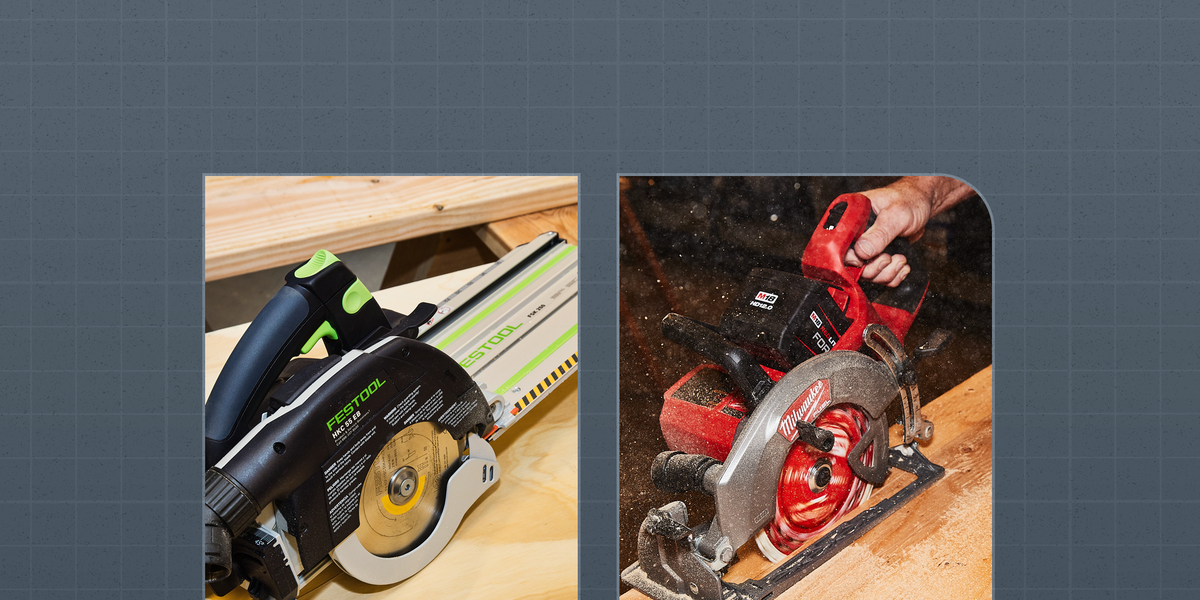
5 min readWith so many power tools—from miter saws or orbital sanders to table saws—the eternal question you need to ask before you pick one up is: Do I need speed or precision? And when it comes to cutting plywood for everything from subflooring and roofing to bookshelves and cabinetry, this question morphs into one between two distinct tools: Do I need a track saw or a circular saw?I’ll jump right to your answer before we dig into the “why.” If you give me a sheet of sanded plywood and plans for a finished bookshelf, I’ll opt for a track saw, like our Best Overall, Festool’s TS 55, over a circular saw any day. I can place the rail on my measurement marks and cut panels for the shelves and sides that are as straight and clean as the original factory edge of the plywood. I don’t want to spend the rest of the project working around a cut that wandered—even slightly—or constantly trying to figure out which edge is the original factory cut.On the other hand, with a sheet of contractor-grade plywood for sheathing a shed or a roof in front of me, I’m going to pick up a circular saw—maybe our Best Overall, the Makita 5377MG, or even our choice for Best for Rough Plywood, the Milwaukee 2930-20. Those cuts need to be accurate but not in a way that’s going to require admiration of the edge and finish once the sheathing is covered with siding or shingles. I want to make those cuts fast and move on.That’s really the biggest distinction between circular saws and track saws: Will the cut edge be part of the finished project, or is it simply there to structurally hold other material in place?Key SpecsTrack Size55 in.PowerCordedSpeed2,000-5,000 rpmBlade Size6-1/4 in.Key SpecsWeight13.2 lbPower15 amp (corded)Speed4,500 rpmBlade Size7-1/4 in., 24-toothWhat Are the Actual Differences Between Track and Circular Saws?A circular saw rides on its own base, or shoe. You guide it along a line to cut framing lumber or trim boards or to rip through sheet material like plywood or paneling. It’s quick to pick up and use, especially when mobility matters.A track saw, on the other hand, rides on a dedicated guide rail that controls its path. These rails are typically compatible with the saw itself across a brand platform. There are some aftermarket brands—like Kreg and Wen—that make rails that are compatible with multiple tool platforms, but you’ll want to check the model of track saw against their specifications before purchasing either.The rail contains a molded groove that accommodates the track saw shoe and creates a dedicated guide for the saw and its movement. Once the rail is set up, its edge shows where the blade will cut, making long, straight cuts easier to accomplish. The splinter guard along the rail helps limit tear-out as you cut the top face of the plywood. Most track saws are also able to plunge into the material, which means you can begin a cut away from the edge of a sheet with ease.Neither saw makes a good cut without some degree of proper setup. You still need to support the material, choose the right blade relative to what you’re cutting, and measure carefully. The track saw takes the steering out of a long cut, but the circular saw lets you move between cuts faster.When I’d Use a Track SawThink bookshelves, built-ins, cabinets, and other projects constructed from finished plywood. If a panel’s edge is wavy, it could leave a visible gap when you assemble the pieces—a situation that’s only fixable by trimming the panel smaller than planned. So getting that first cut right makes every step after it easier.A track saw also lets you rip a full sheet of plywood in place on sawhorses instead of having to maneuver the entire sheet through a table saw. That can be especially tricky if I’m using a job-site or benchtop table saw, as opposed to a larger and more stable stationary saw. Cutting down this large sheet with a track saw gives you the option of taking the smaller panels to the table saw for final sizing—or of course you could make the final cuts with the track saw itself.For a countertop opening for a drop-in sink or another type of cut that starts in the middle of a panel, the plunge cut action is especially handy. The only catches are that you need to position the rail each time you cut, and you need to have enough rail to cover the length of the cut (rails come in varying sizes). So all of that extra setup really makes the most sense when a perfectly straight edge matters a great deal to the finished project.When I’d Use a Circular SawFor framing, subfloors, or roof sheathing, my first choice will always be the circular saw. I can cut a board, size a panel, and keep moving without setting up a rail every time I cut. Not long ago, I resheathed an entire garage using nothing but a circular saw. The pieces just needed to be accurately sized so it was no big deal if the edges I cut wavered slightly, as it wouldn’t affect the overall outcome. There was no need for making furniture-grade edge cuts every time I picked up the saw, so the simplicity of my circular saw was all I needed.To that end, I’ve made plenty of clean plywood cuts using just a circular saw simply by clamping a straightedge along the length of my cut line—but that setup is even more involved than laying down a track saw rail. To pull this off properly, you have to account for the distance between the blade and the edge of the shoe and mark your workpiece accordingly before setting the straight edge on your new marks. The straight edge acts as a guide against which the outside edge of the saw’s shoe rides, so setting up for that distance is critical.It’s a perfectly acceptable—albeit more involved—method of producing a clean, factory-like edge in a cut. Better still, companies like Bora offer self-clamping straight edge solutions like the NGX Circular Saw Guide Rail, which eliminate most of the work from that setup process.The VerdictIf you’re buying one saw, make it a circular saw. It’s the more prevalent—and more useful—first tool for the range of cutting that most homeowners do. If you graduate to more projects requiring finished plywood, add a track saw to your arsenal.There’s certainly a proper place and time for each. The deciding question is whether you’ll see—and have to live with—that cut edge after the project is completed.Other Circular Saws We RecommendPaul Russell Smith is a former NYC ironworker turned screenwriter (Grace Point) and home renovation specialist. He lives in a crooked old farmhouse in Stockton, NJ, where he’s just as likely to be clearing a clogged pipe as rewriting a third act. When he’s not working, he enjoys hiking, pedestrian beer, and cooking over a live fire. His self-proclaimed spirit animal is the English Bulldog.
Track Saw vs. Circular Saw: I’d Choose a Circular Saw in Most Cases—Unless Precision Matters Most
Full Article
Original Source
Read the full article at Popularmechanics →KhanList aggregates and links to publicly available news content. We do not host full articles from third-party sources. Always verify important information with original sources.