
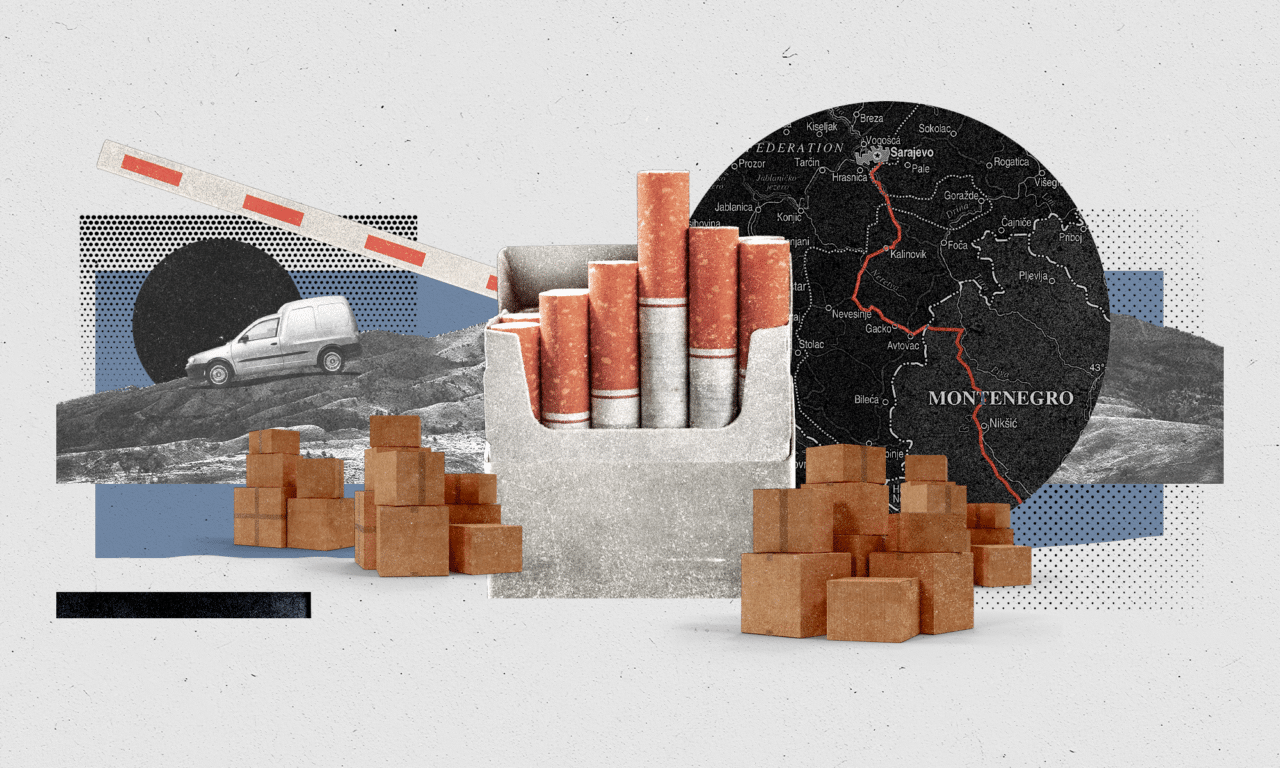
Police believe it was from a house in mountainous eastern Bosnia and Herzegovina that Nebojsa Miletic observed the movements of Bosnian border police – when they patrolled, the paths they took and, most importantly, the shift changes that left the border momentarily unprotected. The forbidding terrain, crisscrossed by rural roads, is ideal for anyone wishing to slip across the border undetected. Forty-three-year-old Miletic, from the village of Lipnik, and his 33-year-old friend Mladen Zirojevic from the neighbouring village of Avtovac knew the roads intimately, and police believe they made that knowledge pay. According to case files seen by BIRN, police in Bosnia’s predominantly Serb-populated Republika Srpska entity and the border police believe the two men built a lucrative tobacco smuggling operation, receiving contraband from Montenegro into Republika Srpska’s Gacko municipality. “We tried to work with the border police by joining our patrols. But they would always observe our vehicles in the parking lot of the police station,” a police source told BIRN on condition of anonymity. “They would check it every night, and it’s known - it’s either fuel or cigarettes.” Allegedly, they worked with brothers Predrag and Marko Cicmil from across the border in Pluzine. The Cicmil brothers are among nine men, including four police officers, currently on trial at the High Court in Podgorica, charged with cigarette smuggling between 2019 and 2021 as part of an organised crime group. The case files in Bosnia allege collusion with police officers in the Gacko municipality and border police stationed in the area. The Republika Srpska interior ministry did not respond to requests for comment. In separate phone interviews with BIRN, Miletic and Zirojevic said they knew the Cicmil brothers but denied colluding in smuggling. They did, however, admit previous involvement in cigarette smuggling; both said they had been arrested several times, prosecuted and either fined or given suspended sentences. “I have nothing to do with that group,” Miletic said, referring to the Cicmil brothers. ‘They drive like crazy’ To cross between the municipalities of Gacko and Pluzine, in Bosnia and Montenegro respectively, most local residents must drive at least 100 kilometres, crossing at the Deleusa-Vracenovici border crossing. Not so for the cigarette smugglers. They use an asphalt road linking the Gacko village of Lipnik with Ravno in Pluzine. It’s a distance of some 10 kilometres. “It’s exclusively a smuggling road,” a security source in Bosnia told BIRN on condition of anonymity. The terrain around the road is too steep for farming, and the road sees almost no other traffic. According to the case files seen by BIRN, police believe the gangs smuggled the cigarettes from Montenegro into Bosnia via mountain passes and stashed them in and around Avtovac and Lipnik. “Given that the territory of the municipality of Gacko borders Montenegro, specifically the municipality of Pluzine, it is possible to transport excise goods to stash locations in the areas of Avtovac and Lipnik within a short period of time,” one document states. With Zirojevic and Miletic allegedly in charge, other members of the group monitored the movement of police or drove ahead of the contraband as reconnaissance, according to the documents. The files name 14 other individuals as involved, all from Gacko and neighbouring municipalities. They used at least nine different vehicles and often switched licence plates. “They drive like crazy,” said a source familiar with the police investigation. “They can be over the border and back in ten minutes.” Police nicknamed one of the drivers ‘Phantom’. “He drives so fast that nobody can catch him in a police chase,” said the source. The smugglers often targeted an evening gap in patrols when shifts change between 6 and 7 p.m. According to sources familiar with the investigation, rather than rotating officers directly along the road, border police shift changes take place at fixed points further away, leaving the unofficial mountain crossing unmonitored for about an hour every day. “And while the shift happens, they have done the job,” a source said. From Lipnik and Avtovac, the cigarettes are transported deeper into Bosnia for sale through street vendors. This reporter found smuggled cigarettes for sale on the streets of Sarajevo for 4.5 Bosnian marks, or 2.25 euros. The price of the cheapest legally sold pack of cigarettes is 6.2 Bosnian marks, or 3.10 euros. Overlapping crimes A car that Mladen Zirojevic used to smuggle cigarettes in 2018. Photo: BIRN.According to the Global Initiative Against Transnational Organized Crime, GI-TOC, contraband cigarettes typically move from Montenegro through Bosnia and Croatia towards Slovenia and other countries of the European Union. Montenegro remains a key hub due to its port of Bar and a wider logistics network linked to maritime transport and storage; Bosnia is primarily a transit and source country for cigarette smuggling rather than a major end market. According to research by Economics for Health, a research and policy body at the John Hopkins Bloomberg School of Public Health in the US, last year the illicit tobacco market accounted for 8.4 per cent of total tobacco consumption in Bosnia, down from 32.3 per cent in 2019. Tobacco excise revenues reached some 600 million euros in 2025, according to state data obtained by Bosnian news website Klix although it is believed the state still loses tens of millions of euros to smuggling every year. In Montenegro, the illicit cigarette market fell from around 51 per cent of total tobacco consumption in 2019 to between 22 and 26 per cent by 2022, while government figures show excise revenues rose from 45.6 million euros in 2020 to 119.15 million euros in 2024. Sasa Djordjevic, a senior analyst at GI-TOC, said that the illicit tobacco trade is typically organised by national criminal groups that work closely with counterparts across the Western Balkans. “In practice, this functions as a regional criminal network rather than a set of isolated national groups,” Djordjevic said. “They are adaptable, well-financed and well-connected across the region. More broadly, they often overlap with actors involved in other illicit markets, including drug trafficking.” In 2018, Zirojevic was among a number of people charged following a major police operation in Republika Srpska targeting suspected traffickers, nine of them from the Gacko area. Zirojevic told BIRN he did not know the other people arrested during the same police operation, apart from those who were with him. He said he had only smuggled cigarettes and was punished for it. “As far as the cigarettes are concerned, I was convicted in connection with that operation, for my part in it,” he said. “I was arrested three times with cigarettes over a course of a year, and every time I was convicted for it at the court in Trebinje,” Zirojevic told BIRN, referring to 2018. “After that I wasn’t arrested for anything else; I haven’t been detained or questioned. Nor do I know there is anything against me officially.” A police officer with cigarettes confiscated from Mladen Zirojevic while he was driving the white van (pictured behind boxes). Photo: BIRN.Following Zirojevic’s original arrest, two sources told BIRN, his phone was placed under police surveillance. When police confiscated a vehicle he was believed to have abandoned, he was taped calling policeman Sasa Glusac, who served as Gacko police chief on several occasions, including the period between 2018 and 2019, and demanding Glusac return the vehicle “untouched”. Zirojevic admitted knowing Glusac, but denied demanding he return the car. “No, brother, I don’t know where you’re getting these little details from,” he said. “When I turned myself in to the police, I said I would come with the keys and open the car so nobody would break the locks or anything like that. I told them there were cigarettes in the car, that they were my cigarettes, and that I was taking responsibility for them.” He said he was detained for 48 hours and then released. Separately, the same year, police sources say Zirojevic was stopped in a vehicle registered to a Gacko butcher, the best man of current Trebinje police chief Sinisa Laketa. The vehicle was found to contain large amounts of cigarettes. Zirojevic said that he was convicted after all three arrests and that he was fined and given a suspended sentence. Glusac refused to comment on the case without permission from his boss, Sinisa Laketa. Laketa also refused to speak to BIRN, and directed questions to the Republika Srpska interior ministry, which did not reply to BIRN’s request for comment. Later, in 2022, Zirojevic was charged alongside a Gacko doctor with falsifying a medical certificate to justify a three-month absence from work at his job at the publicly-owned Gacko coal mine and thermal power plant, known as RiTE. At the time of his claimed illness, Zirojevic was in fact in prison in the town of Foca for allegedly attacking a state official. According to Zirojevic, these charges were dropped. Finally, in 2024, officers searched his house, auxiliary buildings and business premises and temporarily seized 200 litres of what they believed to be motor fuel. Zirojevic did not have papers for the fuel, the Trebinje Police Administration said. He handed himself in to police several days later but was released the same day without charge. “I came with a lawyer and brought the receipt for the disputed fuel from the accountant,” Zirojevic said. “I haven’t even got it back to this day, and nobody has contacted me about it. I just handed the receipt over at the police station. They never called me again after that.” ‘Still a serious organised crime issue’ A sign at the entrance to the village of Avtovac, where Mladen Zirojevic lives. Photo: BIRN. Like their alleged collaborators in Bosnia, the Cicmil brothers knew the border terrain in Pluzine like the back of their hands. As the former director of the Rescue and Protection Service in Pluzine, Mirko Cicmil, 35, had snowmobiles, drones, all-terrain vehicles and boats at his disposal. Petar Cicmil ran the family transport business, Cicmil Prevoz, running buses with the help of state subsidies. The indictment against them alleges they bought “untaxed cigarettes” from co-accused Sasa Pekic and sold them on to “unidentified” buyers in Bosnia. Police officers Dragan Backovic, Predrag Vucurovic, Predrag Mijuskovic and Nikola Glomazic are accused of abetting the operation “using their official positions within Montenegro’s Police Directorate”. Prosecutors say the activities of the nine men cost the Montenegrin state 17.5 million euros in unpaid taxes and duties between late 2019 and March 2021, when they stand accused of smuggling more than 22,500 packages of cigarettes, each containing 10,000 individual cigarettes. The accused have all pleaded not guilty. Djordjevic, of GI-TOC, said that the illicit tobacco trade often attracts less attention than other criminal markets “because it is usually seen as less dangerous than, for example, drugs”. “There is simply greater social tolerance for illicit cigarettes than for many other illegal goods. But that should not obscure the fact that this is still a serious organised crime issue.”
Tracing Illicit Cigarette Flows over Mountainous Bosnia-Montenegro Borderland
Full Article
Original Source
Read the full article at Balkaninsight →KhanList aggregates and links to publicly available news content. We do not host full articles from third-party sources. Always verify important information with original sources.