
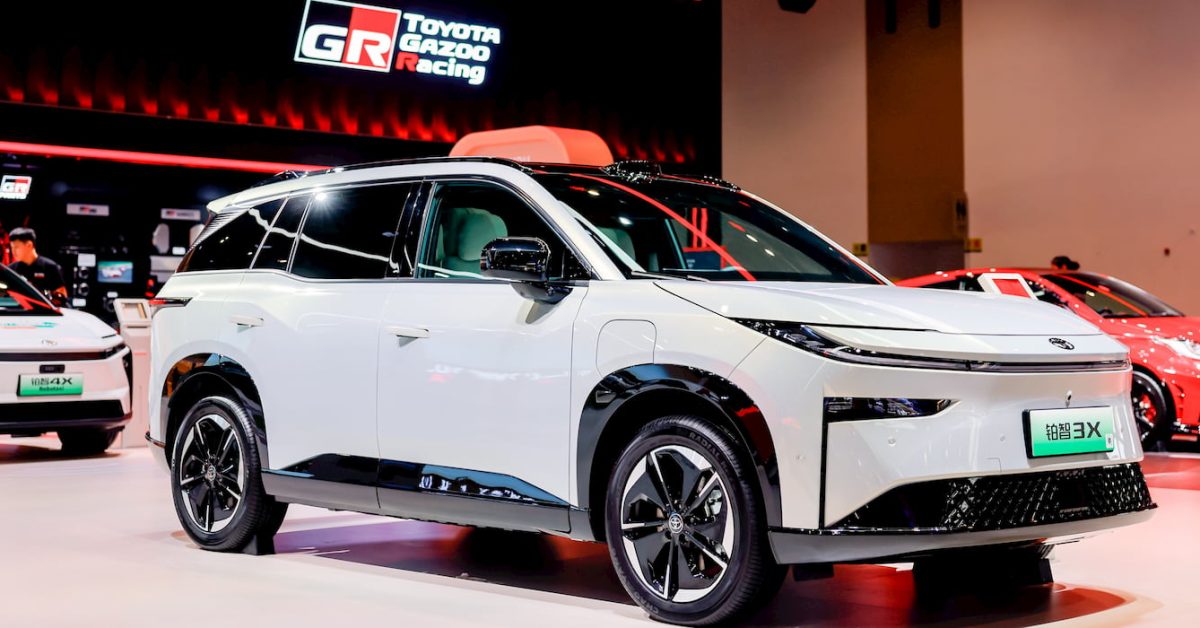
Toyota is the latest carmaker with plans to launch an extended-range electric vehicle (EREV), expected to arrive next year. Toyota will launch its first extended-range EV in 2027 Following Hyundai, Ford, Stellantis, Nissan and several other automakers, Toyota is the latest major automaker to join the global EREV race. The EREV is Toyota’s fifth “electrified” vehicle, alongside battery electric vehicles (BEVs), plug-in hybrids (PHEVs), hybrids (HEVs), and fuel-cell electric vehicles (FCEVs). Extended-range EVs use a gas engine to charge the battery when it gets low, extending the driving range while using mostly electric power to drive the wheels. The battery is typically smaller than a BEV’s, and the engine is smaller than a PHEV’s. Although EREVs are quieter and often cheaper than a plug-in while driving more like an EV, they are also less efficient than a pure electric vehicle. Because they have a gas engine, EREVs require more maintenance than a BEV. However, Toyota is betting on them to compete in China, the world’s largest EV market. Toyota bZ7 (Source: Toyota) According to Nikkei, Toyota will begin producing its first extended-range electric vehicle in China in Spring 2027. Toyota will make the EREV in China, aiming to produce 200,000 units in 2027. In 2028, production is expected to rise to around 400,000 units. Toyota bZ3X electric SUV (Source: GAC Toyota) China is dominated by low-cost domestic brands like BYD, but Toyota sees an opportunity with extended-range EVs. Since EREVs can be more advanced than BEVs, automakers can offer them at higher prices, helping them avoid China’s intensifying price war. Toyota bZ7 (Source: Toyota) A Toyota executive warned that “Competition in China is intensifying as the market fixates on battery EVs, leading to price wars among automakers,” adding, “We need to take steps to avoid being dragged into that competition.” Electrek’s Take After building its legacy on hybrids, Toyota is being forced to break from its traditional ways. Since hybrids are excluded from China’s new energy vehicle incentive, Toyota is betting on EREVs as a middle ground between BEVs and plug-ins. Toyota sold about 200,000 battery electric vehicles (BEVs) and 180,000 plug-in hybrids globally in 2025. The Japanese automaker is increasingly relying on batteries, software, manufacturing, and other components from China for new vehicles. The bZ3X, Toyota’s popular electric SUV in China, starts at just 94,800 yuan, or about $14,000. Through August, the bZ3X was the best-selling joint-venture NEV in China. GAC Toyota produces the electric SUV, a joint venture between Toyota and China’s GAC Group. According to some estimates, the bZ3X uses nearly 90% of its parts sourced from China, including batteries from BYD and autonomous driving software from Momenta. And Toyota isn’t the only one. Most foreign OEMs are turning to China in some way for their next-generation electric vehicles. Japanese automakers, notoriously slow to shift to electric vehicles, are now looking to catch up by using Chinese tech, batteries, platforms, software, manufacturing practices, and more to compete globally. FTC: We use income earning auto affiliate links. More.
Toyota joins the extended-range EV race, but not as you’d expect
Full Article
Original Source
Read the full article at Electrek →KhanList aggregates and links to publicly available news content. We do not host full articles from third-party sources. Always verify important information with original sources.