
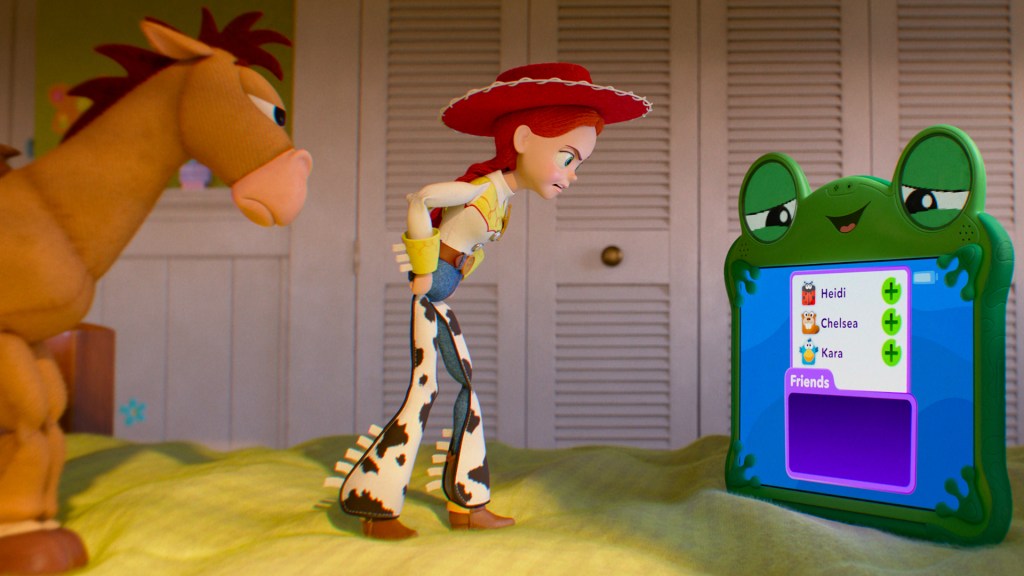
For the better part of three decades, Woody (Tom Hanks), Buzz (Tim Allen), and the gang have kept audiences company through the ups and downs of growing up. Now, Toy Story 5 finds the franchise entering a new chapter, with Jessie (Joan Cusack) taking center stage and technology changing the way children play. Co-writer and co-director Andrew Stanton helps usher in a new group of characters: Lilypad (Greta Lee), a frog-framed tablet, and Blaze (Mykal-Michelle Harris), a confident young girl who marches to the beat of her own drum. Alongside the familiar faces, the new toys bring fresh possibilities to a story that still has plenty to say about childhood and the evolution of social connection. Below, Stanton talks to Deadline about developing another entry, digging deeper into Jessie’s backstory, and the cherry on top of the cake: Taylor Swift’s new pop-country single, “I Knew It, I Knew You.” DEADLINE: How did you and co-screenwriter Kenna Harris decide which new characters would join the story? And how did that ultimately influence the direction of the film? Watch on Deadline ANDREW STANTON: There are unsaid expectations with every Toy Story movie now that we’ve had several installments. I think audiences, even unconsciously, expect to meet somebody new along the way and add to the cast. We bemoan that because the cast is already so huge. I always say I have so many mouths to feed, and if I gave everybody one line, the movie would be over in one scene. So we not only have to be judicious about who we add, but also about who we let go of and who we push to the background. By the time we’re doing five, you’re thinking there may be more. I don’t get too caught up in worrying about everybody getting their fair share of time. I just let the needs of the story dictate things. Right from the get-go, I knew I wanted it to be about Jessie, and I wanted a device to represent technology coming in. That dictated Lilypad right away. In this world, I don’t buy that TVs and phones can just talk to you. There has to be something, character-wise, built in to bring them to life in the same way Forky was in Toy Story 4. So making a frog frame around an iPad was something I came up with very early on, when I was writing by myself. Even in the first draft, I was concerned I was late to the party on this issue, given that technology has been around kids and their toys for at least 10 or 15 years. It’s only gotten more advanced and smarter, and social media and all that stuff have come in more recently. I also started thinking about those early technology toys. We all have these devices, even the computers on our desks, and they change every three to five years. They get upgraded to something else. I thought about the short life those devices have. There’s always that drawer in my house with spare batteries, rubber bands, and cords you don’t know what they’re for. When my kids were little in the 2000s, it started having things like fun calculators for kids. You don’t know how long to keep that stuff. I thought, what a horrible existence for the first generation of tech toys to go through, being played with by kids and then discarded. That was pretty early on, too. It was about creating characters to represent that first generation of technology. The story dictated the new cast. I’ve also just never grown up. Body humor still cracks me up. I was amazed to find out there hadn’t been a toilet-training toy of any sort in the history of toys. I thought, “Well, let’s introduce one and see where that goes.” Toy Story 5 Disney/Pixar DEADLINE: Outside of your own experience, what did other research look like? Did you all happen to talk to other children or parents about how they interact with toys and technology? STANTON: Eventually we did. I’m a little superstitious about knowing the world’s rules or people’s opinions too soon because it starts to influence things. I like to be free to roam about the cabin any way I want for a while. I know there are going to be many years of debating this, many more voices coming in, and many more people weighing in, all meaning well. But there’s this rare window of about a year where it’s just mine, and I get to go, “Where does my mind go?” I have strong opinions based on observing children and not seeing toys played with by older kids. It just seemed to me that the window was getting younger and shorter, that little kids were playing with toys for less time. I remember playing with toys, and some of that was because I had younger siblings. I played all the way up until I was 10. That was really what I wanted to explore from an entertainment and narrative standpoint: What is that doing to the characters we’ve come to know and love over these generations when they’re just getting less time with a child? That was enough to play with for a while. But eventually, we did our own research because we have a lot of young parents who work at Pixar. We didn’t have to go outside the walls to find a large group of people sharing their frustrations and concerns about their children being introduced to technology, when they should be, and how every kid was different. It was nice to know that it was messy. Kenna and I didn’t want to make it a black-and-white binary where this was bad, and this was good, because that’s never good drama. It’s always good drama when it’s in the gray, and it’s messy. You can see the reason why you’re introducing it, and it’s not going away. Some kids are different from others. That made for really good exploration. There are upsides, otherwise, people wouldn’t be tempted to use technology. Kids are shy. Kids live in communities where there might not be anybody like them in terms of their interests, disabilities, or abilities, and suddenly they can reach other people they wouldn’t otherwise reach.Andrew Stanton DEADLINE: I think that’s one of the things that really works about the film. It doesn’t feel preachy, and it would have been easy to lean one way or the other, especially when discussing technology and how children interact with it. How did you find that balance? STANTON: It would be so easy if it were a story about technology just being bad because then nobody would do it. Everybody wants their kid to have these experiences. There are upsides, otherwise, people wouldn’t be tempted to use technology. Kids are shy. Kids live in communities where there might not be anybody like them in terms of their interests, disabilities, or abilities, and suddenly they can reach other people they wouldn’t otherwise reach. As a kid, before there was all this technology, all I wanted was to have a can and a string so I could still talk to my best friend way down the street. That impulse is in us as natural human beings and as kids. The idea of having a secret clubhouse where you can say hi to your friend, with all those innocent needs, is understandable. Technology is also so involved in how our world functions. We want our kids to know how to operate in the world. It does some cool stuff, and we all played games. We were part of the gaming culture. As ’80s kids, we all ran to the arcades. TV was always around, and everybody thought it was going to rot our brains. Maybe it did, but we all did it [laughs]. It’s complicated, and that’s what makes it interesting. The thing I cherish about growing up before all this stuff was how much boredom gave me the skills to enjoy being in my own head. That was something nobody could take away from me. I hate the thought of my kids having less access to that, of having less of that full experience. It’s like the difference between the joy of reading and making up the whole thing in your head versus seeing a movie where it’s all been decided for you. Those are gifts in life that you realize the older you get, and you hate the idea that anybody coming into the world might be shortchanged. We realized that it isn’t about technology itself. It’s a choice. It’s a choice to turn off the TV, it’s a choice to turn off the device, and it’s a choice in how you use it. That’s where we realized the universal truth. I didn’t want anybody to look at any of the movies we make, let alone the Toy Story movies, 10 or 20 years from now and feel they were so dated that they couldn’t relate to them anymore. We’ve always tried to be in the grandparent business. What we used to say is that we’re not just trying to get kids to watch our movies. We want you to like them and have them touch you in a universal and human way so much that, even as a grandparent, you go, “I have to make sure my grandkids watch this particular movie. It was one of my favorites.” Toy Story 5 Disney/Pixar DEADLINE: I enjoyed the film’s new visual style, especially the imaginative playtime sketches. Talk about that aesthetic. STANTON: It seems really obvious now that we found it. We just wanted something that felt handcrafted, kid-conjured, and had an improvisational feel. It had to feel like make-believe in your head, or even when you’re vocally pretending with your friend. You’re allowed to pivot mid-sentence, and suddenly they’re all vampires [laughs]. We wanted to figure out how to make it feel like that visually. It’s sort of like theater, where a spotlight can suddenly come on, something new appears, something is removed, and you’re open-minded to the rules changing at any moment. We compared it to trying to invent a new color. Everybody pictured something a little different. But “ephemeral” and “temporal” were the words that kept coming up. So there was the chalky feel, the fact that things faded off, and the sense of a dream, where your focus was wherever things locked in, but everything else could change. Mood, color, and everything could shift. That childlike illustration-book feeling, but theatrical, was ultimately what we found. DEADLINE: Looking back at the previous Toy Story movies and thinking about Andy, we didn’t focus on his friend group too much outside the house. So, it was cool to me that Bonnie has Blaze as a companion for her. When did she come into the picture? STANTON: The friendship direction of Bonnie making a new friend evolved throughout the making of the story. In the early days, we just wanted Jessie to go to her old address, have it be rural and farm-like, and have new owners. That was it. There wasn’t going to be any connection with Bonnie and the girl who lived there. So we had free rein to ask, “Who should be there?” We wanted to make it a bit more mixed and culturally diverse, and make it feel like how the world looks to us, both emotionally and culturally. Also, [there was a desire of the animators] to conquer curly hair really badly. They wanted to do it right because the technology had changed even since Brave. So, Blaze was thought up by Kenna and [conceptualized by the art team], and we loved it. Then the character started telling us something [as we developed the story]. We worked hard to make sure Bonnie felt different, both race-wise and, more importantly, girl-wise. She wasn’t the trope of a little girl. She was a little left of center. She thought in vibrant, random ways, and she was special. But she’s shy and not brave enough socially to expose that. That’s very common for any kid: showing the real you. But Blaze is the one who does that. We thought about having Bonnie find her tribe in a person who can understand how her mind works. We thought, what if Blaze was the shining example of confidence in that kind of thinking and also being a little left of center? She was just one year older, and when you’re that young, one year older is the coolest club to be in, to be hanging out with. We became enamored with her as a character, and she quickly became the model for somebody Bonnie could connect with, admire, and be friends with, if we could just get them to meet. That ultimately turned the whole story around. The universal thing that will make this movie speak to you 10 or 20 years from now, nostalgically, is when you find that kid who doesn’t think exactly like you, but you complement each other just right. As you get older, you realize that’s one of the most valuable things you find in your life, whether you meet them in college, at a young age, or even later. Those are the things you value most. Suddenly, it became a very priceless story. DEADLINE: You mentioned that the film initially started as a Jessie-centric story. Was there ever a version of the script where Jessie was reunited with Emily, or was that always something you knew you wanted to avoid? STANTON: There was. We just knew there was power in closing that wound for her, so we didn’t know how to go about it. I did the most obvious thing in my first draft. We hid the address from the audience. It was only seen by Bullseye on the back of Jessie’s chaps, and we would always have Bullseye nudge her chaps, thinking he just wanted something like a dog. Without getting into the long plot, it became a third-act moment where he finally brought her to what she thought was Bullseye’s home, only to find out he had brought her to the address on the back of her chaps. We revealed it at the last second, and she suddenly got to witness Grandma Emily playing with her granddaughter, the baby. It was very moving, but it took a lot of mountain-moving to get there. We knew the feeling we had captured for Jessie was something to aspire to and find another way to get to, which ultimately resulted in the finished movie. We worked hard to make sure Bonnie felt different, both race-wise and, more importantly, girl-wise. She wasn’t the trope of a little girl. She was a little left of center. She thought in vibrant, random ways, and she was special.Andrew Stanton DEADLINE: I have to say, one of the things I really loved was Buzz’s relationship with Jessie. When you think about the history of Toy Story and how Buzz has always been so tough, brave, and confident, I left the theater thinking he’s a total “wife guy.” He’s completely smitten with Jessie. STANTON: Is that a term, or is that your own term? I’ve never heard that term. DEADLINE: It’s a term on the internet, so I can’t take credit for it. If a guy is really into his wife or girlfriend, you say he’s a wife guy. STANTON: I’m stealing that. But to get to your point. Nobody even questioned his behavior for five seconds. We always knew Buzz had a big heart. DEADLINE: So he’s always been a softie? Was that the idea behind the dynamic? STANTON: At least for Jessie. I think we all know there’s that person who does that to us. I don’t think he’s like that for anyone else, but I do buy Buzz when he kisses Jessie. I loved the role reversal. Jessie just doesn’t seem like the kind who’s going to lift her leg during a kiss, and neither does Buzz, but I do buy Buzz’s foot pop when he kisses Jessie. There was never even a debate that I can remember. We had spent so much time with him, like a best friend, that we thought, “Well, all bets are off on how he’s going to act when Jessie is in the room.” Jessie, I think, has always been the lead in their dancing pair. She’s always known what effect she has on him and has been gracious enough not to rub it in or squander it. She enjoys it. She enjoys playing that flirtatious game. She knows she can get Buzz’s attention and obedience without much effort, and I don’t think she ever abuses it. Toy Story 5 Disney/Pixar DEADLINE: Lastly, when did Taylor Swift come into the picture? Were you involved in those conversations, and did you know where her song would fit into the movie? STANTON: To this day, it’s a pinch-me moment. I can’t believe it happened, and I can’t believe how it happened. We reached out through the proper channels about a year and a half before the movie’s release, not knowing she was deep into her Eras Tour and didn’t have the time. I didn’t even know if word got to her beyond her brother [Austin Swift] at that point. But eventually, Taylor had circled back around to our request, and as her brother tells it, she was excited, saying how much she loved the Toy Story movies. So she saw the movie at a private screening, and we got a FaceTime straight from the theater with her and her brother on the phone, and she said, “I want to do the song.” And we couldn’t believe it. It came together pretty quickly and even involved a FaceTime from Bob Iger, who was standing with Taylor Swift in the studio, telling me the song was great. She had gotten him out of his house and made him drive down to the studio [laughs]. When [“I Knew It, I Knew You”] was placed in the film, and I had heard it, it felt like kismet. It felt like Jessie’s voice. It still blows me away that it happened and that it happened the way it did.
‘Toy Story 5’ Writer-Director Andrew Stanton Wants To Bring Nuance To The Conversation Between Kids & Technology
Full Article
Original Source
Read the full article at Deadline →KhanList aggregates and links to publicly available news content. We do not host full articles from third-party sources. Always verify important information with original sources.