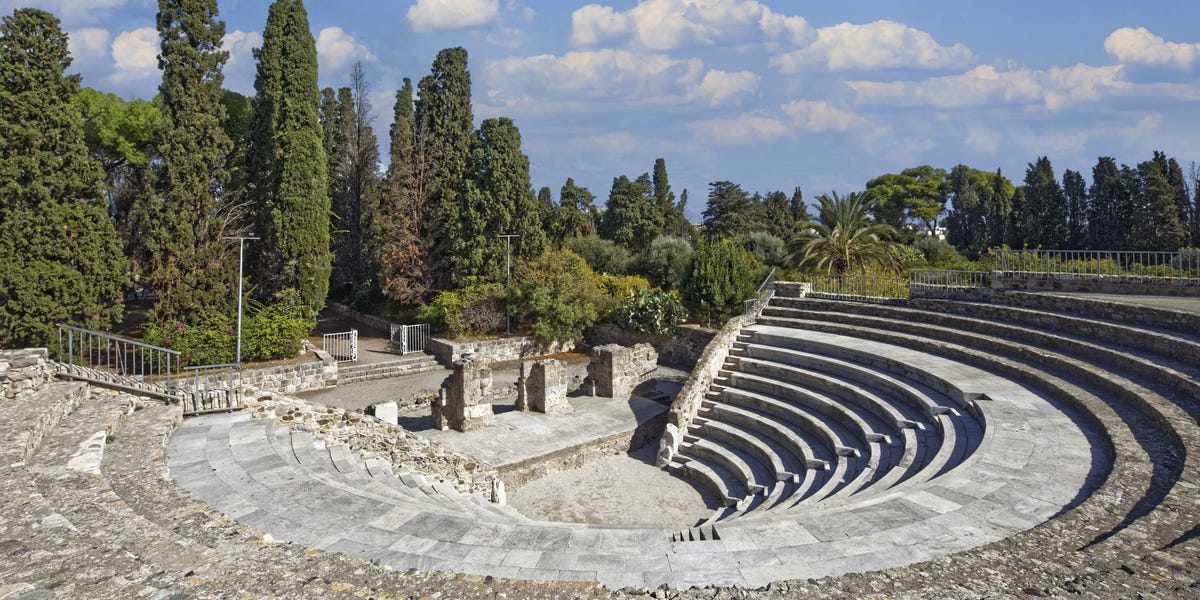
3 min readHere’s what you’ll learn when you read this story:An Italian tourist attraction sold to visitors as a Roman theater full of Neolithic, Roman, and Greek artifacts was outed as a fake.Arrested for art forgery and unlawful construction, the owner of the site went to prison.The theater’s owner continues to defy the government by not removing the fraudulent site as ordered.In the world of art fraud, Franco Malosso, known as Franco Alessandro Molosso Maltarel von Rosenfranz, went big. And bold. The Italian constructed a fake Roman theater, complete with stone steps, columns, and Greek-style statues, advertised it to tourists as a bona-fide ancient site from 393 C.E.But it most certainly wasn’t. After his first court case, an appeal, and a second attempt at an appeal, Malosso’s conviction for art forgery and illegal construction stood, as did his sentence of two years and four months of prison time. Despite all that, the theater still stands, although it’s been under judicial seal since 2016.Exactly how and when Malosso created the Porto degli Angeli Berico Maritime Amphitheater is a bit of a mystery. Malosso claimed he’d found the site, known as the Berico Amphitheater, near the town of Arcugnano in the province of Vicenza in 2005 following a landslide. The attraction, complete with tours, operated for several years, showing off supposed Neolithic, Roman, and Greek artifacts, everything from the theater to statues. According to reviews, some tourists had a grand time, even though they were ultimately scammed out of their admission fee, which ran as high as €40.By 2016, Italian officials got involved, claiming the 53,000-square-foot hillside site was fake. The Vicenza Public Prosecutor’s Office launched an investigation, and Malosso was charged with counterfeiting works of art and illegal construction.Additional investigations revealed the extent of the fraud. Malosso reportedly told tourists the site was constructed in 393 C.E. and that Julius Caesar visited it with Cleopatra, an impossibility due to dating discrepancies. He also claimed that an ancient church at the site was once inhabited by Juliet Capulet, the entirely fictional character in Shakespeare’s Romeo and Juliet—but he’d confused Vicenza with Verona. Then came the actual construction, which included concrete pillars, fiberglass, papier mâché, statues created in the 2000s, and modern building blocks. All these overlapping elements were treated with putty and weathered to look old. There was an artificial pond added to the mix.Comparing satellite images offered additional evidence that Malosso leveled a hillside and constructed the fraudulent ancient site. There was no evidence a landslide had ever revealed such a historic find.Even the name was all wrong. An amphitheater is elliptical—think: the Colosseum—while a semicircular design, such as the Berico forgery, is known merely as a theater.The courts found Malosso guilty, even after repeated appeals and a more recent request for probation, requiring him to serve prison time, pay fines, and restore the site, although he hasn’t yet removed the theater.For visitors believing they were visiting one of the world’s oldest and largest amphitheaters—and there were plenty who believed it, although also those who saw through the ruse—they were instead visiting someone’s imaginary world. And paying up to €40 to do it.Tim Newcomb is a journalist based in the Pacific Northwest. He covers stadiums, sneakers, gear, infrastructure, and more for a variety of publications, including Popular Mechanics. His favorite interviews have included sit-downs with Roger Federer in Switzerland, Kobe Bryant in Los Angeles, and Tinker Hatfield in Portland.
Tourists Bought a Ticket to Visit This ‘Ancient’ Roman Theater. Then Investigators Took a Closer Look.
Full Article
Original Source
Read the full article at Popularmechanics →KhanList aggregates and links to publicly available news content. We do not host full articles from third-party sources. Always verify important information with original sources.