
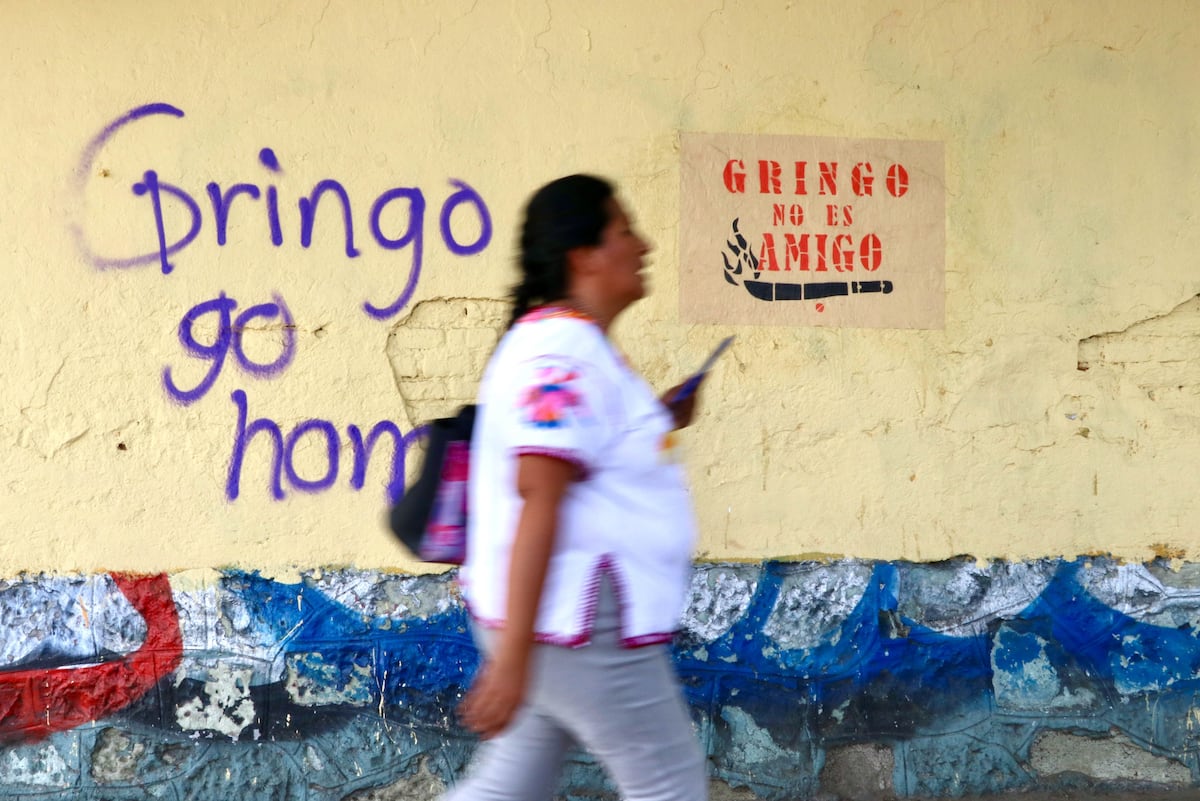
The unusual scene of a tourist demanding a Sinaloa band stop playing on Mazatlán beach sparked a national debate about foreigners who commit xenophobic attacks against Mexicans at home. The incident took place in April of last year, and since then similar occurrences have continued to surface as complaints on social media. In the last few months alone, there have been a series of incidents, including an argument in a café where a woman asked an employee to take down a Mexican flag during the month of national celebrations; a DJ who told two young women to speak more quietly in a restaurant; a foreigner who tried to force a young man filming a video on a public street to speak English instead of Spanish; and a physical assault by an American woman on workers at a taqueria in Mexico City. These incidents are fueling discontent over gentrification, dispossession, and racism within Mexico’s borders.One of the most recent incidents took place in one of the capital’s wealthiest neighborhoods. A month ago, “El Costa,” a content creator, was filming a video for his channel on a bench on Presidente Masaryk Avenue when a foreigner interrupted him: “We’re in Polanco — speak English.” Days later, the scene shifted to Taquería Orinoco in Mexico City’s Condesa neighborhood, a spot famous among tourists. In the footage, an American woman lunges forward, trying to strike the workers, who stand motionless as she hurls one insult after another: “What’s your salary, 500 U.S. dollars a year?” “loser,” “damn losers.” A few weeks ago, New Zealand musician DJezmo told female customers at a sidewalk business that this was not “their space” or “a public space” and that their laughter and conversation were “disrespectful to everyone.” Months earlier, a tourist posted a video in which he said that the residents of Playa del Carmen “should invest a little in their English skills.”The arrogant behavior of the “ladies” or “lords” — as those who commit these acts of discrimination and violence are called — exposes the tension between locals and foreigners who want to impose their way of life on the country. A significant number of these incidents involving foreigners have occurred in the neighborhoods hardest hit by gentrification, the effects of which are increasingly angering locals. In Mexico City neighborhoods such as Polanco, La Condesa, and La Roma, the presence of outsiders is palpable in the rent prices that have driven out original residents and businesses, as well as in the cafes and restaurants catering to their interests — where English is the predominant language and the streets’ aesthetic reflects their tastes. Even the reduction in the level of spiciness at street food stalls frequented by tourists has become a topic of discussion.El Costa reacted to the argument he had with the American who demanded that he speak English: “We don’t hate all the foreigners who come to Mexico to sightsee, but there should be some control. We’re often too kind, too helpful, and too eager to give the best experience to someone coming from abroad, even though not everyone deserves it.” Other users have chimed in: “Why should a Mexican have to stop speaking Spanish?” “We’re helpful and friendly, but there’s a huge difference between visiting and expecting the country to act differently just so tourists feel comfortable.”In 2023, the number of people residing in Mexico who were born in another country totaled 1,168,000, according to the National Institute of Statistics and Geography (INEGI)’s Population and Housing Census. Most came from other countries in the Americas, primarily the United States, although there was also a notable presence of people born in Europe, with Spain among the main countries of origin. They are concentrated in Baja California, Mexico City, and Jalisco — regions where coexistence between the local and foreign populations continues to grow.Racist outbursts are nothing new in Mexico, but the only case that resulted in penalties occurred last year when Ximena Pichel, an Argentine national, assaulted a police officer in Mexico City: “For sure, I hate Black people like you — I hate them — because they’re rednecks”; “Don’t talk to me like that, you fucking Indian”; “This guy’s just a bitter loser — he sees I’m driving a Mercedes, and you don’t have a single fucking peso, you asshole.” She faced legal proceedings and had to pay fines. Insults like these are part of a repertoire of contempt that is perpetuated within the country itself and finds some of its roots in skin color and economic status.The 2022 National Survey on Discrimination, conducted by INEGI, paints a picture of this reality. Twenty-eight percent of the Indigenous population and 35.6% of people of African descent reported having experienced discrimination in the previous year. Among the most common reasons cited were clothing style and skin tone. Nearly 40% of both groups felt that their rights were not respected, and one in five members of the Indigenous population reported having been denied a job opportunity because of their ethnic background. In Mexico City, moreover, the proportion of people who reported experiencing discrimination rose from 23.7% in 2017 to 29.6% in 2022.Insults hurled in public spaces — in front of workers and residents who record and share the incidents — spark a collective response on social media, where the debate over coexistence with tourists or foreign residents in Mexico continues to grow.Sign up for our weekly newsletter to get more English-language news coverage from EL PAÍS USA Edition
Tourist racism hits Mexicans at home: ‘We’re in Polanco — speak English’
Full Article
Original Source
Read the full article at English →KhanList aggregates and links to publicly available news content. We do not host full articles from third-party sources. Always verify important information with original sources.