
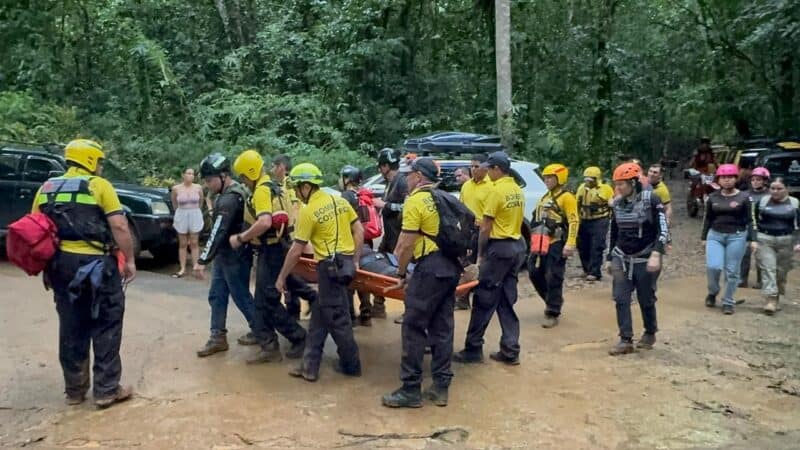
A tourist guide died yesterday when a wall of water came down the Río Barú in Pérez Zeledón and caught a group of roughly 40 people crossing it. The Benemérito Cuerpo de Bomberos confirmed the death, saying rescuers brought more than 20 people to safety from the riverbank after the surge hit, and that one of the guides accompanying the group lost his life. The Costa Rican Red Cross said a team of rescuers, working alongside members of the community, spotted a man without any vital signs on a rock in the middle of the river. The Red Cross confirmed he was the only person reported missing after the incident. Thirty-five people were attended to in all, according to the Red Cross, 32 in stable condition and two in urgent condition. All were brought out to a safe area for evaluation and treatment. The group was mid-crossing when rain sent the river up without warning. The surge split the party, leaving people stranded on the far bank with no safe way back. Preliminary Red Cross reports said two members of the group were carried off, one of them the guide. Getting to them was its own problem. One team of rescuers walked more than four kilometers (2.5 miles) in to reach the site. The response drew in the Pérez Zeledón fire station, the water rescue and cave-and-mountain operations units, local guides who know the terrain, Fuerza Pública and the Red Cross. What killed the guide has a name here, a cabeza de agua, and it is worth knowing, because it is the single most dangerous thing about the rivers in this part of Costa Rica. It is not a flood in the way you probably picture one. The rain that causes it falls somewhere you cannot see, high up on ground that drains fast and steep. The sky where you are standing can be clear and then the water arrives minutes later as a moving wall, and there is no rising edge to warn you. If you are in the channel when it comes, you are not going to outrun it. That is why the timing of a river crossing matters more than the weather in front of you. The Barú drains mountains that take far more rain than the coast below them, and the gap between a calm crossing and a lethal one can be under an hour. So if you have a river hike, canyoning trip or waterfall tour booked in the southern Pacific this week, call the operator before you go. Ask whether someone checked upstream conditions that morning, not yesterday, that morning. Ask what their turnaround rule is and who makes the call. An operator who cannot answer plainly is telling you something. On the day, watch the water itself rather than the sky. If the river is running brown, carrying branches or leaf litter, or has come up at all since you arrived, the crossing is already off. Cross in one group with the strongest people at the upstream and downstream ends, never alone and never trailing behind. And if you hear a roar building from upstream, get to high ground on whichever bank you are standing on. Do not try to cross back to your group. This is the second death of its kind in Barú this year. In June, 30-year-old American visitor Ashley Phillips was swept away at Nauyaca Falls, which sits in the same district. She was reported missing on June 7 after last being seen on June 3 in San Salvador de Barú, and the OIJ circulated her photograph asking the public for help finding her. Barú is a area of about 2,400 residents spread across 191 square kilometers (74 square miles) on the Pacific side of Pérez Zeledón, and it takes in heavy visitor traffic through the Dominical-Uvita corridor during green season. Green season is when these rivers are at their most beautiful and their least forgiving, and the people who die in them are rarely careless. Sunday’s guide was doing the job.
Tourist Guide Dies in Flash Flood on Pérez Zeledón River
Full Article
Original Source
Read the full article at Ticotimes →KhanList aggregates and links to publicly available news content. We do not host full articles from third-party sources. Always verify important information with original sources.