
Dion George has lost his ministry, abandoned the political party he served for 30 years and returned to a career in financing that, he says, pays him three times as much for half the time.And with more time to kill, he has decided to make life considerably more difficult for the people who fired him.Pending George’s ultimatums to current Environment Minister David Maynier, the captive lion trade would be dragged before the court of international opinion, even if the country pays an economic price.“If they will not work together and get rid of this evil thing, I will help the lobby in the UK that is pushing hard to ban all import trophies,” he warns. “I will throw myself behind that.”In an interview with Daily Maverick, the former minister not only levels previously reported accusations at the Democratic Alliance (DA) - that is, what he describes as a party cabal defending “un-African” commercial wildlife interests.He also believes “fear” is stopping Maynier from signing off on the agreed ban on new captive lion facilities.“If professional hunters do it, you know, and it’s fair chase? Fine,” George concedes. But then he hovers his crosshairs over lion-bone controversies.“Let a lion be emaciated, let it be lying there, let it be genetically defective … and then take its bones,” he says. Such bone is, like other controversial wildlife products from South Africa, often valued for unproven medicinal properties in Asian markets.“They kept inviting me to see this,” the former environment minister recalls, describing such practices as “a disgusting thing”. “I said: ‘No.’ It would have tortured my soul.”George says “canned” hunting - the illegal blood sport known to release drugged, baited animals shot at close range in tight areas - is “un-African”. “It was never like this before.”Illustrative image | Lions at a Zimbabwe Park. (Photo: Zimbabwe Parks and Wildlife Management Authority) | Former minister of environment, forestry and fisheries Dion George. (Photo: Gallo Images / Misha Jordaan) The new new minister who still has not signed the approved banDuring George’s tenure, South Africa’s Department of Forestry, Fisheries and the Environment (DFFE) invited captive lion breeders to register for a voluntary exit. In June 2025, George’s DFFE also submitted a ban on new captive facilities to the National Council of Provinces - and held fast to a zero-bone export quota for the same year.The ban was meant to prevent industry expansion while the government worked out how to operationalise its March 2024 decision “to end the captive keeping of lions for commercial purposes”.The zero-bone quota had already brought his department into conflict with an industry wanting new quotas, which had not been issued since 2019 over a court ruling declaring earlier quota decisions as “constitutionally invalid”.And then George, infamously, was sacked in November 2025 while representing South Africa at the UN climate COP in Brazil. George was succeeded by Willie Aucamp, who was succeeded by Maynier just months later, who has still not signed the new captive facilities ban, which was unanimously approved by all nine provinces of the Council in March. And the captive lion industry’s titanic fight to keep its doors open rumbles along inexorably. The South African Predator Association (SAPA) returned to the High Court in Pretoria on 20 and 21 October to try force a bone-quota reconsideration. Judgment is pending.George credits Maynier for defending the zero-bone quota in court. But he believes the delay to sign the ban is political. The new minister, his hypothesis goes, faces rank pressure from within the DA, where “captured” interests oppose industry closure.“We were always in opposition. We were going to be brave. Fight the ANC. That was easy to do because we were outside,” he says of the party he left in January.“As soon as David became minister, I said to him, ‘Congratulations. I wish you all the best. If you need to talk or would like to get a briefing, I’m available.’ I said so - twice. He said, ‘Thank you,’ and never took it up… I can only speculate. I think he just isn’t interested in wanting to know what I have to say as the former minister.“Or he doesn’t want to hear anything because then he has plausible deniability and can say, ‘Oh, I didn’t know that.’”George suggests the internal pressure is more lethal than any external opposition: “Internally, they could come for him. Or he could fear the industry generally. Not fear for his life, but the backlash, the attacks. Maybe he has very thin skin. I don’t know. If you’re going to be a minister, you need to be brave.”Minister David Maynier at Mosaïek Church, 12 January 2026, Johannesburg. (Photo: Gallo Images / Luba Lesolle) Is ’n leeu ’n vegetable? (Is a lion a vegetable?)Demoted DA party leader John Steenhuisen, who asked President Cyril Ramaphosa to fire George, had allegedly pressured the former environment minister into backing an apparent campaign to classify wildlife as agricultural products.“He said, ‘Look, if you agree that once an animal, a wild animal - whether it’s a rhino or a lion or an elephant for that matter - once an animal is now being farmed, it’s now being ‘ranched’ or whatever they want to call it … it’s no longer under the ambit of the DFFE, i.e. yours ; it is an agricultural thing,” George says.He wrinkles his nose. “Like a cabbage that you grow somewhere, right?”He argues that Aucamp, who replaced Steenhuisen as agriculture minister in June after his brief stint at DFFE, is now pressuring Maynier into accepting the same philosophy.“I was removed and Willie was put in there because he is the creature of that lobby,” George says while discussing the allegations he submitted to the Public Protector.Emaciated lions. (Photo: EMS Foundation / Ban Animal Trading) Sorry-not-sorry: George’s plan to take the fight overseasGeorge admits he helped stoke the very public firestorm that erupted after his dismissal, on which Steenhuisen “spent all his political capital”. “As we saw, I pressed my nuclear button. John got caught in the blowback. As did others. I’m not sorry for a second. I should have actually built a bigger one.”“Nuclear button” 2.0 comes in the form of George’s new Conservation Trust.It was created this year “solely” for the purpose of conquering two objectives: obliterating the captive lion industry; and getting states to recognise the primacy of a source country’s laws when prosecuting trafficked wildlife. The latter aim emerged from the Cape Town Ministerial Declaration on Crimes that Affect the Environment, which George hosted in October 2025.A lion cub reaches through the rusted chains of its enclosure. (Photo: Blood Lions) South Africa’s international tourism reputation, he offers, gives campaigners a particularly powerful weapon if - as he puts it - Maynier fails to add his signature to the dotted line.“If you’re a tourist, do you want to go visit a country and spend your hard-earned pounds, euros and dollars and any other currency in a country that treats your creatures like this? Is that what you want? Are you going to enable this? Are you an enabler?”Further grist to George’s mill is the 2022-23 UK House of Commons Bill designed to ban trophy imports. It has yet to become law, but he sees another opportunity. Asked if he would advocate boycotts in the UK against the hunting industry, he said: “Absolutely.”Pressed if he would also take aim at the general tourist economy, his answer reveals that he is prepared to do so: “Tourists must reflect on how they enable this practice by not putting pressure on a government that is clearly disinterested in action. It’s all about the money, so tourists withholding theirs is extremely powerful. I would advocate: don’t go and enable this industry, rather go somewhere that uses your money to your benefit.”He adds: “These very precious creatures belong to everybody. South Africa is the custodian … you need to be judged by how you look after what’s in your custody.“That’s my view and I am very lucky because I am African. I was born here. I will always have my South African passport,” he counters, alluding to insults previously hurled at him as a dual US passport holder. “Nobody can accuse me of being a foreigner.”Deputy Minister John Steenhuisen. (Photo: Steven Booth / Manufacturing Indaba) An election liability, one “drip, drip, drip” campaign at a timeGeorge thinks there is a delicious irony to his self-described international prominence. “By the high-profile firing, they made me famous. I swear to you. They made me internationally famous.”Taking a cue from 2019 UK Conservative and 2024 Labour party election manifestos, he then vows to weaponise that prominence to transform “canned” hunting into an “issue” that will send South Africans to the ballot box. “Thing is, South Africans must vote their preference on this because it’ll become an issue in the 2029 general election.”How? “My intention is to make it so, right?” He narrows his eyes: “Do you want to vote for a party that enables the killing of lions in cages or turning wild animals into product? If you don’t want to, don’t go there. Go somewhere else.”His former life as a politician taught him that, to catch a politician, you must think like one: “You drip, drip, drip, drip, drip, drip, drip … ‘Minister, sign it. Sign the prohibition,” he says. “Focus is the key … on message, on volume, over time.”George also says the dispute over the captive lion industry brought warnings. Someone reportedly told him that he might be killed.The honeybadger of South African political sagas smiles. “First, they’ve got to find me. Then, they’ve got to catch me. Then, they’ve got to kill me.”Aucamp hits backAucamp’s office dismissed as “unsubstantiated and completely fabricated” allegations that Maynier was being pressured to transfer oversight of commercially farmed wildlife from DFFE to Agriculture.The office says George is “entitled to his personal opinion” but comments characterising Aucamp as “the creature of that lobby” require clarification because they are subject to “public misinterpretation”.“Minister Aucamp is not, and has never been a member of any hunting or wildlife organisations,” it says. “The minister supports South Africa’s game sector, based on his experience and interests as a farmer and wildlife enthusiast, and as an advocate for sustainable economic development.”Willie Aucamp, as DA spokesperson, briefs the media outside the Constitutional Court, 6 May 2025, Johannesburg. (Photo: Gallo Images / Sharon Seretlo) The office also “emphatically” states that Aucamp “is neither lobbying for, nor introducing, any amendments to the legislative framework to enable the inclusion of wildlife under agricultural laws” because, it argues, that legislation already exists. “There have been various delays in actioning simply due to administrative changes within the government system.”It further insists that “wildlife on farms as an agricultural activity” is hardly novel.The former Department of Agriculture, Forestry and Fisheries (DAFF), established 2009, “recognised game farming within agricultural legislation under the 1998 Animal Improvement Act and sought to position wildlife production alongside conventional livestock systems”.‘Much-needed jobs for rural communities’Steenhuisen, providing a response to our questions, cites “a number of falsehoods and unfounded allegations against me which are the subject of an investigation by the Public Protector.“I have provided a detailed response and I am confident that the investigation will show the allegations to have no basis in fact.”He says his “focus at Agriculture” and lately as deputy minister at the Department of Trade, Industry and Competition is “constant”. This objective is to “grow the economy and create jobs through a responsive government that works in collaboration with all stakeholders.”He cites the Agricultural Marketing Council whose game meat strategy “is empowered through the Animal Improvement Act … to respond to the direct needs of the existing game farming sector that includes indigenous species of antelope.“Through responsible animal health and safety measures, clear regulations, international agreements, and sustainable management, this sector will be able to provide a healthy protein option for South Africans and opportunities for exporting game meat.“Such sales would be able to directly support responsible game farming and conservation projects, and provide much-needed jobs for rural communities.”The end to an animal bred for its bones. (Photo: Four Paws)‘I have a special lion graveyard’An ardent proponent of a well-regulated industry, SAPA told this reporter for a January 2024 investigation it rejected comparisons to canned hunting.The blurred distinction was a source of deep resentment among association members, said SAPA president Hannes Wessels.Legal captive-bred hunting involved releasing registered “ranch lions” into an area of at least 1,000 hectares a week or more. Cubs and other “working” lions with regular human exposure may not be hunted. He advocated “lawful” use of lion parts, but invited “cowboys breeding only for the bone trade” to “get out of the industry”.During an interview, he emerged as a man who would fight tooth and claw to keep the industry open. “ Ek is ’n leeuboer. Niemand vat my leeus nie [I’m a lion farmer. No one takes my lions],” he said.Visibly fighting back tears, he noted he had a “special lion graveyard”. “Are we going to collaborate, or are we going to see each other in court?” South Africa has currently thwarted the export of lion bones. (Photo: Blood Lions)Approached for further comment nearly three years later, the SAPA president shows no sign of surrendering - neither his lions, nor his defiance.The association, he says, updated its norms and standards this year and invested in technology to track lions from birth to death. It condemns cruelty and breeding lions “solely for their bones”. It is also keen to see a national register, twice-yearly facility inspections and enforcement against offenders, including closure for persistent, serious violations - not a blanket ban.“Simply closing an entire industry does not answer the fundamental question: who will care for thousands of lions, where will they be housed, and who will fund their lifetime maintenance?”Captive facilities may hold about 8,000-12,000 lions - an uncertain number that could be roughly 3.5 times South Africa’s estimated population of about 3,500 wild lions.He calls George’s proposed tourism boycotts “irresponsible and potentially damaging to the country”, warning of consequences for businesses and rural communities far beyond lion breeding.Aucamp’s office echoes those worries about potential damage to rural jobs and “wildlife and game sectors” that “contribute significantly to the national conservation effort”.“The negative impact of unsubstantiated public calls for a boycott on South Africa’s tourism industry on the sustainable livelihood of hundreds of thousands of people employed in the tourism, wildlife and allied sectors and the wider economy will far outweigh the desired effect on some of South Africa’s game and wildlife farming practices,” the office says.“We therefore call on all South Africans who care about the economy and the positive international image of our country to respond constructively, based on verifiable information.”DFFE responds: So Maynier, yet… so far?George says that, if Maynier signs the ban, the state should continue defending the zero-export quota, support inspectors, prosecute abuses and begin reducing the number of lions held commercially.George acknowledges his DFFE ministerial predecessor in the ANC, Barbara Creecy, for starting the process by accepting a high-level panel’s May 2021 recommendations to shut down the captive industry, but if Maynier is not prepared to take the next step as he sees it, George appears decidedly enthused about going nuclear.“Punch me, kick me, I don’t know, do what you must. But while I’m alive, I will do what I think is the right thing. I will try.”Lions in a captive-breeding facility. (Photo: Blood Lions) Asked about allegations of delays, political pressure and a proposed transfer of regulatory authority, as well as George’s threatened boycotts, Maynier’s spokesperson, Kerry Mauchline, offers a one-line response.“ The minister is in the process of being briefed on this complex and technical issue, and a way forward will be determined in due course,” Mauchline says.According to the DA’s environment spokesperson, Andrew de Blocq, if Maynier is “too hasty, he risks being taken to court under the Promotion of Administrative Justice Act and having his decision ruled irrational.“So, it is critical that nobody rushes this, as frustrating as the delays are. He has to apply his own mind to it, regardless of what previous ministers have done or thought.” DM
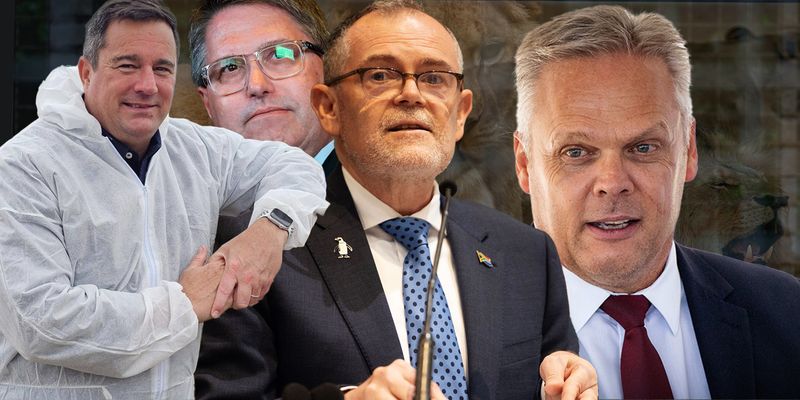
TOURISM BOYCOTT BOMB: The Honeybadger’s revenge: Former minister Dion George’s nuclear war over SA’s captive lions
Full Article
Original Source
Read the full article at Dailymaverick →KhanList aggregates and links to publicly available news content. We do not host full articles from third-party sources. Always verify important information with original sources.