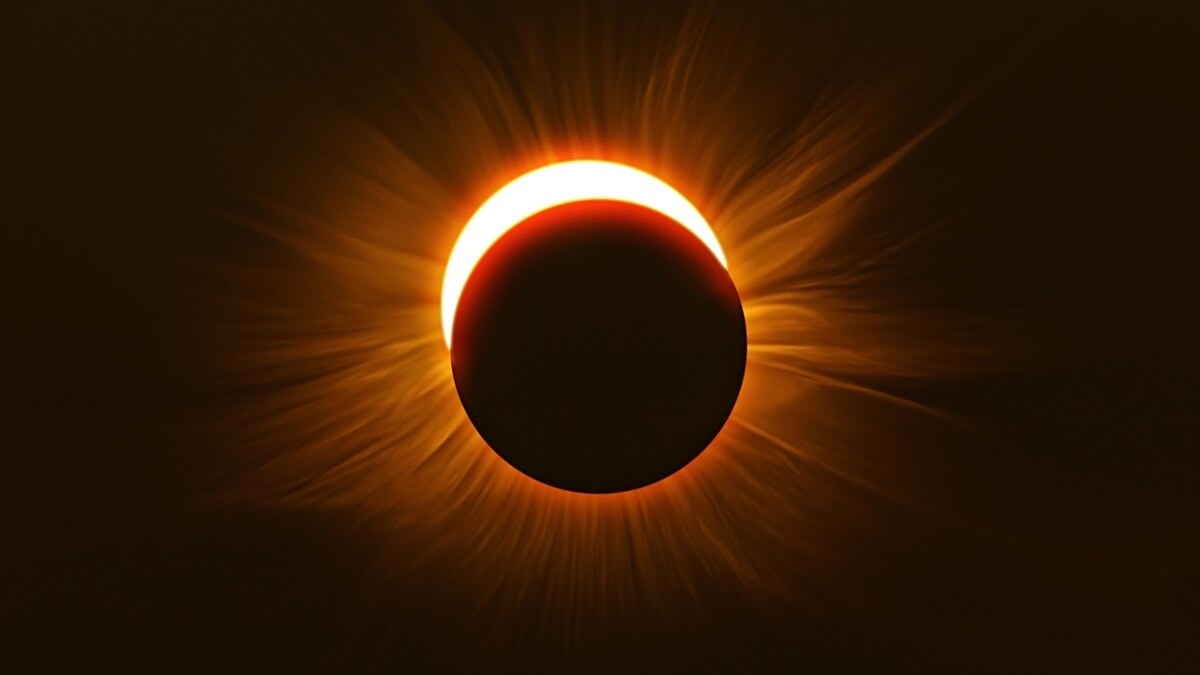
The Moon will block your view of the Sun today, shrouding the day hours in night-like conditions and mark the occurrence of a rare celestial event that offers spectacular views and teachings about our nearest star.A total solar eclipse once occurred on 17 July 709 BCE. (Photo: Getty)The Moon is about to pull off one of nature's rare tricks and briefly blot out the Sun.On Wednesday, a total solar eclipse will sweep across parts of the Northern Hemisphere, turning daytime skies dark along a narrow path.For millions of people, it will be a chance to witness one of the rarest and most spectacular sights in the sky.But for those in India, there is rather disappointing news. The eclipse will not be visible from anywhere in the country. However, that does not make the event any less exciting, as it will be available to watch across the internet and mark a rare celestial event for the year.Maana tendr lugar el primer eclipse solar total visible desde Espaa en ms de un siglo.Durante unos minutos, la brusca disminución de la luz alterar el comportamiento de aves, mamferos, insectos y plantas.Descubre cómo reaccionar la #Biodiversidad pic.twitter.com/2Yqh7QQrEi— Fundación Biodiversidad (@FBiodiversidad) August 11, 2026WHAT HAPPENS DURING A TOTAL SOLAR ECLIPSE?A total solar eclipse occurs when the Moon passes directly between Earth and the Sun, completely covering the Sun's bright disc for people within a narrow strip on Earth's surface. The Moon is much smaller than the Sun, but it can appear almost exactly the same size in our sky because it is also much closer to Earth.When the alignment is right, the Moon blocks the Sun and its shadow sweeps across Earth.For a few brief minutes, the normally hidden solar corona, which is the Sun's outer atmosphere, becomes visible around the dark Moon. A total solar eclipse captured from Greenland. (Photo: Nasa) This is one reason scientists value total eclipses, as the corona is difficult to observe directly because the Sun's bright surface normally overwhelms it.WHAT TIME IS THE ECLIPSE AND WHERE WILL IT BE VISIBLE?The path of totality will begin in northern Russia, cross Greenland and Iceland, and then move across northern Spain before reaching a small part of Portugal.A partial eclipse will be visible across much wider areas, including much of Europe, parts of North America and northwestern Africa.The event is particularly significant for Europe as it will be the first total solar eclipse visible from mainland Europe since 1999.The total solar eclipse will begin on August 12, at 9:04 pm IST and will around 2:15 am in the early hours of August 13.At its maximum, expected around 11:16 pm IST, totality will last about 2 minutes 18 seconds along the eclipse's central path.Cities such as Reykjavik in Iceland and several locations in Spain will fall within the path of totality, although local viewing times will differ.India, however, is outside both the path of totality and the wider region where the partial eclipse can be seen.HOW TO WATCH TOTAL SOLAR ECLIPSE?For those outside the path of totality, the safest option is to watch a live broadcast from an observatory or space agency. Anyone viewing the partial phases directly must use proper solar-viewing glasses or a certified solar viewer.Keep in mind that ordinary sunglasses are not safe.Nasa has also warned against looking at the Sun through cameras, binoculars or telescopes unless they have specially designed solar filters fitted to the front of the equipment.For Indian skywatchers, therefore, the August 12 eclipse will be an event to experience remotely, but one that offers, nonetheless, a rare window into the workings of our nearest star.WHEN WILL TOTAL SOLAR ECLIPSE BE VISIBLE IN INDIA?India will have to wait for a long time for a total solar eclipse. The next total solar eclipse visible from India will take place on March 20, 2034.It will cross a broad stretch of countries, including India, Pakistan, Afghanistan, Iran, Saudi Arabia, Egypt and parts of Africa, before continuing across Asia.- EndsPublished On: Aug 12, 2026 07:30 IST
Total solar eclipse to turn day into night today, make the Sun disappear
Full Article
Original Source
Read the full article at Indiatoday →KhanList aggregates and links to publicly available news content. We do not host full articles from third-party sources. Always verify important information with original sources.